

Keeping children safe online is a complex topic. Australia’s contentious social media ban is seen as one piece of the puzzle, but it only scratches the surface of protecting children’s digital lives. Alarmingly, parental controls, one of the biggest tools dedicated entirely to that mission, remain vastly underused.
Countless apps and devices provide parental controls in some form, allowing families to curate age-appropriate experiences across different platforms. Managing screen time limits, blocking access to inappropriate content, and disabling unknown contacts are among the common settings housed under the parental controls banner.
However, research shows that many parents don’t use these tools. A 2025 study commissioned by Snapchat found that 57 per cent of Australian parents don’t use in-app or online parental controls.
Similarly, only 51 per cent of US parents use parental controls on tablets, dropping to 47 per cent on smartphones, according to the Family Online Safety Institute (FOSI). FOSI’s data also shows that the adoption rate of parental controls reduces further across PCs, TVs, and video game consoles.
The eSafety Commissioner’s 2022 Mind the Gap report found that 59 per cent of parents set rules about when children can go online, but only 43 per cent use parental controls to filter online content.
These statistics beg the question: why is the use of parental control features so low? A perception of difficulty is a big one, according to Dr Joanne Orlando, an author and researcher in digital wellbeing.
“A lot of parents think it’s in the way too hard basket, ‘there’s too many steps’, ‘I don’t really understand’, it’s that kind of thing,” Dr Orlando said. “And family life is so busy that, amongst that, the idea of taking what they probably think is two hours to read the manual is too hard.”

Making parental controls easier
“Not a huge proportion” of parents use the family safety settings on offer, Dr Orlando added, agreeing with the existing research.
“There is an uptake, but I think if we can make [parental controls] really simple, two or three steps, and then they get that protection that they need.”
Some tech companies are trying to make it easier to make child-friendly experiences during the setup, reinforcing Dr Orlando’s belief that using parental controls is “not as complicated as you might think”.
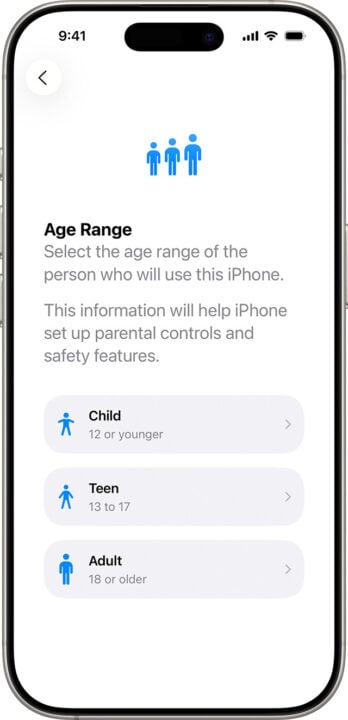
Apple prompts users during the setup stage of its devices to input an age range, which automatically provides some out-of-the-box protections for children. Likewise, Google also supports child accounts on Android devices, providing a similar level of protection.
There’s also a myth encountered by researchers that parental controls are only useful for young children, that they quickly outgrow the limitations placed upon them. But that’s not what the experts say.
“What [parental controls] can do is they’re this amazing space that you can actually teach your children about safety,” Dr Orlando said.
The researcher — who previously argued for social media literacy education, as opposed to an outright ban — suggested that parents use device settings as a prompt to teach kids about digital safety. Instead of setting blocks and limits and walking away, she recommends explaining to children why the limitations are in place.
Shedding the “terrible guilt”
With how quickly technology changes, there’s also an element of parents feeling guilty about not knowing how to protect their children’s digital lives.
“A lot of parents always feel like ‘I’m not doing enough, I don’t know what to do’,” Dr Orlando said. “We have this terrible guilt that we’re not doing enough.”
Aside from the settings and instructions from tech companies, families can access resources, including those from the eSafety Commissioner, to stay informed about digital safety.
As long as parents acknowledge that “no one’s ever going to be 100 per cent up to date” with every technology and every risk, Dr Orlando believes that regularly checking in with children is a good place to start.
“If you keep your reading, keep trying to keep up to date a little bit, but having lots of conversations with your kids, just trying to see what they’re seeing that they think might be dangerous, start with those points and have a conversation.”
Chris Button attended a briefing with flights provided by Apple Australia.
The post Tech’s biggest safety feature is largely ignored, but it shouldn’t be appeared first on GadgetGuy.


0 comments:
Post a Comment