
Headphones, earbuds, or whatever you want to call them, primarily do one job: play music. Over time, they’ve evolved to take calls and block out external noise. Usually, the best headphones are those that handle all three tasks better than the rest. But Anker wants to add a fourth variable into the equation: AI note-taking and assistance.
Several buds from the likes of Apple, Samsung, and Google have incorporated some form of AI functionality, so what’s different here? According to Anker, the new ‘Thus’ AI chip platform in its Soundcore Liberty 5 Pro earbuds range reworks how on-device processing has worked so far (or should that be ‘thus far’?).
Anker claims that Thus combines the memory and processor, which are traditionally separated on the chipsets housed within most headphones. The theory is that bringing compute and memory together reduces power consumption and enables faster and more complex AI processing.
“Every AI chip built until now stores the model on one side and does the computation on the other,” said Steven Yang, Anker CEO. “To think, the device has to carry all those parameters across, many times per second, every single inference. Thus puts the computation where the model already lives.”
Without the need to transfer data between memory and the processor, earbuds with the Thus platform can reportedly use larger AI models locally. Anker’s $279.99 Soundcore Liberty 5 Pro and $359.99 Pro Max earbuds are the brand’s first to use the new processing technology.
What can the Soundcore Liberty 5 Pro buds do?
Included within Anker’s announcement are lots of proprietary names for AI technologies. Put simply, the new earbuds are said to make calls sound clearer through better voice isolation, block out more noise via ANC, personalise EQ settings for each listener, and handle more AI-based tasks on-device.
That sounds like a lot, and technology companies are known for making big claims. To go over some of the basic specs, the Soundcore Liberty 5 Pro range supports connecting up to three devices simultaneously via Bluetooth 6.1. Both models work with Apple Find My and Google Fast Pair technologies, and are designed to meet IP55 dust and water resistance.
Anker claims that its in-ear headphones last up to 6.5 hours with ANC on. Combined with the included charging cases, the total estimated battery life reaches up to 28 hours.
Charging cases with a twist
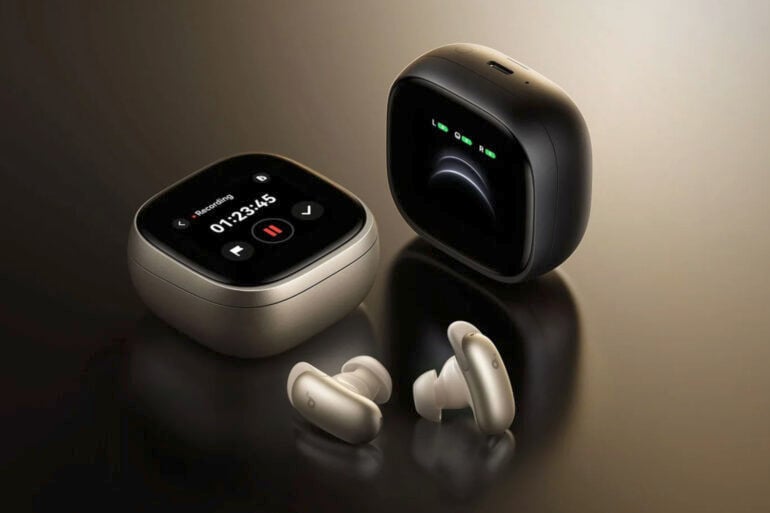
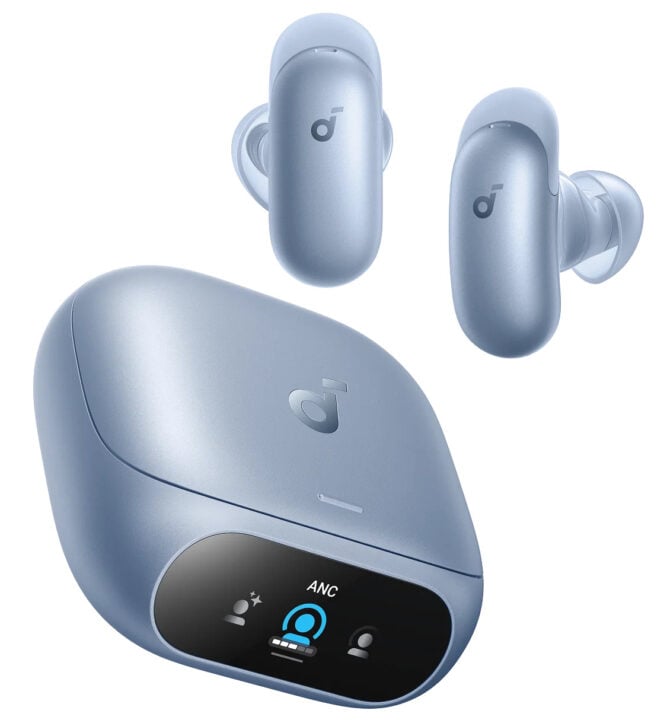
It’s these charging cases that are the most interesting comparison point. With the Liberty 5 Pro comes a case with a small 0.96-inch touch-enabled display, which shows quick readouts of battery life and playback controls, so you can leave your phone in your pocket.
Contrast that with the 1.78-inch touchscreen on the Liberty 5 Pro Max, which also doubles as a recorder with AI note-taking functionality. It’s like an evolved version of the Nothing Ear (3) case, which also functions as a microphone, albeit without the local recording capacity.
Anker says you can record meetings just by using the charging case without being connected to a phone. Afterwards, the recording syncs to the Soundcore app, transcribing the recording and summarising any main points or actions.
Interestingly, the Soundcore website mentions a limitation on how long you can record AI notes for free. According to one disclaimer, the free AI note-taking feature includes 120 minutes per month for 24 months. It’s not clear how much additional time costs.
Based on this disclaimer, it seemingly indicates that Anker’s new AI processing technology is mainly for noise cancellation and enhancement, and not for transcribing audio locally. Similarly, Nothing’s recently launched Essential Voice dictation tool also relies on cloud processing.
It’s an interesting twist on a well-established formula adopted by many headphone makers. Coming in cheaper than a pair of AirPods Pro 3, and with lofty claims about audio and call quality, these Soundcore buds might be a compelling alternative. Australians can try them out when the latest Liberty Pro buds arrive in the first week of June.
The post These Soundcore earbuds are coming for the call quality crown appeared first on GadgetGuy.


0 comments:
Post a Comment