This might be the lightest smartwatch I have ever used. It’s the highly anticipated Coros Pace 4, a watch I’m rather excited about. It’s a new GPS fitness watch with some big updates over the incredibly popular previous model.
Central to those upgrades is the all-new 1.2-inch AMOLED display, which makes the graphics sharper and colours brighter. Coros’ new watch also has an improved battery life of 19 days in daily use mode and 41 hours in GPS mode, so you won’t be left stranded mid-run.
There are lots of other great upgrades, including a microphone for voice-enabled training logs, a flashlight mode and activity cropping. But the big headline for me is the extremely light 40g build with the silicone band attached. You’ll barely notice it’s on your wrist while running.
Try as I might, I’ve never managed to stick with series like Civilization or Crusader Kings for any meaningful length of time. Strategy games sound like my thing: following an established set of rules to see lots of numbers grow higher, represented in the form of digital nations growing before my eyes. In practice, however, my patience usually wears out before the deep strategic gameplay takes hold.
Anno 117: Pax Romana, Ubisoft’s new real-time strategy game, might be different. Its distinctly narrative-focused loop drew me in, while the logical, productivity-driven nature of building a Roman empire keeps me coming back. And that’s saying something, considering I’m not one of the legions of men who frequently think about the Roman empire.
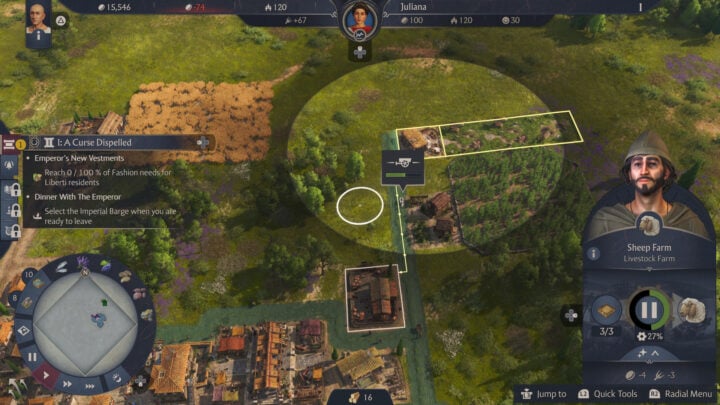
Like many other city-building games, Anno 117 tasks you with making something from nothing. Normally overwhelmed by complex sandboxes, I eagerly took to the game’s campaign mode, which doubles as a tutorial. It holds your hand to an extent, providing specific milestones to hit, but with a reasonable level of freedom to let you find your way there.
Screenshot: Chris Button.
It’s this more guided approach that I think endears me to Anno 117 more than other strategy games I’ve tried lately. Tell me a story, and I’ll happily come along for the ride.
Learning through storytelling
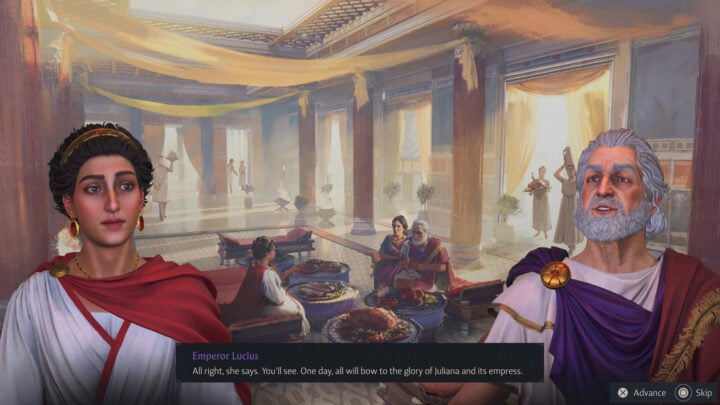
Like a mini serial within a strategy game, Anno 117: Pax Romana unfurls a slow-burning plot as you play. Upon hitting a major milestone, like growing your population or learning how to make cheese (very important), Anno 117 presents a brief interaction between characters, furthering the narrative.
Screenshot: Chris Button.
It looks a little stilted, with awkward animations and mouth flaps that don’t match the spoken dialogue, but the heart’s in the right place. Despite the slightly rough presentation, I found each story beat charming, adding further context to your city-building prowess. I wasn’t just producing tiles for the sake of reaching an arbitrary target; I was helping my emperor build the dream temple for his wife.
Playing as Marcia (there’s also a playable male character), many of my in-game efforts revolved around proving her worth in a male-dominated society. Most other characters dismissed her as merely a woman there for a political marriage, which made it all the more satisfying when Marcia defied their expectations at every turn.
It also reflected my experience of playing Anno 117. The thought of expanding my city, optimising production lines, and defending borders against would-be warmongers was daunting. But the granular approach of the campaign saw me slowly grow in confidence alongside Marcia. To the point where we both believed we were truly capable of leading.
Screenshot: Chris Button.
That’s even aside from the immense satisfaction of seeing a well-oiled city at work. Connecting all manner of production buildings to refineries, and then placing roads to see goods transported to villagers and markets: it’s gratifying work, I tell ya.
Playing Anno 117: Pax Romana on the couch
Perhaps part of my reservations about playing strategy games is how much they favour playing on a PC. Yes, many modern strategy games have console ports, but I can’t help but feel I’m playing an inferior version, irrespective of how rooted in truth that perception may be.
I’ve played Anno 117 entirely on a PS5 Pro so far. At times, I thought a mouse and keyboard would make navigating various sub-menus easier. But, for the most part, I’m impressed by how well the gamepad-based controls work.
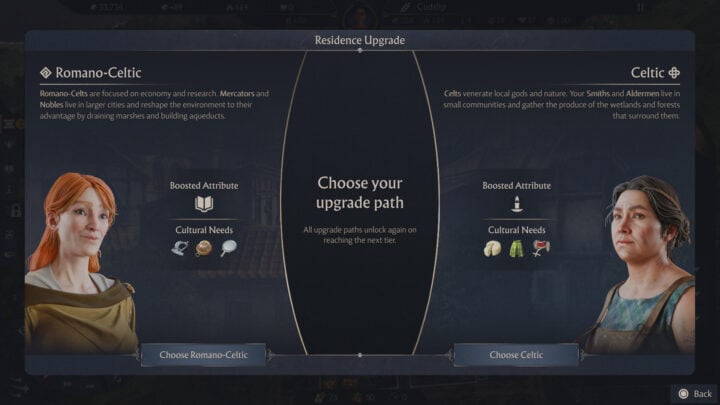
Constructing different buildings and accessing various landscaping tools cleverly uses a series of radial menus. A quick tap of a shoulder button, followed by a control stick movement, quickly gets you where you need to go.
Screenshot: Chris Button.
Navigating other menus, like the quest logs, requires a bit more effort. It’s not as easy to use the directional pad; sometimes, I thought I’d highlighted the correct item, only to make a selection and have a completely different menu appear. Some of the quest logs also wouldn’t let me scroll to read the full text within, leaving me in the dark when I needed a quick refresher on recent in-game events.
Still, after a long day spent at my desk working, I’d happily accept some friction in return for the comfort of playing a game on the couch.
Even after more than a dozen hours, I feel I’ve barely got my head around all of Anno 117: Pax Romana‘s complexities. But the most encouraging thing? I keep thinking about what I want to try and achieve with my city next.
Ubisoft provided a PS5 code of Anno 117: Pax Romana for review coverage.
Hubbl will no longer offer a ‘Stack & Save’ discount to customers who bundle multiple streaming subscriptions together, as Foxtel renews its partnership with American media company Comcast.
Owners of Foxtel’s streaming device started receiving emails about the change, with a notice also live on Hubbl’s support site. Per the announcement, Stack & Save will be discontinued on 10 December 2025.
When Hubbl launched in early 2024, customers could use the streaming hub to stack multiple eligible subscriptions and save up to $15 per month. Instead of a straight discount, however, the saving was applied via credits towards future billing cycles.
Because of this method, any unredeemed credits remain valid for “up to three years”, according to the Hubbl website. As soon as 10 December arrives, customers can no longer earn further Stack & Save credits.
Internal support for Hubbl dwindled after sports streaming giant DAZN acquired Foxtel in April. Hubbl hasn’t been killed entirely, though, after Foxtel announced a renewed partnership with Comcast. Hubbl uses Comcast’s Entertainment OS software, with the announcement suggesting that the device will remain operational for a while longer.
Variety reported claims from Hilary Perchard, CEO of Foxtel, Kayo and Binge, that Hubbl had attracted “record highs in recent months” of viewership. Perchard also explained that ending Stack & Save was to “simplify billing”, reflecting “direct feedback from customers seeking a cleaner, more intuitive experience.”
Foxtel’s attempt to disrupt the streaming device market in Australia faced several issues when Hubbl first landed. Hubbl provided a buggy experience to begin with, while subsequent service outages rendered the device temporarily unusable.
It was, however, one of the first devices to combine on-demand streaming services with live free-to-air TV, while the Stack & Save program helped save money on multiple subscriptions.
If there’s one thing you can rely on Black Friday for, it’s big discounts on home appliances. Roborock has kicked down the Black Friday door with its opening round of sales, including more than $1,000 off a range of vacuums and robot cleaners.
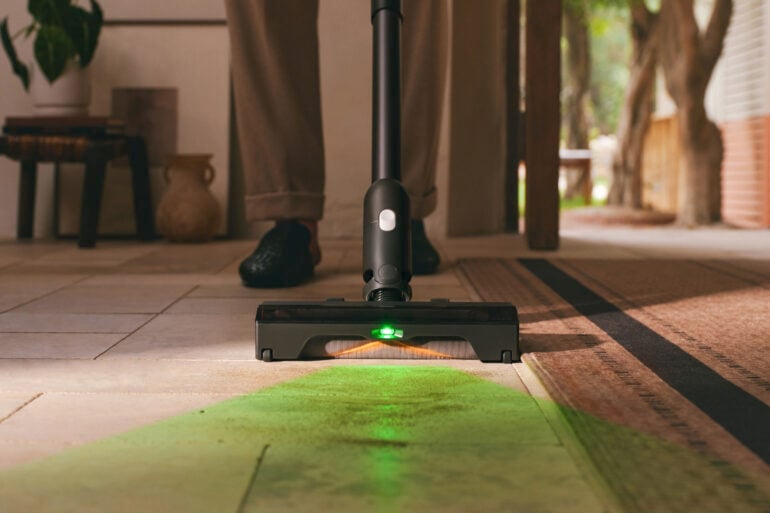
One of the earlier Roborock Black Friday sale highlights is the half-price H60 Hub Ultra. It’s a powerful stick vacuum that comes with an auto-empty hub, reducing the manual handling required between cleans. At $499 during Black Friday, the H60 Hub Ultra is a decent stick vac, best-suited to sucking up small debris on carpeted floors.
Then there’s the Roborock F25 Ultra, which is more than $600 off at some retailers. A wet-dry vacuum with steam technology, the F25 Ultra is a bit pricey at the usual price of $1,499. However, below $900 during Black Friday, it’s easier to recommend.
An interesting addition is the $1,500 discount on the Roborock Saros Z70. That’s the one with the robotic arm designed to pick objects up off the floor. While I thought the robot arm wasn’t reliable enough to warrant the premium $3,999 price, $2,499 is much more palatable for an otherwise decent high-end robot cleaner.
2025 Roborock Black Friday sale
Here’s a live look at what Roborock currently has on sale. Some of the appliances are on sale now through December, while others will be on sale intermittently throughout the Black Friday chaos.
The prices are correct at the time of writing, but expect them to fluctuate as retailers compete to offer the best deals:
Expect to see more devices join the list in the coming days; Roborock has a few more sale items up its mechanical sleeve closer to the actual Black Friday sale dates near the end of November. In other words, check back regularly for more sales as they go live.
GadgetGuy occasionally uses affiliate links and may receive a small commission from purchased products.
An early strong contender has landed for the telco Black Friday sales, with Tangerine dropping prices on some long-term NBN and SIM plan deals.
It’s an especially good time for anyone in the market for an NBN plan; Tangerine’s internet deal includes $20 off per month over 12 months for new customers. Most of the time, introductory NBN discounts last for six months, so this is a decent time to lock in a cheaper rate over the long term.
Regardless of the plan you choose, that’s a $240 saving over 12 months. Not too shabby. When you compare Tangerine’s discounted internet with the current cheapest NBN plans, the monthly rate isn’t the lowest. However, that’s comparing the telco to competitors with six-month discounts. Across 12 months, it’s notably cheaper for multiple speed tiers.
Take the newly available NBN 500 tier, made available to Fibre to the Premises (FTTP) and Hybrid Fibre Coaxial (HFC) following September’s NBN speed upgrades, for example. When sorted by average monthly cost, Tangerine is cheaper than its nearest competitor at the time of writing. Over 12 months, Tangerine’s NBN 500 plan averages $68.90 per month, with the next cheapest sitting at $74.80.
Tangerine Black Friday 5G SIM plan sale
Cheaper internet isn’t the only thing Tangerine is slinging for Black Friday. Along with the NBN deals, Tangerine is selling new 5G SIM plans at half-price. Its postpaid plans start at $15 per month with 30GB of data, all the way up to $30 per month for 160GB of data at download speeds reaching up to 250Mbps.
As an FYI, Tangerine uses parts of Telstra’s 4G and 5G networks, with the 4G connection reaching 98.8% of Australians, while the 5G component reaches 75% of the population.
Compared to the cheapest postpaid SIM plans, Tangerine is within a few dollars of other deals from Moose Mobile, SpinTel, and Dodo. Those higher data plans are arguably the best value, which might come in handy if you’re planning to travel domsestically this summer.
Tangerine’s NBN and 5G SIM sales are live now until 1 December 2025, so you’ve got a bit of time to compare Black Friday offers.
GadgetGuy occasionally uses affiliate links and may receive a small commission from purchased products.
Australian retailers have been warned that trying to pull the wool over customers’ eyes during this year’s Black Friday sales could result in penalties.
A notice published by the ACCC confirmed that Australia’s consumer watchdog will keep an eye out for “misleading or deceptive sales advertising used by retailers”. Last year, the ACCC cracked down on various tactics that could confuse customers about discounts or whether they were saving as much as advertising claimed.
“We are putting retailers on notice to review their sales advertising practices to ensure that any sales or discount claims they make are accurate, clear, and not likely to mislead or deceive consumers,” said ACCC Deputy Chair Catriona Lowe.
“Misleading advertising may influence a consumer’s behaviour and impact their ability to make an informed purchasing decision during the sales.”
Some of the potentially misleading sales tactics on notice include:
Inaccurate sale countdown timers that create a false sense of urgency
Advertised ‘sitewide’ sales that exclude some items
Sales materials that make it difficult to see any ‘up to’ disclaimers
As big as the Black Friday sales are, they are no guarantee that customers will find the best deals. To save as much money as possible leading up to Christmas, the ACCC recommends doing your homework and comparing prices before the sales start.
“If consumers are waiting for the Black Friday sales to make a big purchase, we encourage them to consider checking the prices now before sales start, so they can compare the price and determine if they are making a legitimate saving,” Lowe said.
Another tactic the ACCC is watching for is retailers using ‘recommended retail prices’ when advertising savings. Some retailers already sell products below RRP, so this practice can artificially inflate the value of a discount.
As part of the tech company’s renewable energy efforts, Apple has started building a major array of solar panels in Lancaster, Victoria. Set to finish before 2030, the year Apple plans to be completely carbon neutral, the solar project will reportedly supply more than a million megawatt-hours each year to the National Electricity Market.
Currently underway, Apple expects the solar project to start supplying power in Australia next year. By the end of the decade, the company plans to generate enough energy to match the amount of electricity its customers use to power their devices.
“By 2030, we want our users to know that all the energy it takes to charge their iPhone or power their Mac is matched with clean electricity,” said Lisa Jackson, Apple’s vice president of Environment, Policy and Social Initiatives. “We’re proud to do our part to support Australia’s transition to a cleaner grid and drive positive impacts for communities and nature — all while moving closer to our ambitious goal to be carbon neutral across our entire footprint.”
In addition to its solar plans, Apple also highlighted its forest restoration efforts in New Zealand and its farmland revitalisation project in Queensland.
Australia reportedly has more than four million solar installations across the country, which is a main driver of the Federal Government’s Solar Sharer scheme. If the scheme goes ahead as planned, households across New South Wales, South-East Queensland, and South Australia will have access to at least three hours of free electricity every day when solar generation is at its peak.