

This is default featured slide 1 title
Go to Blogger edit html and find these sentences.Now replace these sentences with your own descriptions.

This is default featured slide 2 title
Go to Blogger edit html and find these sentences.Now replace these sentences with your own descriptions.

This is default featured slide 3 title
Go to Blogger edit html and find these sentences.Now replace these sentences with your own descriptions.

This is default featured slide 4 title
Go to Blogger edit html and find these sentences.Now replace these sentences with your own descriptions.

This is default featured slide 5 title
Go to Blogger edit html and find these sentences.Now replace these sentences with your own descriptions.
Monday, 31 May 2021
Minix Neo G41V-4 mini-PC – another next unit of computing (review)
The Minix Neo G41V-4 mini-PC – is this that. At 139mm square and 35mm high, it has ten expansion ports, including HDMI 2.0, DisplayPort 1.4 and the old DB-15 VGA port. Intel Celeron powered with Windows 10 Pro, it is for digital signage or casual PC use.
Minix is OK with 3-cylinder under the bonnet because it is also one of the most fully-featured NUCs for the price.
Minix has made quite a name overseas for these mini-PCs, and now most of the Minix range is distributed in Australia by Canohm. The Windows range includes (approx. prices from eXpansys excluding freight):
| J50C-4 | $460 | Intel Pentium J5005, 4/64/M.2 Sata6, Wi-Fi AC, BT 4.1, HDMI 2.0, USB-C Alt DP, 12V/3A or USB-C upstream |
| G41V-4 | $350 | Intel Celeron N4100, 4/64/M2 Sate6, Wi-Fi AC, BT4.2, HDMI 2.0, DP 1.4, VGA, 12V/3A |
| N42C-4 | $325 | Intel Pentium N4200, 4/32/M.2 SATA6, Wi-Fi AC, BT 4.1, HDMI 1.4, USB-C Alt DP. 12V/3A or USB-C upstream |
| Z64W | TBA | Intel Z3735F, 2/32GB, Wi-Fi N, BT 4, HDMI 1.4, 5V/3A |
| Z83-4 | $350 | Intel X5-Z8300, 4/32, Whi-Fi AC, HDMI 1.4, Mini DP 1.4, 12V/3A |
| NGC-1 | $699 | Intel Celeron W3150, 4/128GB, Wi-Fi AC, BT 4.2, |
These are ideal in-vehicle or boat use without an AC/DV inverter.
Minix Neo G41V mini-PC
| Minix Website | here |
| Canohm Site | Here |
| Price | $350 approx |
| Warranty | 12-months |
| Country of Manufacture | China |
| About | Minix (Est 2008 – website here) is a Hong Kong-based Mac and PC accessory maker. It specialises in Android Media Hubs, Mini PCs, GaN chargers, USB-C cables, adapters, and storage. |
| Other | Other GadgetGuy Minix News and reviews here |

First impression
It is one of the more attractive NUC styles I have seen, with X-shaped top cut-outs as a cooling vent. Add to that HDMI 2.0 (4K@60Hz), DP 1.4 (4K@60Hz) and VGA (1920×1020@30Hz), Ethernet and 4 x USB, MicroSD and 3.5mm, and it is very well equipped.

Processor – adequate
The Intel Celeron N4100 14nm has four cores and four threads. It runs at 1.1Ghz with short term Turbo burst at 2.4Ghz. It barely draws any power at a 6W TDP. The Celeron is not a powerhouse, and that is fine. There is enough horsepower for web browsing, email, and productivity apps. Geekbench 5 single/multi are 391/1067.
It will throttle if placed under 100% load when the CPU reaches 90° for more than a few seconds. So don’t try t6o multi-task too much if you are playing a video.
RAM/Storage – adequate
It has 4GB, LPDDR4-2133 soldered to the motherboard.
The 64GB (16GB free) is eMMC 5.1 – fast enough at 340/123MBps sequential read/write. But with 16GB free, there is not a lot of space for storage.
There is an M.2 2280 M-keyed slot (accessible without chassis removal) for SATA6 SSD (PCIe NVMe not supported). If you use this slot, it maxes out at about 500MBps sequential read. But it also has a MicroSD slot for up to 256GB extra.

Video
Intel UHD Graphics 600 has 12 Execution Units and will support three displays. OpenCL is 1047, and Vulcan is 1122. It will decode 4K MP4, but you may have to download the K-Lite Codec Pack and Windows Media Player Classic to decode more.
Tests
| HDMI 2.0a Video 4K@60Hz | Pass |
| Display Port 1.4 4K@60Hz | Pass |
| External Support two monitors HDMI, DP |
Pass 4K@60Hz |
| External support three monitors HDMI, DP and VGA |
Pass 4K@60Hz HDMI and DP and 1080p@30fps for VGA |
| Wi-Fi AC (not MIMO) | Dual-band 2.4/5Ghz Maximum 433Mbps full-duplex at 2m from the router |
| Thermals | Fanless – no issue |
| 4K video decode | 4K@30fps – Pass – not HDR. Supports VP9 and HVEC |
| Streaming | Netflix 1080P/5.1 Amazon Prime 720p/2.0 YouTube 4K/5.1 All other services will be at least 1080p/2.0 |
| Sound | Supports PCM 1.0/2.0, Dolby Digital/DTS to 5.1 |
| VESA mount | Supplied |
| USB | 2 x USB-A 3.0 5V/.9A/4.5W 2 x USB-A 2.0 5V/.5A/2.5W |
GadgetGuy’s take
The Minix Neo G41V-4 is a mini-PC – it is well-made and fills a niche for those that want a NUC-sized device and are not bothered by Intel’s 11th Gen Core CPUs.
As its primary use is to drive displays, it receives our recommendation. But look at what you need first – the Neo J50C-4 with USB-C and up to 165GB RAM may be a better fit.
Rating
It is hard with NUCs because there are so many variations on the theme. It passes or exceeds all our paradigms for a lower-powered $350 computing device and throws in three external display support, Windows 10 Pro and a user-accessible M.2 slot.
The post Minix Neo G41V-4 mini-PC – another next unit of computing (review) appeared first on GadgetGuy.

iFixit unhinges the iMac M1 24″ – thin, different
iFixit has completed the iMac M1 24″ teardown and revealed the secrets of an incredibly thin 24″ computer – some impressive engineering, a tiny M1 ARM motherboard and display board at the top.
Of course, with that engineering comes a lack of repairability with everything soldered to the motherboard earning it a 2/10.
What is an iMac M1 24″?
The iMac is perhaps Apple’s most iconic all-in-one computing device. The Mac bit is short for Macintosh from the late 90s. Since 2004 it has had a unibody on a cantilevered stand.
-

“Giulia Piccoli Trapletti, DensityDesign Research Lab”., CC BY-SA 4.0, https://ift.tt/3fzDUm2
The reality is that it has morphed from an Intel-based x86 CPU to Apple’s M1 ARM chip and, in doing so, allowed thinner designs. The downside is you can’t upgrade what you buy.
There are two M1 chips – the standard has eight computing cores and a seven-core GPU. The ‘deluxe’ has an eight-core GPU.
Storage is 256/512GB, 1 or 2TB and memory is 8 or 16GB (at order).
Apple calls the 24″ display, 4480 x 2520, 218ppi, 1billion colour, 500nits a 4.5K. It has a Wide Colour gamut (P3) and senses the ambient light to adjust tone (True Tone).
Ports include two Thunderbolt 4/USB-C 4.0, which supports USB-C 3.1 Gen 2 with Alt DP. The deluxe model has two additional USB-C ports. It has Wi-Fi 6 AX and BT 5.0
Both models are 54.7 (W) x 46.1 (H) x 14.7mm (W) and weight 4.46 to 4.48kg. these require a 240V plug pack outputting 143W. The iMac draws about 60W operating, so the extra is to support downstream USB-C and Thunderbolt ports,
Prices: from $1899 to $2499
Back to the iFixit unhinges, the iMac M1 24″ teardown
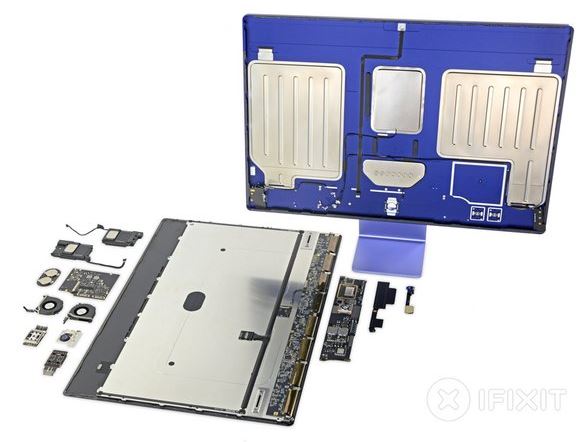
The complete teardown is here. Below are some highlights.
The motherboard is similar to that used in the MacBook M1 air with two fans and heatsinks. Everything is soldered on; repair or upgrade is impossible.
The stereo speakers – impossibly thin – have a full-range speaker and a tweeter.
If you plan to VESA mount – order it that way as the stand is not easily removable.
GadgetGuy’s take
By far the biggest’ complaint’ is about upgradability. But I suspect that this comes from people who don’t understand docking stations (Thunderbolt 3 or 4 – 40Gbps data transfer) that can support external SSDs and peripherals at impressive speeds.
And while the M1 chip architecture only supports a maximum of 16GB if the M1 macOS is anything like iOS (its iPhone 12/Max only has 4.6GB), the ARM OS needs less ram than X86.
Our iMac M1 24″ review is on its way.

You can read more about the Apple M1 chip here.
The post iFixit unhinges the iMac M1 24″ – thin, different appeared first on GadgetGuy.
Chinese smartphone sales Q1 2021 – a huge shakeup
Chinese smartphone sales Q1 2021 shows the most significant market share distribution ever, with OPPO and vivo jointly occupying the top spots and Apple slipping from #2 to #5.
Counterpoint Chinese smartphone sales Q1 2021 reads a little like a fantasy with such a massive redistribution of places.
A year ago, Huawei was undisputed #1 with over 30% of the Chinese market. Today it is at #4 and 16%. We all know why – the US Entities List stopped it using Google Android and Google Play, and then it sold Honor, accounting for 43% of its sales. In addition, it severely channel stuffed (moved phones from its inventory to its retailers’ inventory), and that is coming back to bite as there are still many unsold Huawei phones on retailers’ shelves. And now it has announced that its new phones will run Harmony OS, forcing yet another smartphone operating system and app incompatibilities on users.

A year ago, OPPO was at #3 with 15% of the market. Its Reno sub-brand resonates in that market. It and its BBK sibling vivo are vying for the top spot, each with 23 to 24% sales. vivo is doing very well with its Carl Zeiss camera link. Both have low cost 5G phones offering fantastic value.
Xiaomi, which for a while enjoyed #2, is now #4 at 15%. Xiaomi’s strength is export markets.
And that leaves Apple in #5 at 13%. In the past year, it dived about 5%. Its iPhone 12 series helped it claw back to pre-2020 levels.
Interestingly another BBK sibling, realme, has had an impressive 451% Year-on-Year growth bringing it in at #7. Its online sales model, edgy youth-focused marketing and backed by BBK build quality is undoubtedly working.

GadgetGuy’s take
While 2020 could in no way be representative of the smartphone industry, the status quo was fairly stable until Q4 2020. That is when Huawei and Apple started to nose-dive and OPPO, vivo and realme) stepped into the gap.
With the well-publicised smartphone component shortages, OPPO, vivo and realme are in the best spot with the massive BBK group purchasing power. It buys entire product runs of camera sensors, SoCs, memory, screens and more, then mixes these into the BBK product mix. No one can match its buying volume.

You will note that Samsung does not figure in Chinese sales as it no longer has factories there. Interestingly its strengths in western markets make it the overall Android global leader with about 23% of the market.
The post Chinese smartphone sales Q1 2021 – a huge shakeup appeared first on GadgetGuy.


