
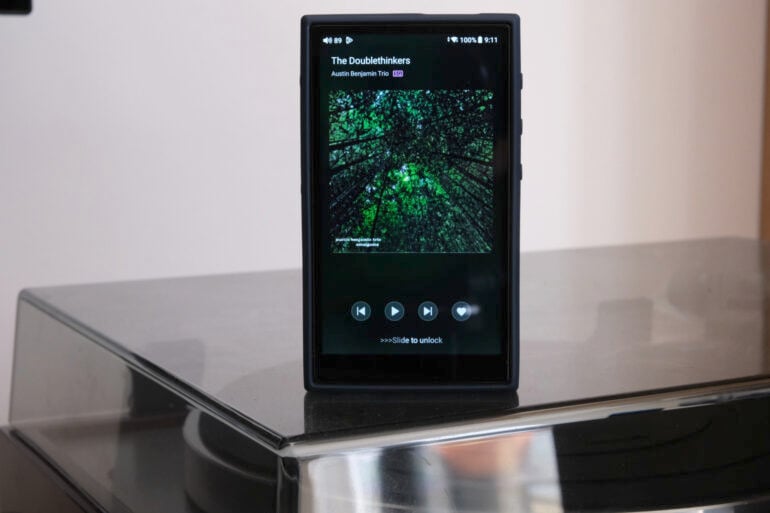
The FiiO M21 is Chinese firm FiiO’s entry-level DAP. DAP? That’s Digital Audio Player, like the old iPod. When Apple vacated the iPod field, that wasn’t the end of portable music players. Typically, a DAP is a phone-like Android-powered device, without the phone functionality or the camera, but with upgraded features dedicated to music playback. The M21 employs Android 13, but the occasional audio limitations of Android are well and truly overcome in a proper DAP. And the M21 is indeed a proper DAP.
Table of contents
- About the FiiO M21 Digital Audio Player
- Power?
- Measurements
- Tape mode
- Listening to the FiiO M21
- Other functionalities
- Who is the FiiO M21 for?
About the FiiO M21 Digital Audio Player
The old iPod Classic, still beloved by many, had plenty of limitations. The primary one was that to load it up – even when the disk size increased to tens of gigabytes – with any reasonable quantity of music, you really had to use a compressed format, preferably AAC. Sure, you could put uncompressed Apple PCM (AIFF), WAV or even Apple Lossless on later models. But even Apple Lossless only roughly halves the amount of space required for files. 128kbps, by comparison, reduces the space by 11:1.
So even while the iPod was the dominant player, other brands survived and did well in the small space servicing audiophiles who wanted the highest quality, along with a good capacity. The iPod is long since gone, and for most modern listeners, their phone satisfies their music needs. But if you want massive capacity for the highest quality music, you’ll need a DAP.
The Chinese firm FiiO Electronics Company Limited, which started around the time of the launch of the iPhone, has expanded from its original high-value-for-money digital to analogue converters to a wide range of primarily head-fi gear. Including DAPs.
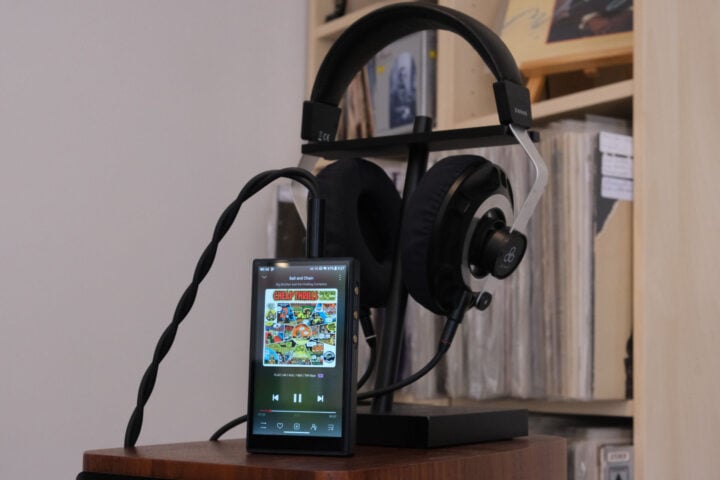
I myself have owned for a few years a FiiO M11 Plus DAP. That one – now no longer available – was priced at north of a thousand Australian dollars in 2022. Expensive, but for a premium product it was way more affordable than most of the competition. And now we have the brand new FiiO M21 DAP, which is explicitly pushing the price-to-performance ratio much lower.
It costs less than half the then RRP of my M11 Plus, but offers quite comparable performance.
It’s smaller – an advantage – at 120.8mm on the longest dimension, 68.1mm wide and 17.5mm thick. DAPs aren’t generally engaged in the thinner-than-thou game. Wearing the silicon (I guess) bump case in which it is delivered, adds a millimetre or two to those dimensions. Build quality tends to be more of a factor upon which quality DAPs are promoted. The M21 features an aluminium alloy body with a glass back (and, of course, front). It weighs 201.7 grams naked, with a microSD card installed, 224.9 grams with the aforementioned case, and 279.1 grams with the “cassette” case we’ll be looking at later.
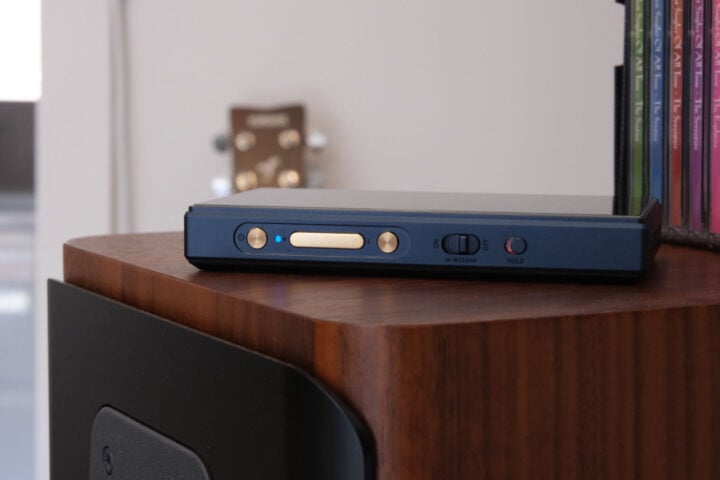
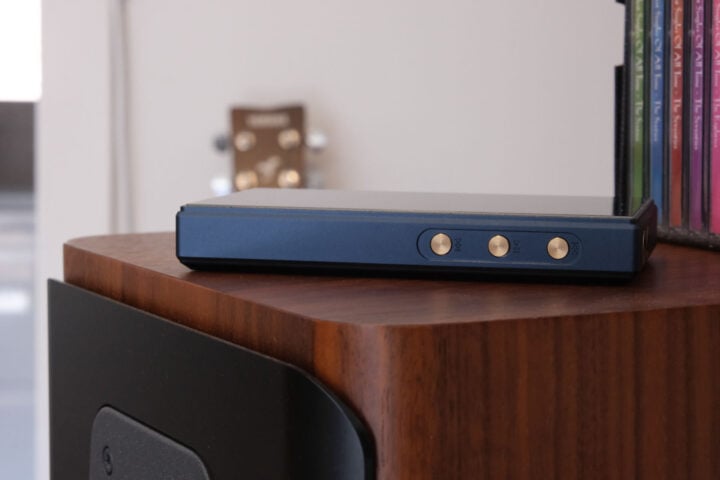

It includes 4GB of RAM and 64GB of storage (50GB+ available for the user). DAPs rarely have their Android version upgraded, but apps should retain compatibility with 13 for quite a few years. That amount of storage isn’t really enough for a huge amount of losslessly compressed music. So there’s a microSD slot, which supports microSD cards of up to 2TB capacity.
It looks like 2TB microSD cards are still pretty expensive. At least from brands I’d be prepared to trust. Say, $300 and up. So for the purposes of this review, I popped the 1TB Samsung card I’d been using in the M11 Plus into the M21. That card has more than 23,000 tracks, all but a couple of dozen losslessly compressed, and quite a few at higher than CD resolution, such as 192kHz, 24-bit, or Direct Stream Digital.
Next to the microSD card slot on the bottom of the unit are two USB Type-C sockets. One allows connections to computers for copying music into the unit or for playing music into it as a USB Audio device, or connections to external DACs (digital to analogue converters). The other is for power input, when required. This one allows fast charging, and when provided with PD2.0 or better power, allows a higher output headphone mode (Super High Gain).
| Bluetooth audio formats | AAC, SBC, aptX, aptX HD, LDAC, LHDC |
| Dimensions | 120.8mm x 68.1mm x 17.5mm 201.7g (without microSD card) |
| Colours | Dark Blue Titanium Gold |
| Price (RRP) | $529 |
| Warranty | 12 months |
| Where to get it | Addicted to Audio |
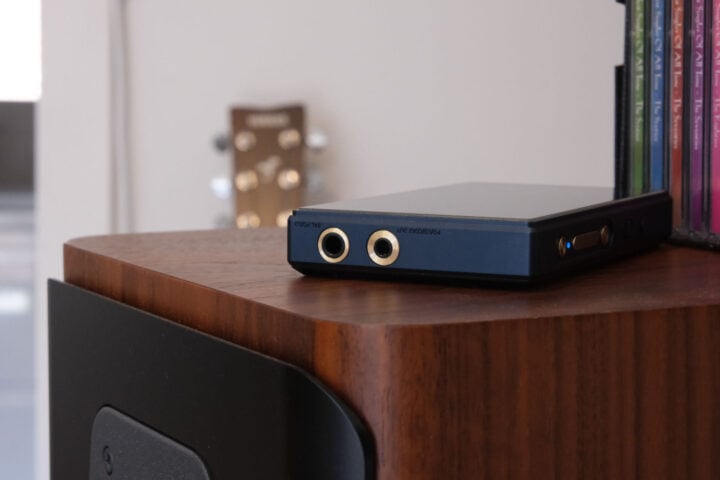
At the top of the unit are the two outputs: 3.5mm and 4.4mm. These are both multifunctional. The 4.4mm one is for balanced output – there are four poles so that each channel can be entirely separate. Both of them can be individually switched to Line Output. This allows the unit to operate as a source to a stereo system if you have the appropriate cable. I do. I used the balanced output with my main system via a 4.4mm to 2 x XLR adaptor, and with an iFi headphone amplifier via a 4.4mm to 4.4mm cable.
The 3.5mm output can also be switched to coaxial digital audio. That’s probably the most convenient way of using an external DAC. This coaxial digital audio output even supports Direct Stream Digital, which an increasing number of DACs will act upon.
On the right side of the unit are push buttons for skip forwards, skip backwards and play/pause. On the left side are the power key, volume up and down and multifunction, and slide switches for desktop mode and hold. That last one stops all the other keys from operating.
It also stops the touchscreen from responding. That screen – 120mm diagonal, 750 by 1334 pixel resolution – was sharp and more than adequate for operation.
Power?
The regular 3.5mm output is rated at 380mW per channel at 16 ohms and 35mW per channel at 300 ohms. The impedance of the headphones clearly makes a difference!
Let me explain those figures.
The efficiency of headphones is typically specified at a particular sound pressure level for 1mW of input. For double that – 2mW – you get 3dB more and so on. For 35mW you should add 15dB to the sensitivity specification. For example, right now I’m listening using the Final Audio B3 in-ear monitors. These have a sensitivity rating of 102dB for 1mW. If they had an impedance of 300 ohms, then the M21 could drive them to an impressive 117dB SPL. But these earphones actually have a 19-ohm nominal impedance, which means the M21 could deliver something like 350mW. That’s 25dB above 1mW, so they could go to 127dB … if you could stand it.
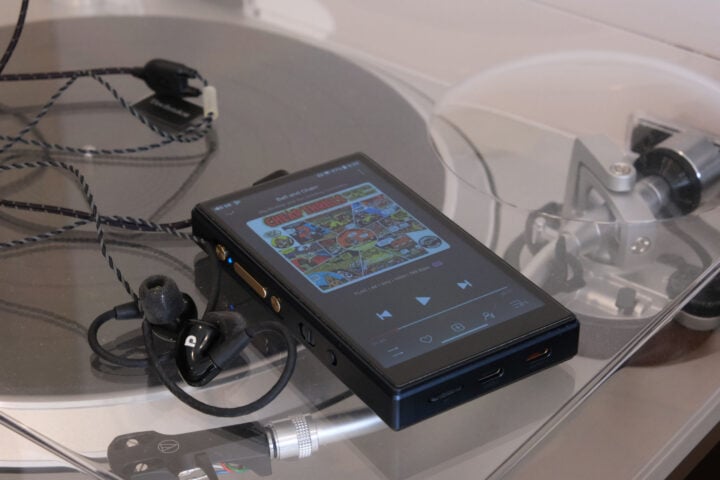
High impedance headphones tend to be larger models, ones you’re less likely to use when you’re out and about. If you do have that kind of headphone, and they’re low in sensitivity, then switch the M21 to desktop mode and plug in a PD20 power supply. That allows the unit to go into Super Gain mode, which boosts the output to 45mW per channel.
All those figures are for the 3.5mm output. Through the balanced output, significantly higher power outputs are available.
The other specifications are at leading-edge audiophile values. At their worst, total harmonic distortion is below 0.0005%, signal-to-noise ratio is better than 123dB, and the frequency response is utterly flat: within 0.03dB to 20kHz and 2dB to 85kHz.
And most importantly, the output impedance of the 3.5mm headphone socket is rated at less than 1 ohm, and less than 1.5 ohms for the 4.4mm output. Most earphones and headphones have an impedance that varies by frequency, so if there is a significant output impedance powering them, that will materially affect frequency balance. Keeping things down to around 1 ohm virtually eliminates that.
That desktop mode should be explained. It requires external power, and cuts the battery out of things completely (unless the battery is very low, in which case it will also charge it). FiiO rates the battery life at 13.5 hours using the 3.5mm output and 12 hours with the 4.4mm one. But this is with MP3 tracks at a lowish volume. It would probably be a little less than if you like a good volume level.
Measurements
I ran a few measurements and pretty much confirmed the figures for high impedance (300 ohm) headphones with the 3.5mm output (my measurement rig is single-ended only). FiiO says 35mW, and 45mW in Super High Gain mode. I measured slightly over 37mW and slightly under 47mW respectively, using three test frequencies. I didn’t achieve the claimed levels with a 16-ohm load: rather than 380mW, I measured 321mW. This may be because the output impedance I measured was a little higher than specified: 1.6 ohms rather than the less than 1 ohm FiiO says.
That value – 1.6 ohms – is low enough that there should be almost no effect on the frequency balance, even of 16-ohm earphones. (Some consumer gear has an output impedance of around 500 ohms!) And 321mW rather than 380mW means a maximum volume of 25.1dB over the earphone sensitivity rating rather than a 25.8dB boost.
Some in-ear monitors are so super efficient that the FiiO M21 has two lower gain settings to cater for them.
Tape mode
Oh, come on. If you’re buying an M21, do yourself a favour and spend thirty bucks or so to buy the SK-M21C. What’s the SK-M21C? It’s a case for the M21, but a very specific, special and strange case.
It’s specific in that it’s hard to see how it would ever work with any other DAP. It’s special because it is essentially a retro disguise. And it’s strange because it’s probably more fragile than the M21 itself. Drop it, and I could see the M21 surviving, and the case shattering.
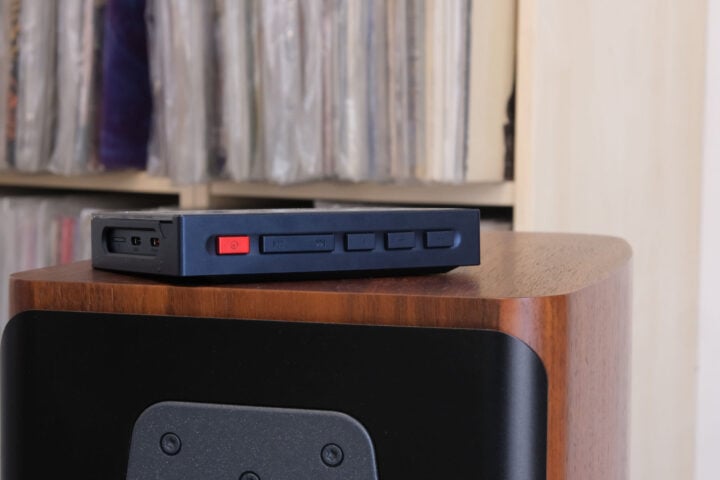
Essentially, it’s a novelty, but a fun one. The case is hard plastic with a flip-open transparent lid and six control keys along the side. Those keys look like the ones you’d see on an old-fashioned personal cassette player (aka Walkman). Place the M21 within it, and the M21 display switches on and adopts the look of an audio cassette (albeit one that’s slightly narrower than reality and significantly shorter). There are rotating spindles and the shape of the mechanism, and “A SIDE” (which never changes, and neither does the amount of tape on either spindle). The artwork and song, album and artist are artfully arrayed around what would be a paper label on a real audio cassette.
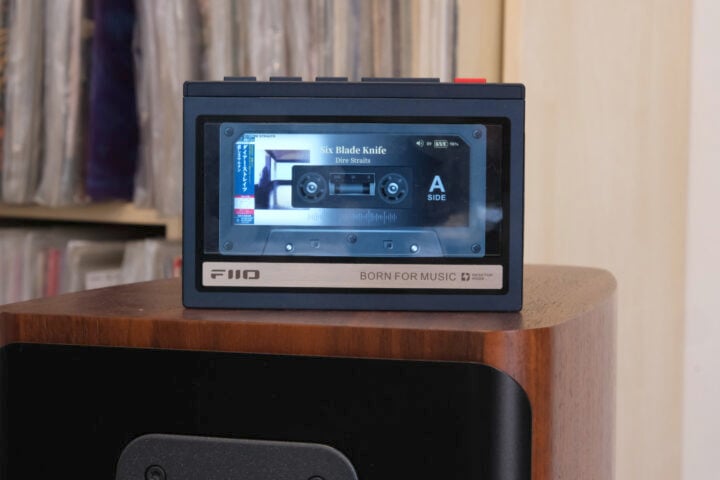
The controls don’t push through to the M21’s own buttons. There are three contacts within the case and three matching ones on the back of the M21. These allow the M21 to realise that it has been encased, and connect the new switches. The case doesn’t need power. Three contacts means eight combinations, which is plenty for the six buttons, especially since some respond to multiple taps or holds. One in particular, held, switches the unit back to regular mode so you can open the lid and use the touch screen.
Added functionality? Not really. Fun? Yes indeed!
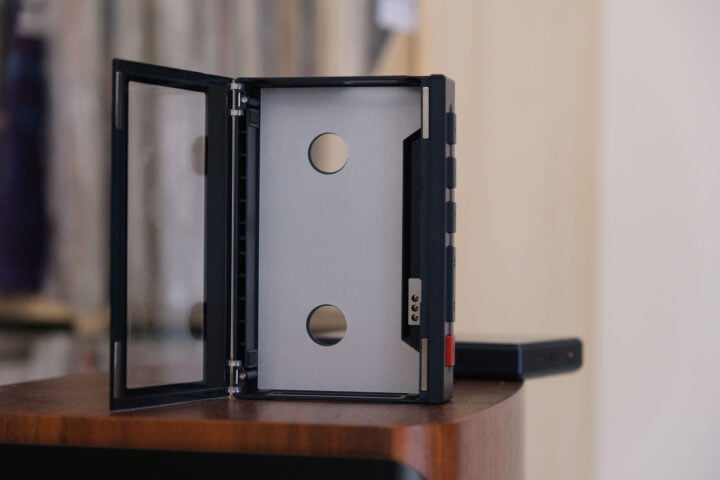
For me, though, there was one disappointment. Somehow, I had gotten the impression that the “tape mode” might do something to the sound as well. Maybe add a little low-level hiss, higher distortion on peaks, reduced high frequencies. Perhaps even a little wow and flutter, which would be a challenge for a DSP. Unfortunately, no. Cassette-style playback is just as perfect as regular playback! But that would have been even more fun.
Listening to the FiiO M21
High-end DAPs, including some of FiiO’s own, tend to use famed DAC chips from ESS or Asahi Kasei Microsystems. Instead, the M21 uses the Cirrus Logic CS43198 DAC chip. Or, rather, four of them. You can divide duties across DAC chips to achieve even higher performance than provided by one alone.
There are some who claim to be able to tell the difference in sound between, say, an AKM and an ESS. I’ll believe that when they can show through statistically-significant double-blind testing that they can. All I’m going to say is that the digital-to-analogue conversion in the FiiO M21 was flawless. Essentially perfect. Any noise, non-linearities or distortion was way, way below the limits of human perception.
Assuming, that is, you choose an appropriate filter where such a choice is available. There is in this unit. The filters remove the ultrasonic noise inherent in digital audio and allow near-perfect reconstruction of the original analogue signal. “Fast Linear Phase” is the most accurate one. The “Slow” ones roll off the high frequencies a little early. There’s also a Non-oversampling (NOS) “filter” which does not filter out the ultrasonic hash at all, but does reduce the high frequencies in the audible band significantly.
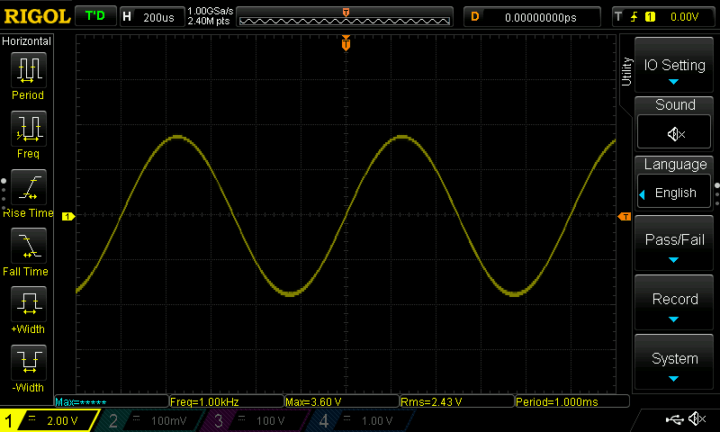
I strongly recommend against using this, even though some reviewers have convinced themselves that it sounds “better”. Why? Here’s a 1kHz sine wave output from the FiiO M21 using any of the other filters:
And here it is using the NOS filter:
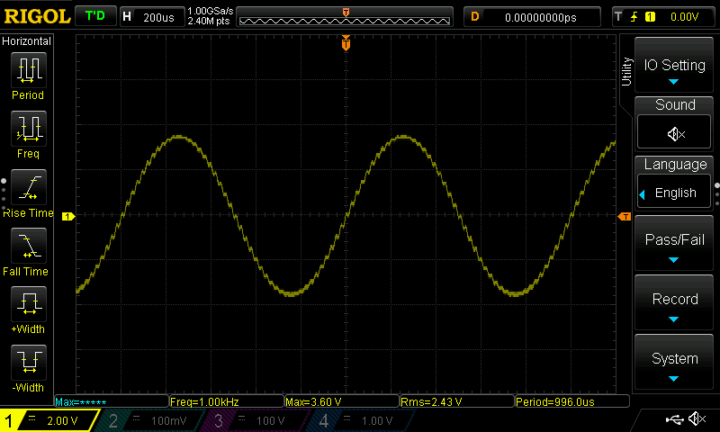
Notice all the jaggies that are no longer filtered out? If that’s not clear enough, here’s a 10kHz sine wave from the unit, looking perfect:
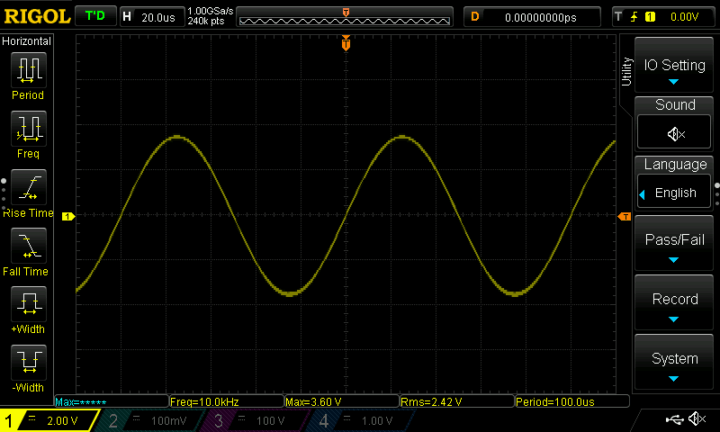
And here it is, a couple of times, with the NOS filter (click on each image for a closer look):
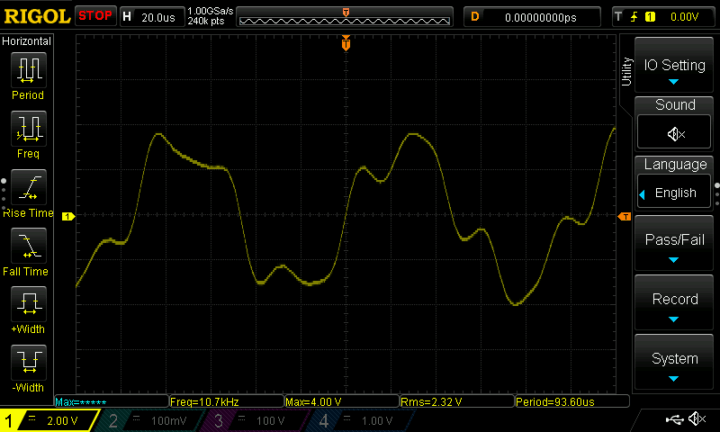
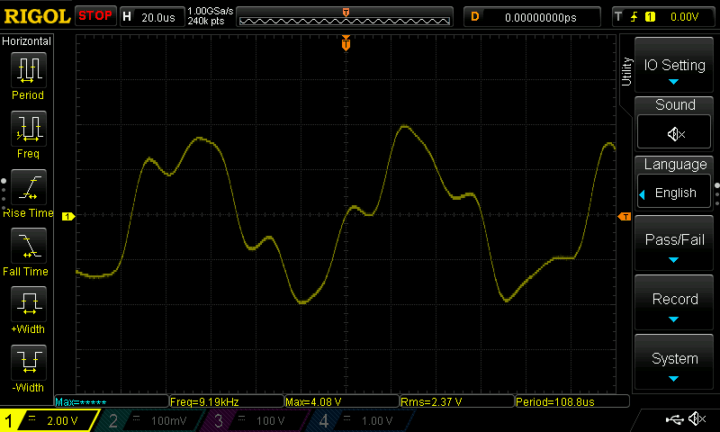
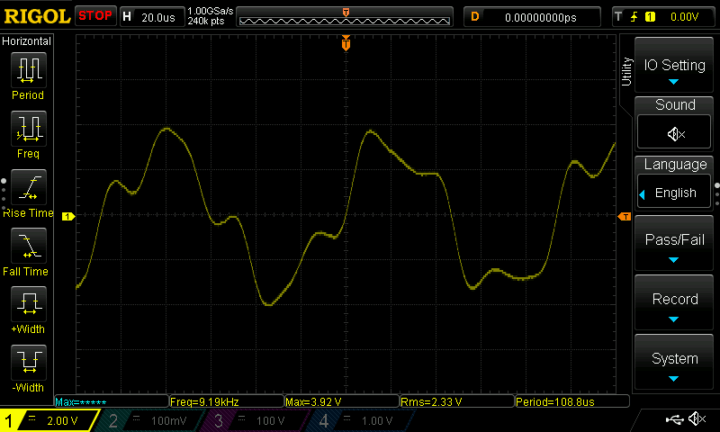
Those weird shapes represent the ultrasonic noise that the NOS non-filter is allowing through to your headphones.
The chip is capable of decoding PCM at up to 384kHz sampling and 32 bits of resolution, and also of DSD – SACD-like Direct Stream Digital – at regular, double and quadruple rates (i.e. DSD64, DSD128 and DSD256). I checked all these formats (I have a DSD256 track playing as I type this paragraph).
The more important question for a DAP is the quality of its headphone amplifier. And I have no quibbles whatsoever about that. I’ve outlined the measured results already. There is more than enough power to drive all reasonable headphones to levels well beyond that recommended for safe listening, and a sufficiently low output impedance to ensure that even with dynamic headphones (planar magnetic models are largely immune to this) there is no unpredictable biasing of the sound’s tonal balance.
But still, one must listen to be sure. So I listened with quite a range of eargear:
- Sennheiser IE 300 in-ear monitors
- Audiofly AF-180 Mk 2 in-ear monitors
- Final Audio B3 high-end earphones
- Oppo PM-3 planar magnetic closed-back, over-ear headphones
- Focal Elear dynamic open-back, over-ear headphones
- Sennheiser HD 535 dynamic open-back, over-ear headphones,
- Final Audio D8000 planar magnetic open-back, over-ear headphones, and
- FiiO JT7 planar magnetic open-back, over-ear headphones.
So, a range of technologies and performance characteristics. The FiiO headphones are new budget models – review forthcoming – while the D8000 ones cost more than ten times as much. I used them all only with the 3.5mm connection, except for the FiiO, which comes with both normal and balanced cables. For them, I used the 4.4mm “balanced” connection.
The only thing missing is very high impedance models. The HD 535 headphones come closest at 150 ohms. I bought these headphones back in 1996, and they are still quite the delight.
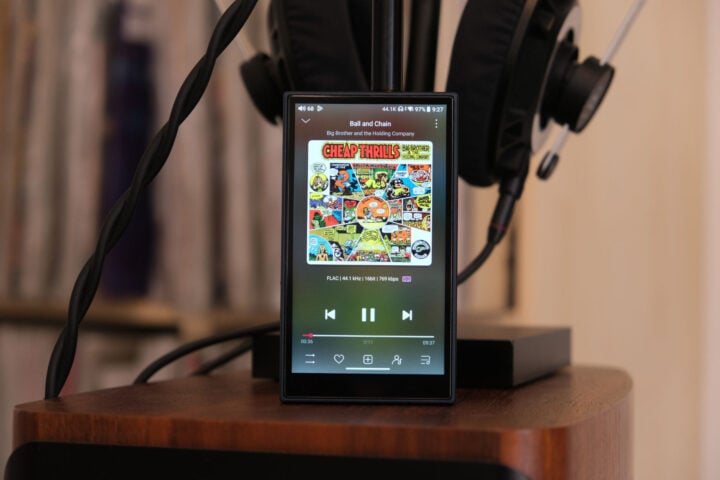
As was the FiiO M21 DAP. It made all these perform as well as the very highest-end dedicated headphone amplifiers that I’ve used over the years. The material I used ranged from astoundingly well-recorded jazz in DSD128 format, through 192kHz, 24-bit jazz from the 1950s and 1960s on the Blue Note label, to both high and mediocre quality recordings of rock and classical music in standard 44.1kHz, 16-bit CD format. Some of the material was from a Chesky compilation CD designed specifically to sound great on headphones. Others consisted of late 1950s RCA classical recordings, captured with a simple pair of microphones suspended in front of an orchestra.
I’m not going to go on about “microdynamics” and other, possibly imaginary, terms of art. Just that if there was some element of sound that the particular headphones or earphones were capable of recording, the FiiO M21 produced it. And that included the bass. The deepest material was delivered with tightness and precision.
The M21 is highly usable. The default FiiO music player app supports all formats the hardware supports. Including even Apple’s own ALAC.
It operates swiftly, with the possible exception of the Play/Pause button, which seems to take the better part of a second to act. But the only real delay is when the unit is new. If, like me, you insert a MicroSD card already full of music, be prepared to give it up to an hour to scan the thing for the music, so that it can be properly made available by Artist, Album and Genre. You can also navigate by Folder. If you like your music to play in the order in which it appears on the album, number the track titles, otherwise they will play in alphabetical order. This is a common quirk of DAPs.
Other functionalities
So far, I’ve been talking about the M21’s main purpose, but there are two other things of importance. One is that you don’t have to use wired headphones. It supports Bluetooth headphones, and for that purpose, the AAC, SBC, aptX, aptX HD, LDAC and LHDC codecs. None of those are as good as wire, but you ought to get the best sound possible out of any Bluetooth headphones you do use.
Secondly, the M21 is, after all, a competent Android device. I installed Spotify (now lossless!) and TIDAL on it, thus having access to millions of tracks beyond the 23,000-odd local ones. When working in a coffee shop, I simply used my phone as a Wi-Fi access point.
Who is the FiiO M21 for?
If you want, you can spend in excess of $6,000 on a DAP. And you’re welcome to, of course. But unless you have the strangest of headphone requirements, I doubt that you’re going to get significantly more features or sound quality than provided by the FiiO M21. And there’s really nothing more to say than that.
The post FiiO M21 Digital Audio Player review: Entry-level excellence appeared first on GadgetGuy.


0 comments:
Post a Comment