This is default featured slide 1 title

Go to Blogger edit html and find these sentences.Now replace these sentences with your own descriptions.

This is default featured slide 2 title

Go to Blogger edit html and find these sentences.Now replace these sentences with your own descriptions.

This is default featured slide 3 title

Go to Blogger edit html and find these sentences.Now replace these sentences with your own descriptions.

This is default featured slide 4 title

Go to Blogger edit html and find these sentences.Now replace these sentences with your own descriptions.

This is default featured slide 5 title

Go to Blogger edit html and find these sentences.Now replace these sentences with your own descriptions.

Thursday, 4 February 2021

Save money on mobile data – you could get it for free!

Average monthly Australian mobile data use is a very closely guarded secret – only Telstra, Optus and Vodafone know and they are not talking. Why? Because the current mobile data pre-and-post-paid plan systems are a huge cash-cow for them and their MVNOs (mobile virtual network operators).

Mobile data plans work on the principle of users never using their data plan fully each month. If they do data rates are throttled to 1.5Mbps or you have to buy data top-ups. And in most cases the data allowances reset monthly – lost after each billing period. Its very one-sided!

The dirty secret Telcos don’t want exposed is that most Australians commit to mobile data plans that are way above their average use. All they are doing is making money for the Telco or MVNO. There are ways to save and even get you mobile data for free!

How much mobile data is too much?

If you search for ‘Average monthly mobile data use in Australian’ (or any reasonable variation) you will find lots of articles on how much audio or video streaming uses etc. There is no end of helpful advice (see Step 2 below) but nothing that tells you what are averages for different types of users.

The last Australian Bureau of Statistics mobile data study was in June 2018. It found then that average mobile data use was about 9GB based on 26.981m connections. Industry analysts generally predicted a 40% growth in mobile data use each year. Telcos seized on that saying plans less than 20Gb risked running out of data.

Well here is the rub. Datareportal says number of mobile connections has grown to 32.89m (a 1.3% increase between January 2019-21) or 130% of our population. A large proportion of that number is machine-to-machine communications.

But it does not stop there. OpenSignal has real world stats from its users. It says Australian 4G users (in September 2020) consumed an average of 9.4GB a month. That is nowhere near the Telcos suggested 40% FUD (fear, uncertainty and deception) increase a year!

mobile data

You have to ask why Telstras lowest post-paid plan is 40GB per month. There is a huge disconnect between this amount and real use. Of course Telstra will say its the consumers choice but we reasonably understand that its marketing and sales efforts are focused on even more expensive 80GB plans because they include 5G!

By the way most people make the same mistake with unlimited NBN plans when a typical streaming savvy household uses about 300GB a month. You could save there too. It is high time mobile data and internet use was charged per GB just like electricity is charged per Kilowatt hour (and a daily connection fee).

Step 1 to save is to work out how much mobile data you use (average over three months).

 It should be on your monthly account. We find that

  • Occasional users who regard a smartphone as a device to make and receive calls are flat out using 1GB a month – often only a few MB for telemetry and location.
  • Average users with daily browsing, email and search will, at best, need 3-5GB (about 100-120MB per day).
  • Power users that stream Spotify (music) and some YouTube (video) generally get by with 20-30GB.
  • And if you are a ludicrous user have a very close look at how to cut down.

Step 2 is to recognise the mobile data munchers

Telstra has a handy use calculator here

  • 25 emails and 25 web page view daily is 1.5GB a month
  • HD Video (YouTube or Facebook) for 1 hour a day is 20GB a month
  • Browser-based games are similar to HD Video
  • Stream music for 1 hour a day is 5GB per month
  • Stream HD Movies (Netflix) is 115GB a month
mobile data

And remember that we are only talking about mobile data – you can safely assume that every pre-or-post-paid plan has unlimited free texts and voice calls to national numbers.

Step 3 is to research mobile data plans that suit you use.

I urge you not to use price comparison websites for anything more than to get a feel for what is out there. Once you go down that rabbit hole (sign up or answer an online questionnaire), you are mercilessly treated as their property with the sole aim spamming the hell out of you to get more of your business.

I repeat – a price comparison website aims to make money from you, not necessarily to get you the best deal!

As a wise, long-dead reporter Franklin Pierce Jones once said, “When you get something for nothing, you just haven’t been billed for it yet.”

mobile data
There are hundreds of MVNOs and plans but all insist you get their sim first. e-Sim will fix that and open up the ability to instantly switch providers or plans.

Step 4 – assuming that you don’t need more than 20-40GB a month

That puts Telstra out of the picture. Its lowest-cost post-paid plan (not 5G) is $55 for 40GB – $1.38 per GB, and you lose all unused data at each new bill.

It also has pre-paid monthly plans at 8GB/$30 ($3.75 per GB), 18GB/$40 ($2.22) and 28GB/$50 ($1.79). These have up to 200GB data bank roll-over provided you recharge on time. The roll over sounds good but you must use your included data allowance first before digging into the data bank.

But the Catch 22 on many plans is that if you don’t use that in the following month, it disappears. You need a data bank with no expiry provided you pay on time.

Step 5 – investigate MVNOs.

MVNOs resell the Telstra, Optus and Vodafone network. If you need Australia wide coverage, then its Telstra or Optus networks.

The majority of MVNOs buy data at wholesale rates and resell it to you at a package price with their terms and conditions. Note all prices below exclude specials and limited time offers.

Woolworths (Telstra network) gives you a 200GB data bank roll-over as long as you pre-pay each month. As an added carrot it offers users 10% off a monthly shop (to a maximum of $50 discount). It is by far the easiest pre-paid plan.

Prices are 1GB/$10 ($10), 6GB/$20 ($3.33), 30GB/$30 ($1.00), 42GB/$40 ($0.95) and 55GB/$50 ($0.91). There are frequent specials that can halve prices for six months. They also have 180/365-day plans with data gifting to other Woolworth Mobile users.

Aldi (Telstra) has 3GB/$15 ($5), 20GB/$25 ($1.25), 40GB/$35 ($0.88) and 55GB/$45 ($0.82) pre-paid plans with no limit on data roll-over

Boost Mobile (Telstra) has 5GB/$20 ($4), 20GB/$30 ($1.50), 30GB/$40 ($1.33), 40GB/$50 ($1.25) and 65GB/$70 ($1.08). Boost allows unused data to roll over for one month.

Step 6 – save more money using home Wi-Fi.

Assuming you have an NBN Unlimited plan, use Wi-Fi instead of mobile data when you are at home. Most phones have a Wi-Fi preference setting over using mobile data.

Step 7 – check phone settings

Every app can be set only to use Wi-Fi, not mobile data. Even better only turn mobile data on when you go out.

Step 8 – buy the phone outright

If you buy a phone on a Telco plan for 24 to 36 months, you are stuck using its higher cost mobile plans.

With 85% of all smartphone purchases under $600, you can read GadgetGuy’s reviews, and you will find some excellent 4G phones from $399.

Step 9 – 5G forget it for a few years

My neighbours are with Telstra, each having an expensive late-model Samsung Galaxy smartphones, one Samsung Galaxy Tab 4G and a 4G modem (as they travel a lot and don’t need fixed NBN). And they are wasting money by not using their respective 40GB plans.

Well, blow me down when Telstra emailed them and advised they should upgrade to 5G for an extra $10 per month. They dutifully did despite not having 5G devices nor 5G reception and are now paying extra for service they don’t need and can’t use.

Step 10 – get it for free!

My wife and I were each on a Telstra $65 monthly plan because frankly, I dropped the ball – after all, my business was paying for it – a tax deduction and all that. That was $1560 per annum.

We now have a total $40 a month commitment via Woolworths ($480 per annum) and get that back with the 10% monthly shop discount that saves us $500-600 per year (no real cost😁). And in checking our data banks, we each have 200GB in reserve if we need it.

Mobile data for free – works for me!

The post Save money on mobile data – you could get it for free! appeared first on GadgetGuy.


It is all about trust – or lack thereof

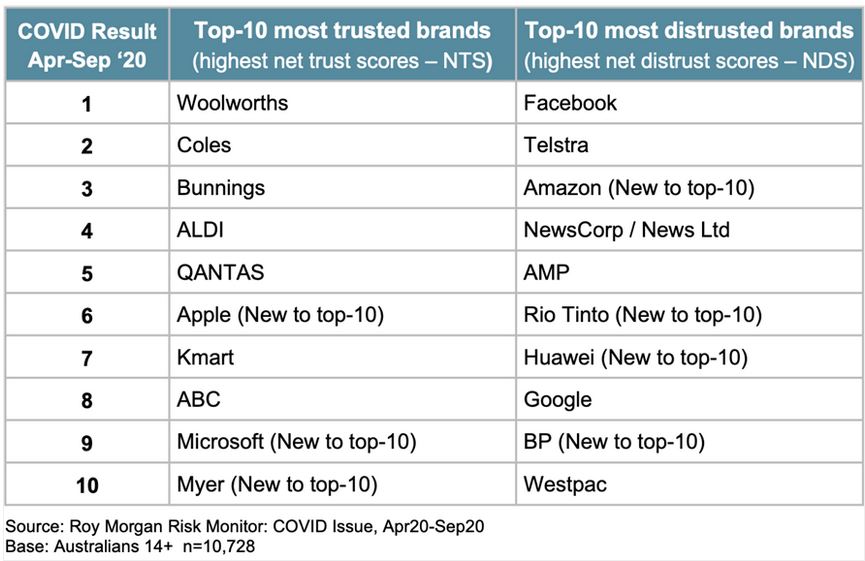
A recent Roy Morgan Risk Report identified Australia’s top 10 most trusted and top 10 most distrusted brands and companies. And in uncertain times it is all about perceived trust – or lack thereof.

The report results were from 10,728 Australians and revealed some surprising shake-ups. Previous trust stalwarts like banks and utilities have been banished to the naughty list. Woolworths is Australia’s most trusted brand followed by bitter rival Coles.

It is all about trust

And the most distrusted are Facebook (# Delete Facebook) and Telstra (which this author and judging by reader comments most of Australia has had no end of issues with).

But the new entrants are most interesting – It is all about trust – or lack thereof

On the good side are Apple, Microsoft and Myer (it slips in and out).

In Apple’s case, it has been heavily spruiking trust and making the right noises.

In Microsoft’s case, the move to a new CEO Sataya Nadella in 2014 and a 360° turnaround from world domination 101 to ‘how can we help the world’ make Microsoft cool and trustworthy again. I venture that Microsoft’s offer to step in if Google deserts Australia will further propel it up the trust charts.

A new entrant on the naughty side is Amazon. No matter how big it gets in the US, it is not a trusted brand with big hopes that Amazon Web Services chief Andy Jassy will change that when he takes the CEO spot for Jeff Bezos. It is not fair that the world’s largest online retailer knows more about you than you do.

Google is still on the naughty list and likely to go down a few notches over its refusal to pay for Australian news.

Huawei is also a new entrant on the naughty list. Joe and Jane Average only really see the 5G commotion. Australia and most of the western free world won’t let it into our supercritical 5G infrastructure. And it is the government’s right to select suppliers they are comfortable with. But the brand is now so damaged that Huawei has begun flogging off sub-brands like Honor and Mate and P-series to other owners.

GadgetGuy’s take – It is all about trust – or lack thereof

Last year we published a series of articles on trust (Click here). The time when you could look a person in the eye and judge their mettle has gone in this digital and lawless world. If you want to know more about trust in a digital world, click here.

The post It is all about trust – or lack thereof appeared first on GadgetGuy.


Realme 7 5G (RMX211) cracks the sub-$500 barrier

5G phone prices are racing to the bottom so expect to see more headlines like this. But the realme 7 5G is offering some pretty high-end tech for $499 and is throwing in a pair of realme buds Q at $79 for pre-orders.

This is an announcement – GadgetGuy will review the Realme 7 5G shortly.

Here is an overview of the Realme 7 5G

  • 2400×1080, 120Hz, 480nit, 1500:1, GG3, display with 180Hz touch response
  • 5000mAh battery, 30W fast Dart charge (0-100 in 65min) and OTG reverse charge
  • MediaTek Dimensity 800U, 7nm 8-core 5G SoC
  • 8/128GB plus microSD to 256GB
  • Dual Sim 5G with VoLTE and Wi-Fi calling
  • DOLBY Atmos, 3.5mm combo jack, and Hi-res stereo speakers
  • 48+8+2+2MP Quad rear camera
  • 16MP selfie
  • Flash Silver or Mist Blue
  • Combo fingerprint reader/power button
  • Wi-Fi AC, BT 5.1, NFC and GPS
  • Android 10 and ColorOS 7
  • 162.2 x 75.1 x 9.1mm x 195g
  • Website here
Realme 7 5G camera

It is available from Available:  realme e-store, JB Hi-Fi, Officeworks, Bing Lee, The Good Guys and Catch.com.au.

GadgetGuy’s take – superb value and quality

In 2020 realme had a 65% market share growth, bringing it well into the top 10 global makers at #7. Its BBK siblings OPPO and vivo occupy #5 and #6 spots.

 Its youth-focused social media and online marketing are working. It is the trendiest Android brand to own. realme is now places selected models via online retailer channels to maintain its spectacular growth.

One of the things I have been impressed with its focus on quality and reliability. Over 320 stringent tests for the various buttons, USB port, fingerprint reader, and torturous humidity/temperature tests have resulted in one of the industry’s lowest fault rates.

We have not reviewed it yet, but the Dimensity 800 series 7nm SoC is in the OPPO Reno4 Z (8.8/10) and reviews show it as a very powerful chip with minimal throttling. So if you want lower cost 5G and can get a 5G signal (😂) this is it.

Realme 7 5G

On the other hand, if you are part of the 85% that want extreme value the realme 7 Pro (9.8/10) at $469 is amazing with a 64MP quad-camera setup, and 32MP selfie is both the class leader and what I would buy.

The post Realme 7 5G (RMX211) cracks the sub-$500 barrier appeared first on GadgetGuy.


Cheap video doorbells and security cameras are highly insecure

Students at Florida Tech have discovered that most cheap video doorbells and security cameras are highly insecure – they are capable of spying on you.

In fact, mention video doorbell security, and you immediately think of the Amazon Ring debacle and the wholesale transmission of its user’s data (without their permission) to Amazon, Facebook, and Google!

But this goes far deeper. Pretty well all cheap video doorbells and security cameras can spy on you. What is worse – the security flaws appear intentional. We speculate why, later in the article.

Here is a summary of the students and another reputable investigative company’s findings. If it scares you then read the full article below.
  • Most cheap video doorbells and security cameras come from a handful of Chinese manufacturers (ODMs) using a standard, generic design and components.
  • That design has secret and untraceable backdoors that allow access to the camera, video feed and even your home Wi-Fi network.
  • No firmware updates to close the holes.

For now, we urge you not to buy cheap video doorbells and security cameras and if you already have them get rid of them as fast as you can. And be aware – generics, no matter how prettily packaged are everywhere from Bunnings to JB Hi-Fi.

Most video doorbells and security cameras are highly insecure (full article)

This article represents paraphrased findings from the students under Dr TJ O’Connor, Cybersecurity Program Chair, Florida Tech and similar research from nccgroup conducted for Which? UK. In any case, both back up the statement – Most cheap video doorbells and security cameras are highly insecure.

There are a few ‘safer’ brands in Australia – Arlo, Nest, Uniden, Swann, and D-Link have better design control. For example, Arlo has its own cloud, designs its motherboards and firmware and uses its factories in Vietnam. From a backdoor spy prevention perspective, that is what you need.

The risk is hundreds, if not thousands of cheap, generic brands and models churned out from Chinese ODMs

Why? Because most generics use the same electronics, operating systems, firmware, cloud and wrap it in a cosmetically different housing – white labelling. Then AliExpress, eBay, Amazon, Kogan, Disk Smith or other merchant sites flog them. It is cheaper to do it that way.

Some generics have better pedigree and marketing than others. In Australia Laser Co (Connect Smart), Brilliant Lighting, and Jacar come to mind. Most of these use a generic Tuya IoT cloud (China-based) and at least attempt to obtain firmware updates from the ODMs. But as <$100 products you can’t expect long support periods.

Suspect brands include EUFY, EZviz (Hikvision), Merkury, Geeni, Orion, Youpin, Qihoo, Accfly, Banggood, Chuango, Kogan, Dick Smith, Imou, 360, Vivitar, Eken, Lyeef and hundreds of Ring knockoffs are the main risk. Just look at AliExpress here – there are 5390 results!

Further investigation with Made In China notes 11,554 current video doorbell products from 525 ODMs. Digging in FCC records shows that there are currently about eight variations to a standard motherboard design – integrated camera/speaker/PIR/IR module, audio/video processor Wi-Fi, power/charging (battery) and generally a Linux/ARM-based IoT controller with a SIP and IP web-interface.

Oh, and Wi-Fi security cameras have 12,846 listings. I guess that is OK for a country of 1.3 billion people.

Main spyware issues

The students found

  • Remote Telnet access CVE-2020-28998 to easily expose MD5 4-digit hashed passwords
  • Undocumented and untraceable backdoor account CVE-2020-28999 allows remote access to the device or a streaming video feed. This account is invisible to any logs
  • Ability to redirect a telnet session to another device CVE-2020-29000 and bypass any firewalls
  • Remote code execution to access files CVE-2020-29001 to install malware on other devices
  • Ability to stop the doorbell functioning (to allow criminal access).

Sadly, Walmart, Amazon, Home Depot, Best Buy and many more online merchants sell these extremely popular cameras in the US.

Overview of nccgroup findings

In addition to the student findings, nccgroup found

  • DNS (Domain Name Server) port 53 – enables DNS hijack of IoT devices on the home network instead of obtaining a DHCP IP address from the router – great for setting up Botnets.
  • Wi-Fi credentials stored in the device in clear text – not encrypted.
  • Ability to connect to a remote backend server – control DDoS Botnets.
  • System commands outside login – factory reset (wipe), console, sleep and active
  • Remote firmware commands – flash (and several options)
  • Untraceable internet-facing gateways www-user@XXXXXX remotely accessible
  • Unencrypted mobile app communication
  • Root certificate-granting via an HTTP request
  • Many apps generate a QR code on the phone to connect to the device during setup. Such codes may be insecure, especially when used to add profiles to access the device
  • No back end authentication of API requests
  • HTTP Port 80 allows undocumented login and allows commands like open, upload and close. This is part of Huawei LiteOS (Huawei’s “1+2+1” Internet of Things solution). Huawei freely distributes LiteOS via open-source development kits and industry offerings. Hackernews confirms its widespread use because its free. See below
Cheap video doorbells and security cameras

And the big one

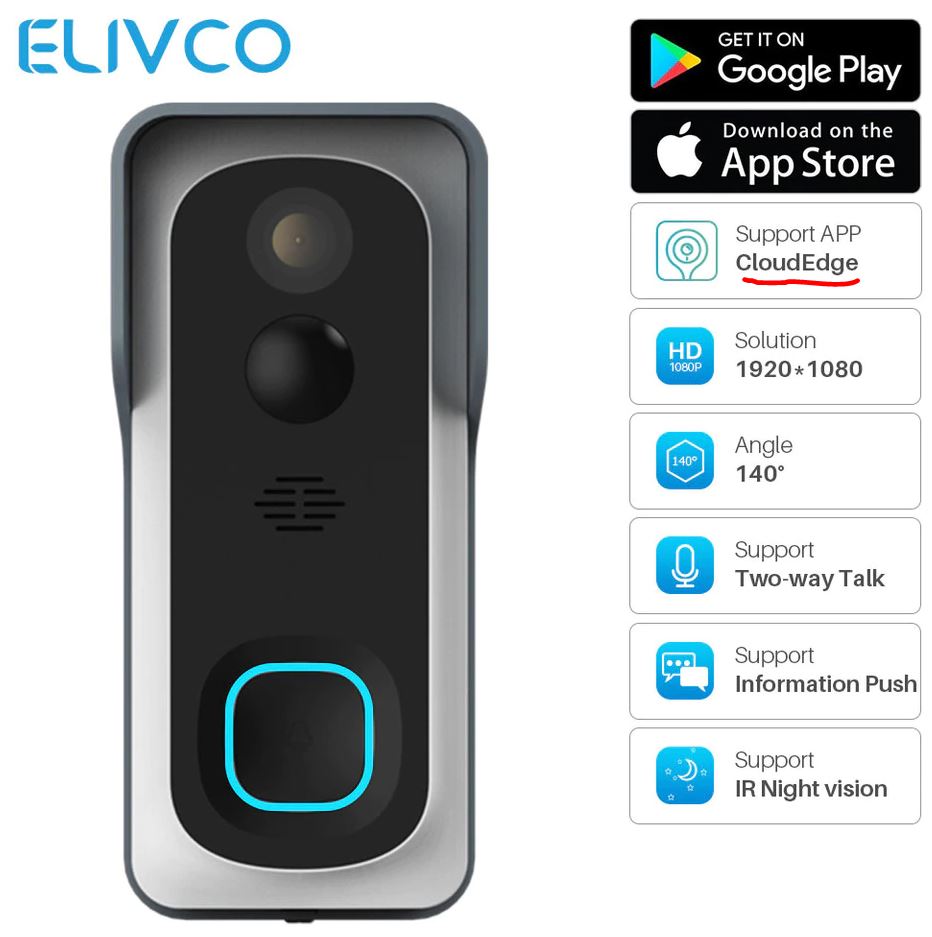
  • Data sent to other countries without permission, especially clouds in China like CloudEdge for Android and iOS  (app-logs.meari.com.cn) used by many ODMs. Note: Elinz Camera’s here use this. Forbes found that CloudEdge uses dozens of different names on more than 30 brands of doorbell cameras sold retail in the US.
  • The data includes full smartphone data, ID, logs, contacts, GPS location, Wi-Fi credentials, and much more.
Cheap video doorbells and security cameras

nccgroup concludes

“Confirmed conclusively that the majority of the devices were clones, all of which have the same security issues. Mobile applications were clones of each other as well. The firmware binaries proved the devices’ hardware design and manufacturing were similar.”

Cheap video doorbells and security cameras
Most use a generic motherboard to keep costs down

GadgetGuy’s take – bloody hell

It is a bold statement, fact-backed statement – Most cheap video doorbells and security cameras are highly insecure

This is current – nccgroup released its finding on 18 December 2020 and the Florida Tech on 4 February 2021.

Simply put if you buy a generic camera or video doorbell, you open your home up to spying, criminal access and even nation-state attacks. Your video camera or doorbell could be leading a DDoS attack on major infrastructure right now!

And it is your fault! You are reinforcing generic production using third-party software and third-party parts because you buy cheap.

But what is worse is that any generic IoT devices are made the same way. Think of connected security cameras, locks, speakers, light bulbs, power points, printers, refrigerators, televisions, photo frames, microwave ovens, bathroom scales, toothbrushes – the list is endless. If they connect to the home network via Wi-Fi or even BT, they can phone home.

IoT
If it connects to the internet it can spy

Its all about your data

A recent Australian survey by Telsyte shows 42% of Aussies have no idea where their security camera data is stored. Do that matter? Hell yes!

Knowledge is power, and absolute knowledge is absolute power.

Does it matter if it is stored in the dark web for criminal purposes. Or somewhere that a nation-state can access and use it? With just your IP address, cyber spies can access your home network, cameras, computer, and even your phone. A nation-state could simply shut it down.

Now is not the time to lambast Google, Amazon and Apple for their privacy invasion via smart assistants and smartphones. At least we know that they share western values and only want to empty our pockets.

GadgetGuy has ceased reviewing smart IoT devices that don’t meet reasonable standards for privacy or that come from generic suppliers where firmware and security upgrades never happen.

For that reason, we support Arlo’s privacy as a pledge. So far, no other security camera maker has been able to match.

Arlo privacy logo

Now is the government’s time to make more than voluntary policy statements

The Australian Governments Code of Practice- Securing the Internet of Things for Consumers (it is a PDF – check downloads) is voluntary. Its not working! Mandatory means teeth!

ReFirm Labs Binwalk Enterprise IoT security tools helped the Florida Tech students uncover the vulnerabilities. ReFirm says a short term fix would be to implement mandatory Cybersecurity Certification Labels. But longer term retailers and consumers need to step up and stop buying insecure rubbish.

ReFirm says Governments have policies to stop retailers selling products that burn down your house down or make you sick. How about not selling horribly insecure IoT devices that turn your house into a hacker’s playground?

The post Cheap video doorbells and security cameras are highly insecure appeared first on GadgetGuy.


Wednesday, 3 February 2021

WD Black D50 Game Dock. Why should gamers have all the fun? (review)

8.8

The WD Black D50 Game Dock is a Thunderbolt 3 (TB3) dock with an M.2 PCIe NVME SSD slot and a range of expansion ports including 87W upstream power for a laptop.

Well, perhaps that techy description does not do it justice. Let’s look at the non-game use cases for the WD Black D50 Game Dock.

Australian review: WD Black D50 Game Dock

Fast external storage

The WD Black D50 Dock (1TB as tested) comes in 0, 1 and 2TB units. Apparently, the 0TB unit cannot be upgraded to SSD. That is a shame as you should have that choice like Seagate FireCuda Gaming Dock (8.8/10).

On upgrades, the WD Black is not meant to be opened. It has four screws on each left and right cover that don’t match the typical Torx screw designed to keep you out.

I know WD is going to kill me, but we found an unusual screw head in iFixit’s amazing Manta Driver Kit and well, could not resist a look inside.

The 1TB SSD is an OEM WD SN730 PCIe NMVMe Gen 3×4-lane. It has a big heatsink so we assume that you would need a heatsink on any other SSD. The 2TB uses the WD SN750 SSD.

Potential buyers can reasonably assume that it is upgradeable to larger capacities as they become available.

Speed – as fast as external storage gets

In a perfect world, the SN730, when used internally reaches 3400/3100MBps. As an external drive, the TB3 connection limits the bandwidth.

It achieves 2800/2400MBps sequential read and write speeds. That is about 75% as fast as any premium PCIe 3.0 4 lane internal SSD.

It is roughly 23/20Gbps, and that is about the limit of 40Gbps TB3 with display port, ethernet and USB overheads.

Note that the SSD temp reached 80° during heavy load and the fan did a reasonable job of keeping it stable. The outside temperature reached 38° – warm.

WD Black D50
This is as good as it gets for external storage

Chipset – won’t work from USB-C 3.1/3.2 Gen 2

We had high hopes that this may be an Intel Titan Ridge TB3 chipset that would support both TB3 (and TB4/USB-4) and USB-C 3.1/3.2 Gen 2 (10Gbps) like the Plugable Dock that does10/10!

But apart from providing upstream charging to a Surface Pro 7 (3.2 Heb 2), it did not recognise anything else. Until proven otherwise assume it’s a Gen 1 TB3 only dock.

Ports well endowed

  • TB3 with up to 87W upstream to the PC
  • TB3 downstream with 15W, Alt DP, USB-C and TB3 (limited to 20Gbps)
  • Display Port 1.4 (5k@60hZ)
  • 2 X USB-C 3.1 Geb 2 10Gbps 15W (we understand these share both the data and power bandwidth)
  • 2 x USB-A 3.1 10Gbps (ditto) 7.5W – one with sleep charge
  • 3.5mm combo audio
  • Gigabit Ethernet
  • Power port – 19.5V/9.23A/180W brick charger

LAN

It has a Gigabit LAN port that allows you to disable Wi-Fi or Ethernet on the laptop. This could be useful for accessing the router at the best stable speeds.

Dual monitors

Three choices depending on your monitor refresh rate and connections.

  • Use the DP 1.4 and the downstream TB3 port (if the monitor supports it) – up to 4K@60Hz
  • Use the DP 1.4 and the downstream USB-C 3.2 Gen 2 port (ditto)
  • Or you can use DP 1.4 and a USB-A 3.0 to 4K HDMI Adapter (4K@30Hz)

Build – love the shipping container

Wd Black’s shipping container industrial style sets it apart. The unit is quite small at 120m square and 55mm high x .56kg – although it should sit upright so that the fan can effectively remove heat.

It has a 5- year limited warranty (depends on Terabytes written) so it’s a keeper.

WD Black Dashboard

The Dashboard is a black and orange overlay on the WD Dashboard. I am not saying its garish, but I am so over dark and brooding themes.

It gives the status, temperature, various performance settings, disk tools, and settings.

RGB control (Windows only) is for the LEDs at the bottom of the case. It has many p[re-sets and support for Gigabyte RGB Fusion 2.0, MSI Mystic Light Sync and ASUS Aura, and Razer Chroma RGB.

WD Black D50
RGB controls

Tests

A TB3 connection provides full-duplex 40Gbps (it is actually 4x8Gbps pipes) speeds. Once you dole nearly half that out to the second TB3 downstream port and distribute bandwidth to the SSD, the pipe inevitably becomes congested. That will happen with any dock with external storage.

Here we see the internal SSD bandwidth throttled as other devices need bandwidth. When fully loaded the SSD achieved 1900/1800MBps.

The Gigabit Ethernet port was rock solid on 1000Mbps. But when we added a UBS-C 3.1 connection to a Samsung Galaxy S20 Ultra and transferred 10GB of files it varies between 200-1000Mbps.

The USB-C 3.1 Gen 2 external Orico SSD was rock solid on 1000/1000Mbps, and we were able to max out the DP and a TB3 port with two 60Hz monitors.

We did not repeat the ‘Game Mode’ tests, but I understand it optimises Ethernet and display priorities.

GadgetGuy’s take – gamer’s will love the dark theme and design.

I think the container looks great on any desk.

The USP is the additional fast 3000MBps 1 or 2TB SSD storage. Only one other dock, the Seagate FireCuda can do this.

There are a few caveats to consider for creatives and power users that may not need the external SSD

  • Some later docks use the Intel Titan Ridge chipset that supports TB4, USB-3.2 Gen 2 and USB-4. These also can have two DP out ports or one and a TB3 port.
  • The SSD does throttle under TB3 load – something I have not noticed before as the other docks are generally diskless
  • Is 87W upstream enough for a gaming notebook? It will power a MacBook Pro.

WD Black D50 Game Dock fast facts

  • Website here
  • Price: We can’t find an Australia retailer yet. US-based Newegg.com  has the 1/2TB for $765/1040
  • Warranty: 5 years limited (not ACL protected if you buy in the US)
  • Comes with Australian RCM certified power supply and 70cm TB3 cable

Rating

Comparing it to the Seagate FireCuda, it matches all specs. The FireCuda has a 4TB HDD and an M2 slot for any SSD. Price-wise they are very close. Compared to the Firecuda I think the WD Black looks better and as long as it is future-upgradable (and I can’t be sure), it gets the tick.

Features
9
Value for money
8
Performance
9
Ease of use
9
Design
9
Positives
One of the few with external PCIe 3.0x4 lane SSD expansions
SSD should be user upgradeable
Small and light and love the container theme
Negatives
It would have been perfect with Intel Titan Ridge chipset
8.8

The post WD Black D50 Game Dock. Why should gamers have all the fun? (review) appeared first on GadgetGuy.


Tuesday, 2 February 2021

Trade-in phone values – best and worst revealed

You have just bought that shiny new smartphone. Pity that for most it is worth nothing after 12 months. Maybe you should investigate trade-in phone values before you buy.

Trade-in phone values have become big news since Apple decided to break the $1000 barrier with Samsung soon following. Both have tantalising trade-in, and trade-up offers that make updating less painful. But for the majority, these trade-ins are not applicable.

Are Trade-in phone values any good?

First, let’s look at the life of a phone. Day one, you buy it at full price (no you cannot trade-in shonky grey market phones). All is well for a year or so until you get phone envy or perhaps the battery is not lasting as long.

You begin to look around and see that Telstra is touting its smartphone trade-in program to reduce e-waste. The reality is that it is only interested in ‘selected’ late-model Apple and Samsung phones in near perfect condition. But to Telstra’s credit, its offer is often slightly better to lock you into a 12/24/36 month voice/data plan where it makes real money.

Then you see a plethora of cash-back companies including Mobile Monster, Sell Your Mobile, Mazuma Mobile, Mobile Trade, Cashaphone, and many more. Just search for ‘phone trade-in Australia’. But these offer a fraction of the Telstra, Apple and Samsung schemes. Why? Because they have to refurbish and resell your handset and there is not much money in that.

What is my phone worth as a trade-in?

Unless it is an Apple or Samsung, then the answer is nothing after 12 months. It is whatever you can get on the second-hand market.

US research shows a one-year-old flagship One Plus is worth just 18%. Similarly, Huawei – well, that name is on the US’s nose – is nil.

Then you have Google Pixel (a good choice). A one-year-old is worth 31% if you sell it second-hand.

Apple depreciates at about 4% per month – after one year it is worth 49%.

Samsung depreciates at about 5.5% per month – after one year it is worth 33%.

Why just Apple and Samsung?

Technically resale value is a function of desirability and initial cost. Users will pay more for a brand or model they want.

Apple’s AU trade-in program is here. Samsung’s is here. Both will trade each other’s brands to help users jump ship.  And both have token trade-in values on some other brands like OPPO, Google and Huawei. As long as either brand gets the user to buy it is a win!

Trade-in phone values
This really should read ‘up to’

And second, Apple and Samsung trade-in programs control the market prices. That is a reference point for all recyclers

With Apple and Samsung flagships now coming naked (no charger etc.) prices have been adjusted downwards.

Where is this heading?

If a global brand like, say OPPO wants to play in the same flagship sandpit, it will need to factor in deferred revenue from trade-ins. I don’t see that as smart if 85% of all phones cost below $699 and are sold outright.

No Apple and Samsung are cannier. They want a direct relationship with the user either via their credit card finance (Apple Card) or via a recurring subscription.

Trade-in phone values

This is the only way to keep users in the tent and to ensure retention times don’t blow out to over three years (as they have during COVID).

With recurring payment systems, they do not even have to reveal purchase or trade-in prices at all. It keeps you in the tent where both can earn more money from services – forever.

And the benefits for Apple and Samsung are enormous. No finance costs leaking to third parties, and only holding the manufactured value (circa A$200), not the phone’s retail value on its books. Very clever.

GadgetGuy’s take

The two main suppliers operate trade-in programs that work for them. The rest of these second-hand cash-back schemes are marginal at best.

The raw data came from US-based Declutter that operates a large second-hand smartphone reuse, repair and recycling business. The figures are expressed as percentages to eliminate the countries’ price differences.

The post Trade-in phone values – best and worst revealed appeared first on GadgetGuy.


Monday, 1 February 2021

Global Smartphone sales Q4 2020 (all of 2020) – a few surprises and Australian commentary

While global smartphone sales Q4 2020 are still down from 2019 figures, there are signs of recovery. Q4 sales of 395.9 million units took the years total to 1332.5m, down from 1479.1m in 2019.

These were the figures the industry needed after an abysmal Q1, Q2 and Q3 detailed here. At that time dire predictions were between a 5-8% decline for the year. It was 10% down but perhaps that was cathartic.

Counterpoint’s figures use ‘sell-in’ that can reflect ‘channel stuffing’. But these are full-year, year on year (YoY) figures, so any ‘stuffing’ averages out. Here is an overview.

Global Smartphone sales Q4 2020 (all of 2020)

Global Smartphone sales Q4 2020 (all of 2020)

#1 Samsung lost 14% but still the largest with 19% single market share. A-series was the strongest performer (85% of smartphone sales are below $699 – see our late 2020 picks here). This segment is hotly contested in Australia, and smaller, perhaps more agile players like OPPO, vivo and realme ate its lunch! Flagship sales dropped to single percentage digits. Samsung’s 5G offerings garnered 8% of the Q4 2020 market.

#2 Apple had a 3% growth to 15%. The iPhone 12 5G came out in Q4, 2020 and quickly took 24% of the lacklustre 5G market. This was because a) there was a pent-up demand by Apple users for a 5G iPhone, b) it offered mmWave in the US and China, c) heavy discounts/trade-ins and strong carrier promotions inflated sales and d) it was only in 5G!

#3 Huawei continued the downwards spiral shedding 21% market share to 14%. More than 70% of its sales were in China for the lower cost Nova 7 5G and where Google Android does not matter. Chip shortages due to the US Entities blacklist have strangled its new phone development and flagship sales.

Huawei also sold Honor (a Huawei sub-brand accounting for 43% of its sales) to a Chinese-based Consortium to reopen the sub-brands supply lines with Google Android and ARM chip fabricators. It is also considering selling the Mate and P sub-brands, leaving very little in its smartphone range.

#4 Xiaomi’s 17% growth to 11% was in European international markets, but some was at the expense of Honor in China. While the brand is in Australia via its mi Store, its lack of retailer channels has held it back. It will soon make a huge push here with a range of new models.

#5 OPPO (BBK brand) lost 7% to 8%. It is doing very well in Europe, MEA, India and Australia. Its seen as the safe ‘Chinese’ brand.

#6-10

#6 vivo (BBK brand) lost 5% to 8%. We call it a worker’s phone, and it has a reputation for solid value and performance.

#7 realme (BBK brand) grew 65% to 3%. Admittedly the growth was from a lower base, but this is amazing. Its youth-focused social media and online marketing are working – it is trendiest Android brand to own. realme is now looking to place selected models via retail channels to maintain its spectacular growth.

#8 Lenovo (mainly Motorola brand) dropped 18% to 2%. But it’s doing quite nicely to even be in the top 10 – it was not there in 2019. Lenovo is in the envious position to ‘experiment’ with different strategies to see what works. For example, it is trying to move from the ‘pre-paid’ to ‘post-paid’ market – that takes time, but the rewards are Telco support. Its Razr gamble is paying off – not so much in sales but in positioning it as a key innovator. My UI still allows it to claim pure Android, and it’s a hit with users. While it appears slow and steady, it knows that ‘Legends are made moving forward’.

#9 LG lost 13% to 2%. Its lower cost K-series sell well. Its LG Velvet is GadgetGuy’s pick for 2020. For whatever reason, it never quite gets the attention that its other South Korean sibling gets. However, both are benefiting from not being made in China.

#10 Tecno – a new Chinese entrant. Started with the Phantom 6 in 2017 and 50 models later is the major player in Africa and the Middle East. It is cheap and cheerful and moving outside its low-cost base to include mid-range models for new markets. We don’t expect it will be in the top 10 in 2021.

And the rest.

Outside the top 10 are a hundred or more makers. Collectively they dropped 27% to 18%. There is no doubt that the spectacular increase by realme is evidence of a move to ‘brands’ and support.

Sad to see Nokia at .7% where its feature phones are doing extremely well.

5G

5G was 34% of sales in Q4, 2020 up from 2% in 2019 where there was a handful of models and almost no reception. It is not that consumers are asking for 5G – it is that Apple now only offers the iPhone 12 in 5G and Qualcomm now has good supplies of 5G chips ranging from its SD888 flagship to its value SD480.

Australia

There are no local figures yet. Our retail spies confirm that Apple’s 5G move has excited the 5G segment, but 4G still rules.

  • 85% of smartphone sales remain under $699 with a strong downwards push in Q4 to phones under $399. It seems ‘back to school’ hip-pocket is around that figure.
  • The cheapest Android 5G is the Motorola G 5G at $499 but the Reno4 Z and Samsung Galaxy A42, both at $599 are the best sellers in that segment. Since the LG Velvet 5G dropped to $799, it dominates that segment.
  • Apple iPhone 12 mini 64GB at $1199 is the runaway Apple seller with reasonable upsell to the 128GB model at $1279.
  • Flagship market – the Apple iPhone Pro Max is the king of post-paid (Telco plan) sales with the majority taking combined data/handset plans and trade-ins that tend to offset handset costs.
  • It is too early to tell the cut-through on the new Samsung S21 series, but the price reductions mean it offers higher specifications for less. The Blue Tick classification (that Apple does not have) for regional use it a real driver.

Global Smartphone sales Q4 2020, Global Smartphone sales Q4 2020, Global Smartphone sales Q4 2020, Global Smartphone sales Q4 2020

The post Global Smartphone sales Q4 2020 (all of 2020) – a few surprises and Australian commentary appeared first on GadgetGuy.