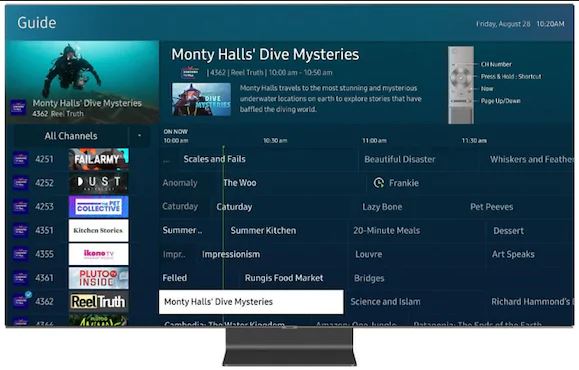
Samsung TV owners from 2018 onwards can add Samsung TV Plus to their streaming options.
Samsung TV Plus in Australia has over 40 channels of free, ad-supported content. Some available channels here include Bloomberg, RYAN and FRIENDS, Stingray Karaoke, Qwest and Tastemade.
The full channel list and further information can be found here.
The app can also run on Samsung Galaxy S10 and later smartphones. Extreme Caution: Mobile data charges apply.
We cannot confirm if it is voice searchable (OK Google show me X) or if its interface is a simple guide or fully searchable resource. We suspect its EPG does not integrate with the Free-to-Air EPG.
Samsung TV Plus – if the product is free, the product is you
Be aware that the ad-supported format means that you will have ads injected into the stream. You cannot skip them either. There will also be banner ads on the main smart TV interface.
We understand that Samsung continually profiles its customers via Automatic Content Recognition (ACR). It works by detecting what kind of content a viewer is watching. Samsung claims that ACR data is ‘not sold, rented or distributed’ but used exclusively to sell programmatic advertising.
But Samsung does not mention if other data is gained from third parties to round out a profile.
However, Samsung has a US webpage that states, Samsung Ads provides the holistic view advertisers need, in one platform that captures and connects real-time TV behaviours. With the largest, most powerful TV data source, Samsung Ads delivers reach that scales and drives results.
That is on over 60 million eligible TV and hundreds of millions of Galaxy smartphones.
Is it a matter of trust or which company to trust?
Samsung is not alone in supplying ad-supported streaming. Every streaming channel – Netflix, Amazon, Binge, Foxtel, Stan (and there are thousands) collects data on what you watch, where you are up to (in a series) etc.
Like Netflix, some are subscription-supported and use the information to serve you content that it thinks you will like (a match). Others are ad-supported. One, in particular, Amazon Prime uses the login to marry this with its huge shopper’s profile it keeps on you. Others may aggregate data and sell via data brokers.
Even then free-to-air TV broadcasters have ways of measuring audience habits using two-way signals in Digital Terrestrial Transmission. This applies to all TV brands and was the prime driver to change from Analogue to Digital (and you thought it was to get a better picture).
This applies to audio content streaming, radio stations and every free content service.
So, let’s not gasp and pillory Samsung but understand that privacy on a smart TV or any smart device is an oxymoron. It’s a case of whether you trust Samsung or any other brand.
The cure – there is none except to maintain a very small digital footprint.
Motorola (Moto) says Hello to Android 11 announcing a staggering 22 model phone update. As far as we can tell it’s the world’s largest single brand/model rollout.
In its pre-Christmas blog it lists the following Hello to Android 11 models – with the two caveat
First, that that roll out may be dependent on a country’s Telco. Second that for the majority of the phones below the OS upgrade will be the only one. Moving forward Motorola aims for at least two upgrades over the life of a flagship device and one for all others.
razr 5G
razr 2019
Edge
Edge+
one 5G
one action
one fusion
one fusion+
one hyper
one vision
g 5G
g 5G plus
g fast
g power
g pro
g stylus
g9
g9 play
g9 plus
g9 power
g8
g8 power
Moto has until recently used Pure Android on its handsets. In 2020 it introduced My UX, not as an overlay or loader but as a companion to Google Android to take advantage of hardware features. It has been extremely successful in not altering Android.
It also means that security patches can now be rolled out faster as the phones are essentially still Pure Android – with benefits.
Motorola has also started to achieve market penetration that may see it break into the top 5 manufacturers sooner rather than later. Analysts say that it is fast emerging from the ‘other category’ with 3% market share in Q2. This represents a 37% growth QoQ and a 4% YoY growth driven by strong U.S. and Latin America performance for the E and G series.
You can read other Motorola news and reviews here.
According to Gartner, worldwide smartphone sales to end-users totalled 366 million units in Q3 2020 – a worse than expected decline of 8.7% year-over-year.
What a difference three months makes. While analysts were upbeat in Q2 about the overall impact of COVID-19 on sales (about 6% decline) they were equally downbeat by Q3 2020 (July-Sept) when it showed an 8.7% annual decline. That does not even include Q4 figures.
Table 1. Worldwide Top 5 Smartphone Sales to End Users by Vendor in 3Q20 (Thousands of Units)
Vendor
3Q20 Units
3Q20 (%)
3Q19 Units
3Q19 (%)
3Q20-3Q19 Growth (%)
Samsung
80,816.0
22.0
79,056.7
20.3
2.2
Huawei/
Honor
51,830.9
14.1
65,822.0
16.9
-21.3
Xiaomi
44,405.4
12.1
32,927.9
8.5
34.9
Apple
40,598.4
11.1
40,833.0
10.5
-0.6
OPPO
29,890.4
8.2
30,581.4
7.9
-2.3
Others
119,117.4
32.5
139,586.7
35.9
-14.7
Total
366,658.6
100.0
388,807.7
100.0
-5.7
Q3 2020 highlights
Samsung benefited as the prime non-Chinese alternative using Google Android.
Approximately 90% of its sales were the A-series. Samsung has the widest distribution via its online stores, retail and Telcos and it considered the best option.
Huawei shed enormous market share (in China).
Huawei’s massive ‘Chinese channel-stuffing’ in Q2 (moving its inventory off its books to resellers warehouses) came back to bite it, and sales to western markets were almost non-existent. Huawei cannot use Google Android, but that is of little consequence in China were Google apps are banned.
Huawei’s figures will plummet even further as it offloads 100% of the Honor brand to the Shenzen Government-owned Shenzhen Zhixin New Information Technology Co., Ltd. Honor is Huawei’s value brand accounting for somewhere between 35-40% of its sales. But U.S. Trade Sanctions affected its ability to access U.S. tech (like Google Android), and the brand has suffered.
Huawei has undertaken not to design or manufacture Honor phones. Instead, it will contract to Chinese owned ODMs Huaqin Technology and Wingtech Technology that also work with Xiaomi. Huawei will ‘not hold any shares or be involved in any business management or decision-making activities’ once the sale is complete. According to Nikkei Asia, no guarantee splitting the brands will help Honor comply with U.S. export control regulations.
The shock entrant was Xiaomi that overtook Apple for the first time.
Apple may pick up in Q4 due to the delayed launch of its iPhone 12 series. Xiaomi picked up in China with new models selling against seriously older Huawei/Honor tech. It is starting to get global distribution in place.
OPPO and its BBK Siblings faced severe component shortages that meant a reduced new model rollout.
OPPO has good online, retail and now Telco distribution (replacing Huawei and ZTE).
But Gartner is only one statistics source. Counterpoint has similar statistics for the top 5. It shows OPPO, vivo and realme at cumulatively 22% market share (up 2%) which puts BBK at #2.
The winner here is realme that has rocketed from nothing in 2019 to 4% of the global market. Its shipments grew 132% QoQ, becoming the world’s fastest brand to hit 50 million shipments since inception. It started as purely online but is now selling select models via retail.
Not on the top 5/10 list is Motorola/Lenovo. But analysts say that its fast emerging from the ‘other category’ with 3% market share in Q2. This is a 37% growth QoQ and a 4% YoY growth driven by strong U.S. and Latin America performance for the E and G series.
5G
Over 50% of smartphones sold in Q3 were 5G capable. But the figures were massively skewed by the dumping of Huawei 5G Balong modem devices for Chinese consumption only.
And OEMs like OPPO (BBK) and Xiaomi only received 5G Qualcomm SDD765G and Media Tek Dimensity chips late in the quarter. OPPOs Reno4. Pro and 4Z (5G), vivo X50/X50 Pro/X50 Pro Plus 5G had a 90% growth over sales of the Reno3 and earlier vivo 5G phones.
OPPO A72 5G and vivo Y70S 5G vivo have released the next value level of 5G using Qualcomm SD690 that we will see here soon at <$400.
In Australia, the great bulk of smartphones sold are still 4G until 5G has no price premium.
Rumours abound, but some sources are better than others. Here is a roundup of the Samsung S21 rumours that appear to be most likely.
It is that time of the calendar year – Samsung is usually the first cab off the rank with the release of its 2021 flagship devices – the Galaxy S21 family. And if the schedule is true to form it will be at least a Galaxy S21 and Galaxy S21 Plus with more models like the Ultra, Fan Edition, Active, Note21, etc. to come later in the year.
You know it is getting harder to improve on the traditional glass slab. A new processor, changes in memory or capacity, bigger cameras etc. From what we can gather the S21 series is more evolution of the excellent S20 series in 2020.
And while some are critical of the ‘tick-tock-tock’ evolution (new-update-update) process does not offer enough incentive to upgrade, it makes sense in a COVID world to update the tech. S10 and earlier model owners are the targets here.
Simultaneously, its excellent A-series is where 90% of the action is, and the S-series tech flows down, making ‘A-X2’ series even more compelling.
Note: any images are artists renders only.
Samsung S21 rumours – three models – well, at least two
Samsung always manages to surprise so while it may be two (S21 and S21 Plus) or three models (S21 Ultra) it will have something else up its sleeve to make 14 January even more exciting.
What we are seeing is a pattern appear. The S21 and S21 Plus will be a case of good and better but largely using the same design, camera, internals etc. So, the differentiation here is screen and battery size.
Ultra will have some cool things. Certainly, the huge, binned main sensor and periscope zoom (that has made such a difference to my photography), more storage, and the huge screen – 6.9 is wonderful.
Screens
It is no surprise that the S21/Plus will have flat 2400x1080p screens with small bezels. They will have 60/120Hz adaptive and the new Dynamic AMOLED 2X capable of 1300-1400 nits for HDR10+.
The ultimate Gorilla Glass 7 Victus will protect both. The under-glass fingerprint sensor becomes ultrasound for faster response.
The S21 Ultra (should we see it) will be 6.9” 3200×1440, 120Hz adaptive.
Processor/ram/storage
Some countries get the Qualcomm SD888 (US and others with mmWave 5G), and there is always a kerfuffle over the rest (like Australia) that get the Exynos version. The Exynos 2100 5nm has 1 x 2.98Ghz, 3 x 2.8Ghz, 4 x 2.4Ghz and leaked tests show the performance gap between both brands is very close.
We are a little concerned that base memory/storage is 8/128GB (256GB option), and apparently but no micro-SD expansion. However, Samsung has a good implementation of USB-C 3.2 Gen 1 (5Gbps), giving backup speeds of 200-300Mbps.
And with small external SSDs now common that allows for videographer use.
Comms
The SD888 has Wi-Fi 6E and Qualcomm 5G Modem. The Exynos version Wi-Fi 6 but HT160 and Samsung 5G modem. The Bottom line is they will perform similarly. We will get a single sim and eSIM version.
Of more importance is the availability of 5G in Australia. It uses the slower sub-6Ghz band (mmWave is probably 2025 for consumer use and only in a few locations). The Samsung 5G Modem is fine.
As usual, there will be the BT 5.x, NFC, Ultra-Wide-Band
Battery
The Samsung S20 series gets good battery life anyway. The move to 5nm SoC and reverting to 1080p screens means that the extra power use of 5G should be well offset.
Samsung has a 25W ‘fast charge’ that is a far cry from the speedy 65W offerings from OPPO et al., but a two-hour charge is acceptable.
We expect the batteries to remain at 4000/4800 mAh with 15W Qi charge.
The Ultra has space for a 5000mAh battery.
Camera
The camera housing appears to wrap around from the frame – not a separate camera block.
Here is where rumour tends to give way to speculation. The renderings appear to show three 12MP cameras, similar to the Samsung Galaxy Z Fold 2 and Note20. Others claim at 64MP binned 16MP primary sensor.
Regardless Samsung knows what it is doing here, and the cameras will rate well in the DXOMARK tests.
The Ultra could see a huge 144MP primary sensor binned to 16MP. We expect the 48MP Pericope ‘folded prism’ camera with 4X optical, 10x digital (lossless) and 100X hybrid zoom to remain.
Ultra render – centre
The selfie is 10MP with large 1.8um pixels.
Android
Samsung has already committed to three OS updates and three years of regular security patches. But its also working with Google’s Project Treble to allow Android updates regardless of any UI or hardware customisations.
Having seen Android 11 and UI 3.0 on the S20 Ultra, Samsung users will not be disappointed.
Price
The world is not ready for more price hikes, so the S21 is just a technology refresh. We were impressed at the Samsung S20 Fan Edition (FE) – the lowest cost S20 device of the year. Expect the S21 FE to impress as well.
Samsung S21 rumours- to finish
Samsung is experiencing a major upswing in the west as one of the few phones not made in China. It also controls most of of its supply chain to confidently produce millions of devices that may otherwise be competing for critical parts made in China.
There are rumours that these will not come with a charger or USB-C earbuds but given Samsung’s response to the Apple iPhone 12 move that is unlikely.
As I said earlier, I don’t expect any unforeseen technological advancements in this or even perhaps the S22 – at least until the words resets and gets back on its feet.
And that is why Samsung is also working on new models of the Flip Z and Fold Z. These inspire people and are proving grounds for new tech.
The U.S. DHS has issued a 15-page ‘Data Security Business Advisory’ to U.S. companies on the risks of using Chinese tech – data services, equipment and companies from the People’s Republic of China (PRC).
The DHS Advisory (here – it’s a PDF so check the downloads folder) describes the data and other reputational related risks risks of using Chinese tech. It outlines steps that businesses can take to mitigate them.
It makes the decisive statement
Businesses expose themselves and their customers to heightened risk when they … use equipment and software developed by PRC, as well as with firms that have PRC citizens in key leadership and security-focused roles.
Due to PRC legal regimes* there are unique risks of Chinese tech, especially for its data service providers and data infrastructure.
Risks includes the theft of trade secrets, of intellectual property, and other confidential business information; violations of U.S. export control laws; violations of U.S. privacy laws; breaches of contractual provisions and terms of service; security and privacy risks to customers and employees; risk of PRC surveillance and tracking of regime critics; and reputational harm to U.S. businesses.
* Chinese laws compel PRC firms to provide data, logical access, encryption keys, and other vital technical information and install ‘backdoors’ or ‘bugdoors’ in equipment to create easily exploitable security flaws. The Chinese Communist Party does not have to give a reason other than on-demand.
MIC mandates 100% Chinese developed and made electronics by 2025. To get there means technological advancement at any cost.
If oil is the core resource in the era of the industrial economy, then data is the most important strategic resource in the digital economy era.”
– PRC National Information Centre. March 10, 2020
The DHS states the CCP will help Chinese companies replace foreign companies/personnel as engineers, designers, and manufacturers of key emerging and foundational technologies.
Through state-sponsored theft of data, such as intellectual property theft and trade secrets, the CCP plans to shift manufacturing from lower-value goods to higher value-added technical areas.
CCP-sponsored data theft not only accelerates the reduction of foreign competitors’ domestic market share, but it also hastens the arrival of PRC technological dominance in international markets. These include aerospace, semiconductors, robotics, artificial intelligence systems, biometrics, cyber intelligence, genomics, pharmaceutical medicines, and sustainable/green energy materials.
The CCP also collects foreign data to enhance its national security and geopolitical interests.
Stolen intellectual property has been essential to the People’s Liberation Army’s modernisation, equipping it with advanced warfighting and information capabilities. The CCP utilises foreign data as a tool to map the activities, relationships, status, and vulnerabilities of key individuals, including PRC dissidents.
Foreign data collection helps the CCP monitor global sentiments, such as criticism of human rights abuses surrounding minority ethnic groups (e.g., Uyghurs or Kazaks). It can rapidly develop new propaganda tools and messaging to inject its preferred narratives into global discourse and suppress speech.
The Advisory goes on to outline many instances where China has engages in intellectual property theft.
DHS Recommendations on the risks of Chinese Tech
Do not
Use Chinese owned or located data centres. Store data in U.S. owned/located data centres (the term includes cloud).
Use foreign data centres (anywhere) built with PRC components. PRC can mandate backdoors or bugdoors in the equipment. Google and Microsoft use thier hardware designs to keep backdoors out.
Use Telecommunications infrastructure PRC designed, built or maintained by PRC companies
Allow data to transit over the above. It cites a Huawei-built data centre in Papua New Guinea using equipment that can easily intercept data flows via an “openly broken” encryption algorithm and outdated firewalls that reached their “end of life” two years before the facility opened.
Accept predatory deals under the market price.
Enter into PRC joint ventures
Assume that anonymised data cannot be reconstructed
Use software and mobile apps designed in PRC (and the cloud is usually there as well). It cites evidence that the Chinese app TikTok can covertly track a device’s unique MAC address. Combined with app usage and location data, it enables real-time relational mapping and monitoring capability.
Use Chinese developed fitness trackers or wearables. Evidence is that it identifies where each user lives, works or spends time. It provides travel patterns and can be used to identify names and family members.
Believe any PRC companies’ statement that they are somehow exempt from PRC law or can resist the CCP requests.
It finishes (paraphrased) that many U.S. companies often don’t realise their data’s value, whether business confidential, trade secrets, customer personally identifiable information or other sensitive information.
Data theft can lead to legal exposure, reputation risks, and unfair advantage that data and intellectual property theft can provide competitors.
Implementation of the Advisory is at a whole of government level. Businesses should refer to the Cybersecurity Framework published by the National Institute of Standards and Technology (NIST).
Steve Job’s famously said, “We iPhone users are the software testers, or better yet, the guinea pigs.” Well, it seems the new iPhone 12 needs more than guinea pigs.
Brisbane reader Laurie wrote to me about issues with his new iPhone 12. He is highly computer literate having spent more than 30 years starting at IBM and Lexmark, programming and writing drivers and software.
I will paraphrase the most common issues he is experiencing with the iPhone 12 mini.
Dear Ray
I have always bought Apple – iPhones, Macs and more. That may be about to change.
I have experienced so many issues with the iPhone 12 mini that I am now on the third replacement since late November (one month). The best option for me is to take it back, but Apple is being difficult and won’t refund. And perversely I want to see if it is just bad luck or a lemon. I suspect it is the latter.
Perhaps my greatest frustration is that little works as it is supposed to – or at least as my old iPhone did. This is not unique to me – the internet is full of similar experiences, and all Apple says is, “Reset the phone and start afresh.”
Don’t they know ho much time and inconvenience a reset causes, even to a seasoned IT vet like me. Let alone to someone who doesn’t know what to do. I swear Apple support is on a different planet.
Some of the issues:
Speakerphone cuts out randomly. It has been chronic with mine.
It is not an issue of weak 4G or 5G, the environment (I have tried many different locations) or the Telco you use as Apple has steadfastly indicated. After the second replacement, I went to the iPhone 12 (next model up) at extra cost, and it is still happening. Never happened on my previous iPhone in the same locations.
Apple’s solution – a factory reset and reinstall apps. I also had to do this for my non-tech-savvy neighbour.
Bluetooth car connection (to Camry Hybrid) unreliable
Yes, I know the Camry Hybrid does not have Apple CarPlay, but it should reliably connect when you get in and out. The old iPhone was perfect. I hope Apple pay my fine as I cant use it handsfree!
The screen suddenly goes black both in an app and especially swapping to another app.
The screen randomly blacks out for a few seconds. Apple doesn’t know why?
Settings change without you changing them
This is extraordinary. Again, I know tech, and I know how to set up an iPhone and save the settings. Often only to find later they have changed back to default. Apple’s response, “You must be at fault.”
For example, a notification suddenly showed ‘push for mobile phone’, but this was previously not in the settings. No, it was not a result of a firmware update.
Camera unreliable
About 50% of the time pressing the on-screen shutter button does not take a shot. You have press and press until it takes your photo. I have missed so many ‘moments’.
Could not get a push notification from the bank when transferring funds
Never had this issue on older iPhones, and Apple could not solve it. After a factory reset and tweaking some settings on the bank’s advice, it finally worked. Something so fundamental should work out of the box. There is no logic to it.
Apple MagSafe charger not working.
I returned the $65 charger and $29 20W USB-C plug pack it and found a 15W Qi charge pad at a fraction of the cost that works fine.
Editor’s note: This is a known problem, and Apple is working on a fix
Incoming SMS messages cripple the outgoing one
You are having a lively SMS session to and from. You compose a response, but another SMS comes in before you hit send. The green send arrow goes grey, and you can’t send the message or copy the content to redo it. Have to start again. Apple response – useless.
iPhone 12 annoyances
Bluetooth is the only way to play music to external sources
Editor’s note: You can get a Lightning to 3.5mm adaptor.
The speakers are horrible
I appreciate music. The speakers sound like the it is coming from inside a dull metal bucket. Voice is not clear, and music or video is muffled.
Editor’s Note: We will test the frequency response soon.
The settings are highly complicated
Apple’s appeal was its relative simplicity in comparison to Android settings. Now Android seems a walk in the park. With Apple, you spend way too much time trying to figure them out, let alone recall how you set them. Yes, I know it should work on defaults – ha!
Can’t disable photo shutter on the side button
I don’t want to press a button to engage the shutter. There is no ability to set the functions of the side buttons.
Old familiar Apple interface gone
Instead of swiping the lower bar to remove the app, why couldn’t they have you double-tap that bar to simulate the old home button. I don’t want to swipe all the time. Whatever happened to finger tapping? It is is more natural and quicker. Swiping uses joint muscles at the base of the thumb and index finger. It can cause discomfort to many people with joint issues. I use both hands to reduce the amount of swiping that do excessive work on those muscles.
The old iOS keyboard had greater than and less than symbols < > which sometimes need. You cannot do it on the new one.
Information and graphics bar is a nuisance
When typing messages, the information and graphics bar above the keyboard can get in the way, so you make mistakes. You can disable it except with emails. So you type an email accidentally taking pictures with your camera all the time.
Known Apple iPhone 12 issues
Tom’s Guide says at least 500 people have reported issues with their iPhone 12 unexpectedly 5G and 4G LTE signals.
Forbes confirms that thousands of owners have serious cellular problems.
A Reddit thread says dropout is due to immature iOS Apple’s firmware and it has difficulty switching (handoff) from 5G to 4G or even tower to tower. The fix – switch airplane mode on and off. Too bad that you lost the call.
Apple users have started a reception thread that now stretches for 38 pages and the advice – factory reset and install from scratch (they must be drinking the Kool-Aid).
GottaBeMobile has added activation issues, Face ID problems, issues with first and third-party applications, Exchange problems, iCloud issues, visual voicemail problems, SIM card issues, Bluetooth issues, issues with the screen dropout, green tinge and flicker, design problems, charging problems, Wi-Fi issues, sound issues, battery overheating, and excessive battery drain while devices are in standby mode.
Piunikaweb has a list of known issues here from November 28, and it is continually updated.
GadgetGuy’s take – iPhone 12 has issues
Our advice. Delay buying an iPhone 12 until it has at least three iOS updates. Early users are Apple’s guinea pigs and the most likely to accept that.
But as reader Laurie has had three replacements and wasted countless hours reset and reinstall, he is well within his ACL rights to demand a refund. The problem is that Apple users are hesitant to make the switch to Android.
We’ve all heard about the dark web. That’s a hidden part of the internet you can’t get to with Google. People use it to share – or sell – all kinds of illicit products and data, including stolen passwords, email addresses, credit card numbers and other personal information.
ID Security from Trend Micro can help you find out if your personal data has been stolen and shared on the dark web.
Let’s take a closer look at this clever technology.
ID Security is an app for iPhone and Android devices that searches websites, message boards and forums on the dark web for your personal information.
Enter an email address, password or credit card number into the app, and it will report almost instantly whether the information has been found.
If it is, you should update your passwords, switch on 2-factor authentication, or notify your credit company. If not, you can rest easy.
These features are free in the app, but subscribing lets you to check for your bank account codes, tax file, passport and driver licence numbers.
You can also have ID Security continually monitor the dark web and alert you if any of your information has been posted.
The ID Security app is impressive, not just for how it probes so deeply into cyber-criminal territory, but for the crucial early warning it can provide against identity theft and financial loss.