
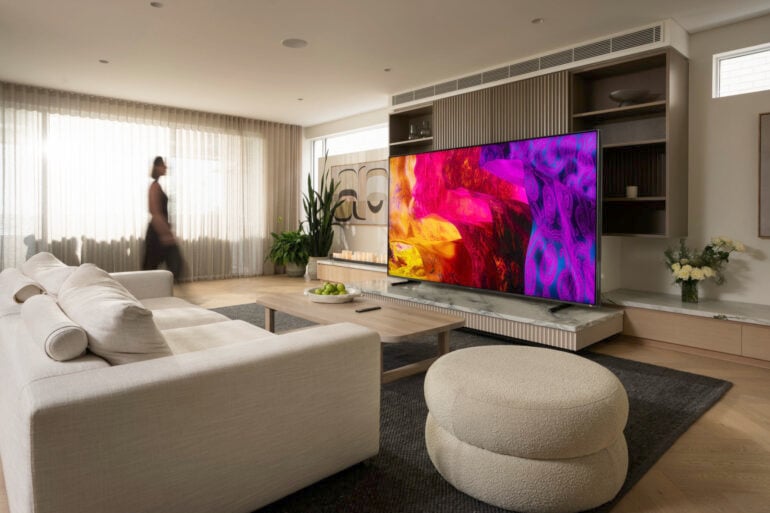
Last week, when Hisense announced its 2026 range of TVs coming to Australia, the new RGB technology rightfully took all the attention. It’s fresh and exciting, bringing an emerging technology at an approachable price point. However, buried in the spec sheets was an eyebrow-raising design change: reducing the number of HDMI ports from four to three.
When reviewing the mid-range Hisense U7QAU TV last year, I expressed great relief that it included four HDMI 2.1 ports. Previous TVs in the range had four ports, albeit only two that supported the higher-bandwidth HDMI 2.1 standard. This was a boon for gamers, who rely on HDMI 2.1 connectivity to play games at 120Hz refresh rates or higher.
While HDMI 2.1 remains a core feature of Hisense’s TVs, the number of overall ports is set to reduce. As seen in the technical specs of the upcoming UR9S model, which starts at $3,999 for the 65-inch version, only three HDMI ports are included.
It’s not uncommon for lower-priced TVs to have three or fewer HDMI ports. For $4,000 TVs — like the latest Samsung OLEDs or LG’s flagship models — however, four is generally the norm.
When asked about the change, a Hisense spokesperson explained that the company has “shifted from 4 to 3 HDMI ports, which is complemented by the addition of a USB-C port on the left side.”
“This enhances overall versatility and future-proofs connectivity, supporting multiple formats such as DisplayPort, USB-C to HDMI, and USB-C to VGA.”
This USB-C port is also mentioned on the UR9S’ product page, advertised as supporting file sharing, displaying content in 4K at up to 165Hz, and able to charge devices at 10W speeds. A more detailed spec sheet on Hisense’s website doesn’t specify the exact details of the port, other than a mention of ‘USB 3.0’.
For some, the lack of a fourth HDMI port may prove a hindrance. Across modern video game consoles and soundbars, those ports can fill up quickly. In some instances, the port reduction can be offset by soundbars that support HDMI passthrough. This means plugging an input, like a games console or a Blu-Ray player, into a compatible soundbar, which then passes the signal through to the TV via one HDMI port.
Conversely, the addition of USB-C will make it easier to connect laptops, with many recent portable PCs favouring Thunderbolt-certified USB-C slots instead of HDMI connections. Either way, it’s a change that might take some adjusting to.
GadgetGuy has asked Hisense to clarify the bandwidth of the new USB-C port and which TVs the three-HDMI design applies to.
The post Hisense cuts TV HDMI ports to 3, but adds high-speed USB-C appeared first on GadgetGuy.


0 comments:
Post a Comment