
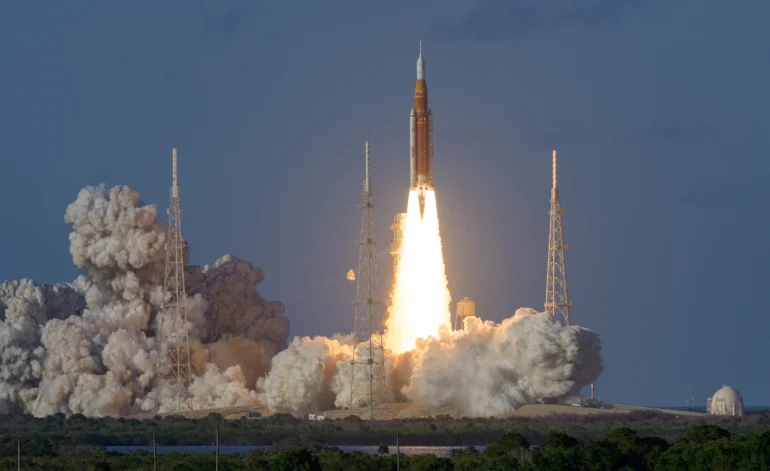
Artemis II lifted off from Kennedy Space Center on 1 April 2026, carrying NASA astronauts Reid Wiseman, Victor Glover, and Christina Koch alongside Canadian Space Agency astronaut Jeremy Hansen. The crew is travelling on a free-return trajectory around the Moon and back, targeting a distance record that will put them further from Earth than any human has ever been – roughly 252,000 miles beyond the lunar surface. They don’t land, but that’s not really the point for this mission. This is a test of the Orion spacecraft and its systems with a live crew, paving the way for an actual lunar landing mission in 2028.
How to watch Artemis II live from Australia
NASA+ and YouTube: free 24/7 live coverage
The simplest starting point. NASA is running 24/7 coverage on its YouTube channel throughout the entire mission, with live commentary, telemetry data, and video feeds. NASA+ carries highlights coverage of key moments including the lunar flyby, far-side pass, and splashdown being the ones to bookmark. Search for “NASA” on YouTube and hit subscribe, or go to plus.nasa.gov.
The Artemis mission blog at nasa.gov publishes rolling written updates at every major milestone. Useful if you want quick facts without sitting through a stream.
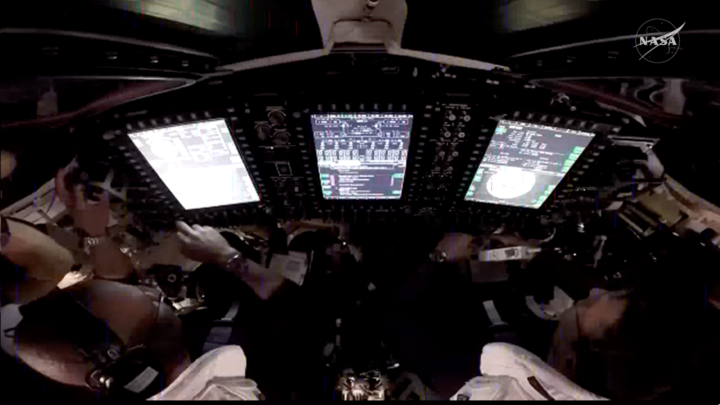
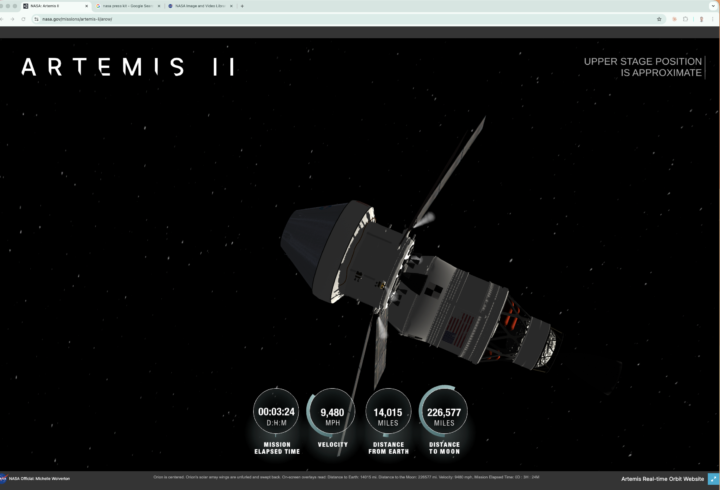
How to track Artemis II in real time: NASA’s AROW orbit tracker
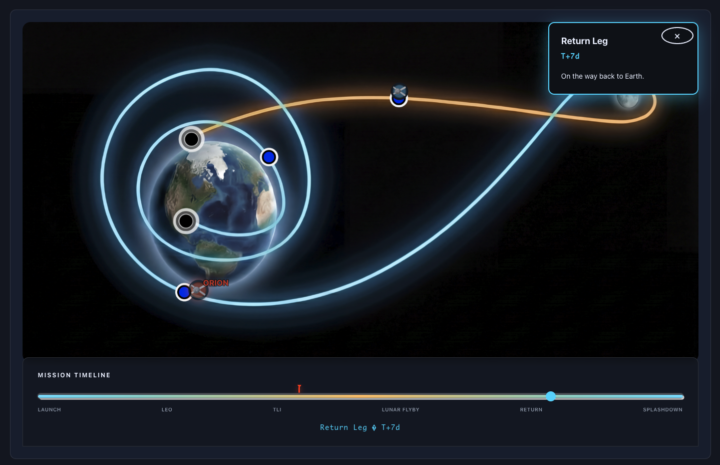
This is the coolest one. NASA’s Artemis Real-time Orbit Website (AROW) lets anyone track exactly where the Orion capsule is at any moment with stats like distance from Earth, distance from the Moon, mission elapsed time, and current trajectory. The data feeds directly from sensors on the spacecraft via Mission Control in Houston, updating continuously from around one minute after launch through to reentry.
On desktop, the Unity 3D engine provides views of Orion from multiple camera angles, including from cameras mounted on the spacecraft’s own solar arrays. (Although there may be a bug right now as I can’t seem to access all views).
On the NASA app (iOS and Android), there’s an augmented reality layer where you can point your phone at the sky and it shows you exactly where Orion is relative to your location. That feature activates roughly three hours into the mission.
Best Artemis II tracking websites in 2026
Several independent developers have built their own dashboards that are genuinely good.
artemislive.org uses NASA JPL planetary data to display the free-return trajectory and live spacecraft telemetry in a clean 3D view.
artemistracker.com links directly to the NASA stream alongside its own 3D Orion timeline.
jasperbernaers.com/artemis-ii-tracker adds crew profiles, a full mission timeline, and a live space weather monitor showing solar radiation data. This is relevant because the crew is beyond Earth’s protective magnetosphere for much of the mission.
Keep in mind that some of these sites may still be updating with the latest Atremis II info.
Watch Artemis II through a telescope: live from Earth
The Virtual Telescope Project is tracking Orion from Earth and streaming it live on YouTube. It’s an unusual experience as you are actually watching a crewed spacecraft move across the sky as a point of light in real time. Search “Virtual Telescope Project Artemis II” on YouTube.
If you own a Unistellar smart telescope, the company is running a citizen science program where your scope automatically tracks and records the spacecraft using live ephemeris data from NASA.
Artemis II photos and mission updates: where to find them
NASA is releasing crew-uploaded images daily via images.nasa.gov, processed and published as they come in. NASA’s accounts on X and Instagram will push alerts at each major milestone throughout the mission.
Artemis II mission schedule: key dates and events to watch
The lunar flyby and far-side pass are the emotional high points of the mission. I’m stoked to witness the moment the crew gets a view of the lunar far side that no human has seen with their own eyes since Apollo! Splashdown in the Pacific wraps the mission around 11 April. All times will be published on the NASA Artemis blog closer to each event.
The post Artemis II launch 2026: how to watch and track the Moon mission in real time appeared first on GadgetGuy.


0 comments:
Post a Comment