This is default featured slide 1 title

Go to Blogger edit html and find these sentences.Now replace these sentences with your own descriptions.

This is default featured slide 2 title

Go to Blogger edit html and find these sentences.Now replace these sentences with your own descriptions.

This is default featured slide 3 title

Go to Blogger edit html and find these sentences.Now replace these sentences with your own descriptions.

This is default featured slide 4 title

Go to Blogger edit html and find these sentences.Now replace these sentences with your own descriptions.

This is default featured slide 5 title

Go to Blogger edit html and find these sentences.Now replace these sentences with your own descriptions.

Tuesday, 3 February 2026

Tech’s biggest safety feature is largely ignored, but it shouldn’t be

Tech’s biggest safety feature is largely ignored, but it shouldn’t be

Keeping children safe online is a complex topic. Australia’s contentious social media ban is seen as one piece of the puzzle, but it only scratches the surface of protecting children’s digital lives. Alarmingly, parental controls, one of the biggest tools dedicated entirely to that mission, remain vastly underused.

Countless apps and devices provide parental controls in some form, allowing families to curate age-appropriate experiences across different platforms. Managing screen time limits, blocking access to inappropriate content, and disabling unknown contacts are among the common settings housed under the parental controls banner.

However, research shows that many parents don’t use these tools. A 2025 study commissioned by Snapchat found that 57 per cent of Australian parents don’t use in-app or online parental controls.

Similarly, only 51 per cent of US parents use parental controls on tablets, dropping to 47 per cent on smartphones, according to the Family Online Safety Institute (FOSI). FOSI’s data also shows that the adoption rate of parental controls reduces further across PCs, TVs, and video game consoles.

The eSafety Commissioner’s 2022 Mind the Gap report found that 59 per cent of parents set rules about when children can go online, but only 43 per cent use parental controls to filter online content.

These statistics beg the question: why is the use of parental control features so low? A perception of difficulty is a big one, according to Dr Joanne Orlando, an author and researcher in digital wellbeing.

“A lot of parents think it’s in the way too hard basket, ‘there’s too many steps’, ‘I don’t really understand’, it’s that kind of thing,” Dr Orlando said. “And family life is so busy that, amongst that, the idea of taking what they probably think is two hours to read the manual is too hard.”

Dr Joanne Orlando presenting at Apple briefing
Dr Joanne Orlando presented at a recent Apple briefing. Image: Supplied.

Making parental controls easier

“Not a huge proportion” of parents use the family safety settings on offer, Dr Orlando added, agreeing with the existing research.

“There is an uptake, but I think if we can make [parental controls] really simple, two or three steps, and then they get that protection that they need.”

Some tech companies are trying to make it easier to make child-friendly experiences during the setup, reinforcing Dr Orlando’s belief that using parental controls is “not as complicated as you might think”.

Apple prompts users during the setup stage of its devices to input an age range, which automatically provides some out-of-the-box protections for children. Likewise, Google also supports child accounts on Android devices, providing a similar level of protection.
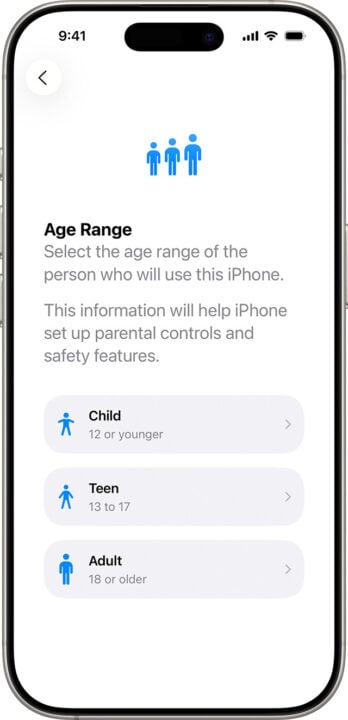
iPhone setup Age Range
Image: Apple.

There’s also a myth encountered by researchers that parental controls are only useful for young children, that they quickly outgrow the limitations placed upon them. But that’s not what the experts say.

“What [parental controls] can do is they’re this amazing space that you can actually teach your children about safety,” Dr Orlando said.

The researcher — who previously argued for social media literacy education, as opposed to an outright ban — suggested that parents use device settings as a prompt to teach kids about digital safety. Instead of setting blocks and limits and walking away, she recommends explaining to children why the limitations are in place.

Shedding the “terrible guilt”

With how quickly technology changes, there’s also an element of parents feeling guilty about not knowing how to protect their children’s digital lives.

“A lot of parents always feel like ‘I’m not doing enough, I don’t know what to do’,” Dr Orlando said. “We have this terrible guilt that we’re not doing enough.”

Aside from the settings and instructions from tech companies, families can access resources, including those from the eSafety Commissioner, to stay informed about digital safety.

As long as parents acknowledge that “no one’s ever going to be 100 per cent up to date” with every technology and every risk, Dr Orlando believes that regularly checking in with children is a good place to start.

“If you keep your reading, keep trying to keep up to date a little bit, but having lots of conversations with your kids, just trying to see what they’re seeing that they think might be dangerous, start with those points and have a conversation.”

Chris Button attended a briefing with flights provided by Apple Australia.

The post Tech’s biggest safety feature is largely ignored, but it shouldn’t be appeared first on GadgetGuy.


Huge 100TB hard drive is set to arrive by 2029

Huge 100TB hard drive is set to arrive by 2029

I remember using a 128MB USB drive in school and thinking that was a lot of data. Now, there’s talk of 100TB hard drives arriving before the end of the decade.

That lofty target came from Western Digital’s ‘Innovation Day 2026’, where the data storage company outlined its long-term plans. It’s on the verge of releasing a 40TB UltraSMR ePMR HDD, which will be used to keep up with the increasing demands placed on data centres by AI technologies.

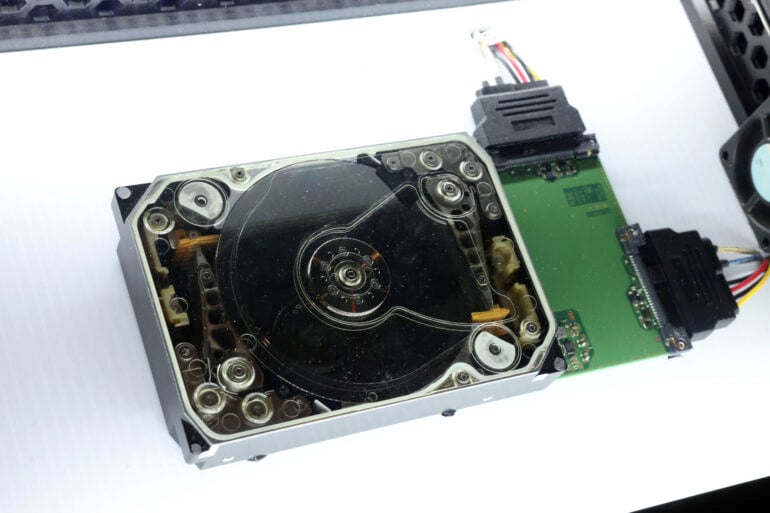
But WD isn’t stopping there. By 2029, it plans to produce 100TB hard drive technology by using what’s called “HAMR”. Short for heat-assisted magnetic recording, HAMR uses a precise laser to heat the precise location of a drive that’s being written to, which is part of a process to help increase storage density.

WD’s blog on the technology goes deep into the science, most of which goes over my head. All I can think of is how much would fit on a 100TB hard drive. Sure, such technology is only meant for enterprise-level use, but it’s fun to think about what one could do with 100TB on hand.

Using Netflix’s data rate guidelines, you could store more than 34,000 hours of high-definition video, or roughly 14,600 hours of 4K footage. Based on the recommended 80GB of storage required for Battlefield 6, you could have 1,280 copies of the game saved at the same time.

Again, that’s not what this storage would be used for, but it gives you an idea of how big 100TB is. At the moment, WD sells data centre hard drives reaching 32TB of storage. To more than triple that in just a few years is quite the feat.

The post Huge 100TB hard drive is set to arrive by 2029 appeared first on GadgetGuy.


Sleek Logitech G325 doesn’t look like a typical gaming headset

Sleek Logitech G325 doesn’t look like a typical gaming headset

Gaming headsets usually have one feature in common: a boom mic for clear audio. Some mics are retractable, while others are fixed, but they’re pretty much synonymous with gaming headsets. Not the Logitech G325, a new mid-range wireless headset that abandons the boom altogether.

Instead of a mic that protrudes outward, Logitech’s $199.95 headset uses a beamforming microphone that’s built into the earcup. While the idea of a boom mic is to get close to the mouth so it can isolate audio, a beamforming mic uses software trickery to achieve the same effect.

Logitech advertises the G325 as using built-in AI software to cut out background noise, placing the focus on your voice. In theory, your online teammates shouldn’t hear loud keyboards or the fan of a PC tower.

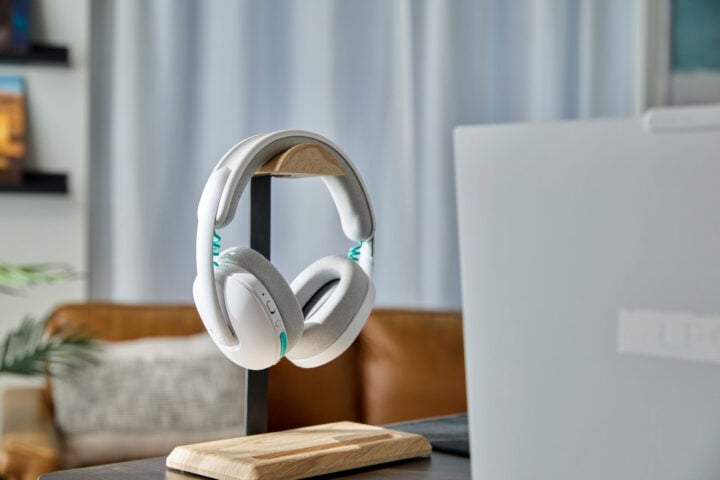
Logitech G325 headset white
If it weren’t for the colourful flourishes, you might not be able to pick this as a gaming headset. Image: Logitech.

Without the visible mic arm, the Logitech G325 doesn’t look like a traditional gaming headset, much like how the Jabra Evolve3 doesn’t look like a call centre headset without a boom mic. As a result, the G325 looks like it could be used in public without attracting too many stares from passersby.

It’s a very light headset, weighing a svelte 212 grams, with a battery life rated to last more than 24 hours at a time. It uses Logitech’s proprietary Lightspeed wireless technology and Bluetooth, making it compatible with nearly any gaming platform. However, unlike some headsets, the G325 does not support both Lightspeed and Bluetooth simultaneously.

In terms of audio, Logitech says the G325 uses 32mm drivers, supporting 24-bit audio. It’s designed to have a relatively flat EQ out of the box, but Logitech’s G Hub software supports customised audio profiles.

Available in lilac, black, and white colours, Logitech’s newest wireless gaming headset is available to order this month.

The post Sleek Logitech G325 doesn’t look like a typical gaming headset appeared first on GadgetGuy.


Monday, 2 February 2026

Reolink shows that true user-centric home security is possible

Reolink shows that true user-centric home security is possible

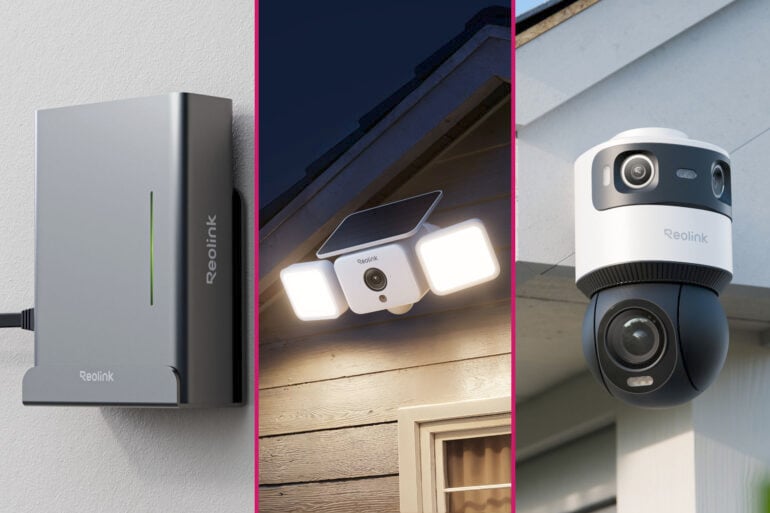
Security innovation never stops, nor should it when it comes to protecting our homes. At CES 2026, Reolink made affordable, practical, and versatile home security a focus, showing a range of new devices that make protecting your property easier.

Convenience and powerful AI features, without sacrificing privacy, were common themes. Reolink’s upcoming gear, from the brains of the AI Box, to the sheer flexibility of the new OMVI Series, aims to streamline home security for the everyday user.

There wasn’t just a sole type of user or scenario catered to: the whole home was covered, and every budget considered. Most importantly, Reolink respected individual user choice, which is the mark of a smart home brand worth investing in.

Here’s a close look at every new thing Reolink announced at CES 2026. There’s a lot to be impressed by, especially if you’re in the market for some new home security gear.

AI Box

What if you have an older Reolink device, or a camera that doesn’t come with the latest built-in AI smarts? Acting as the brain of the Reolink ecosystem, the AI Box is central to the brand’s connected smart home vision.

Rather than relying on cloud-based processing, which is often associated with costly subscription fees and potential security breaches, the AI Box handles your security system’s data locally. Not only does that enable a more secure environment, but it also cuts back on latency and reliance on external servers.

When compatible Reolink security cameras connect to the AI Box, they all benefit from high-end ReoNeura AI features, like text-based video search, and specific prompt-based alerts.

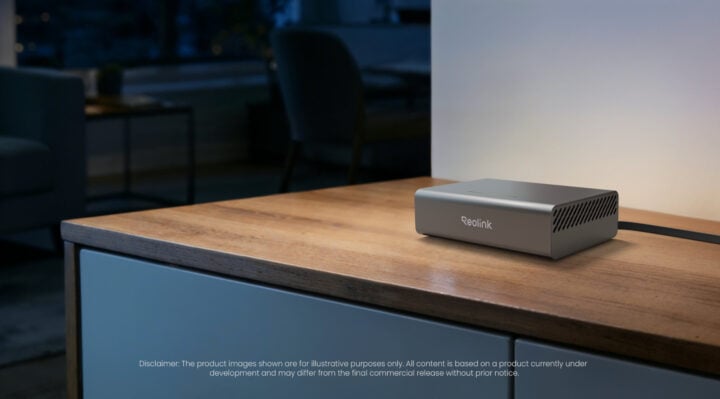
Reolink AI Box with disclaimer

These prompt-based alerts let you create your own rules, so you only receive notifications for specific actions. For example, assigning the system to notify you when “someone approaches the front door” results in more precise and context-specific alerts. ReoNeura AI takes these instructions and applies logic to reflect real-world situations, making your security system more useful.

The AI Box also adds smart features like text descriptions of events captured on footage, and smart summaries that help you identify trends at a glance. If the same person visits frequently, at the same time of day each time, your Reolink system will tell you.

All of this functionality comes from a small box, one that only needs a power connection to get started. From there, the AI Box can plug into various Reolink security cameras, hubs, and NVRs to upgrade them instantly with advanced AI features.

Powering the AI Box is the Qualcomm Dragonwing Q8 series processor, equipping it with more power and faster processing than a security camera by itself.

When it arrives later in 2026, the AI Box will be a huge upgrade for existing Reolink systems.

OMVI Series

If you thought single or dual-lens security cameras weren’t enough, wait until you see the triple-lens Reolink OMVI Series. Consisting of several different models, OMVI will be the go-to security camera range for crystal clear footage with widespread coverage.

Leading the charge is the award-winning OMVI X16 PoE, a versatile security camera that does it all. It records crisp footage, has a wide field of view, zooms in from a distance, and tracks subjects with pan and tilt motion.

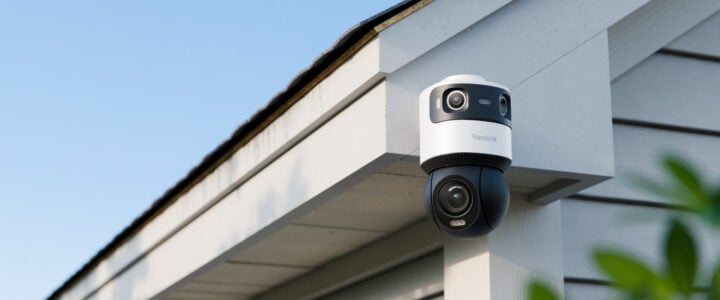
Reolink OMVI X16 PoE wide image

At the heart of the OMVI X16 PoE is a three-lens 24MP system that combines multiple perspectives to identify anything that happens on your property. For an ultra-wide view, its 16MP dual-lens camera gives a zoomed-out angle that captures a wide 180-degree field of view. To see up close, the camera’s 8MP pan-tilt-zoom (PTZ) lens can punch in up to 16x via optical zoom, which is ideal for when you need to identify an individual after an incident.

Those cameras would be great in isolation, but it’s the smart tracking that really elevates the OMVI X16 PoE. Its PTZ camera can pan a full 360 degrees, while tilting 140 degrees up and down. When the OMVI system detects a subject in the wide-angle view, the PTZ unit locks on, following them until they leave.

For particularly large properties, you can program routine patrols or sweeps via the Reolink app. This will make the OMVI scan back and forth over a designated area, ensuring nothing is missed, even if it sits outside the view of the wide-angle camera.

Due to release midway through 2026, the OMVI range, including the X16 PoE, is shaping up to be the security camera that’s a jack of all trades, master of all.

Floodlight Cam series

For even better after-dark security, Reolink also introduced the new Solar Floodlight Cam at CES. As its name suggests, it shines a light on potential intruders, while keeping charged from the sun during the day.

It doesn’t need external power, nor is it merely a small light attached to a camera. Accompanying this 2K security camera is a set of 1,000-lumen floodlights that records clear footage and wards off trespassers.

Reolink Solar Floodlight Cam at night

Reolink’s Solar Floodlight Cam lasts up to three months on a full battery. But, thanks to its solar panel, you should be able to get continuous use from just an hour of sunlight each day.

Like much of Reolink’s range, the Solar Floodlight Cam saves footage locally, supporting up to 512GB via a microSD card. There’s no expensive ongoing subscription just to access your footage here.

With the addition of the solar model, Reolink has even more choice when it comes to floodlight security cameras. It joins the Elite Floodlight WiFi and TrackFlex Floodlight WiFi cameras as an affordable option for any home that needs illuminating.

Power-efficient series

No one wants to waste time charging batteries. Nor does anyone want to think about when they’ll next have to swap out a device’s batteries.

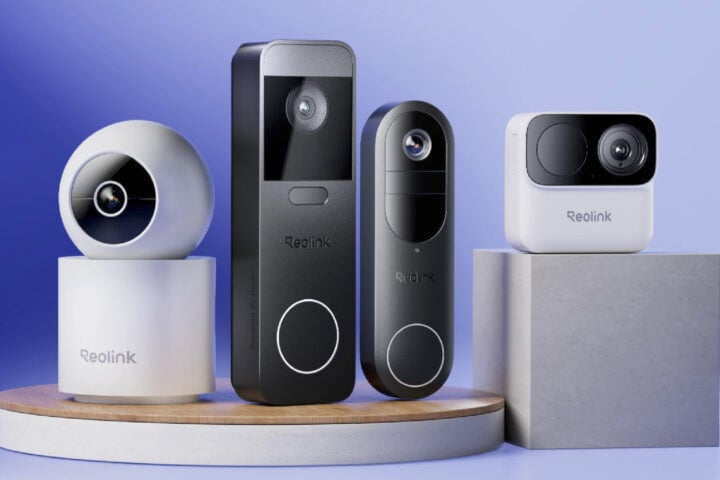
Reolink’s approach? Simply make a series of devices that barely requires any power to run at all. At CES, Reolink showed several highly power-efficient security gadgets, including the Argus MagiCam, E1 Swift, 2nd Gen Video Doorbell, and Video Doorbell SE.

Reolink micro-power Wi-Fi security range

Most of the devices last up to nine months of standard use — roughly five minutes of daily use on average — on a single battery charge. Or, in the case of the Video Doorbell SE, those nine months come courtesy of just four AA batteries — nothing fancy required.

Behind the big power efficiency gains is the Qualcomm Micro-Power Wi-Fi QCC730 processor. It’s a chip that uses a special low-powered type of Wi-Fi technology, significantly reducing the power consumption.

These power-efficient devices are set to be affordably priced, so keep an eye out for launch details.


Visit Reolink’s Australian website to keep up with the new home security range arriving locally this year.

The post Reolink shows that true user-centric home security is possible appeared first on GadgetGuy.

Sunday, 1 February 2026

Quad Lock has a backpack now, aims to keep your gadgets dry

Quad Lock has a backpack now, aims to keep your gadgets dry

We love Quad Lock here at GadgetGuy. It’s always good to get behind Australian-founded companies that make good gear. Quad Lock’s phone accessories and mounts are among the best out there. So, when it recently announced a backpack, it warranted a closer look.

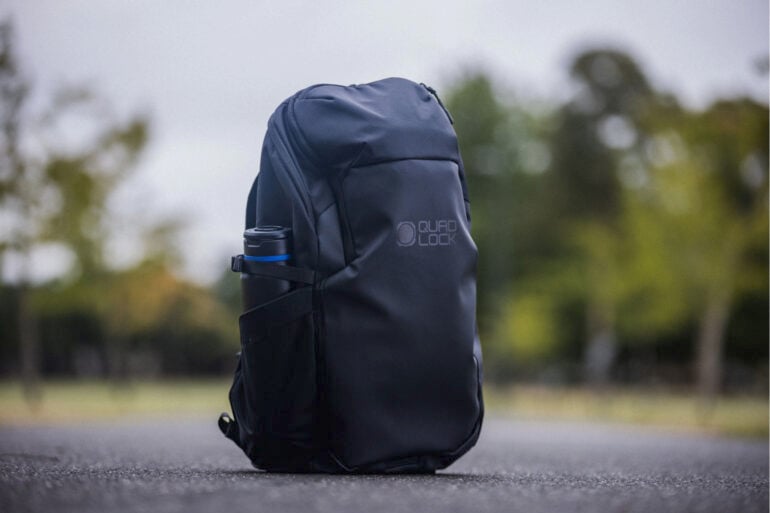
Quad Lock teamed up with Swedish company Thule for the backpack, an accessory with a 26L capacity and all the straps, pockets and pouches you’d expect. In Australia, the backpack retails for $199.99, which isn’t cheap by any stretch.

So, what does that nearly $200 get you? According to Quad Lock, a backpack that’s breathable, rugged, and weather-resistant. It’s designed for everyday commuters, with most of the promotional imagery showing bike riders wearing the accessory. Makes sense, given the brand’s big focus on cyclists and outdoor activities.

Considering that outdoors-y positioning, the weather-resistant claim is the most interesting. Quad Lock advertises the backpack as using “rugged 900D materials”. This refers to a dense polyester fabric that’s commonly used in outdoor gear, largely because of its water-resistant properties.

Alongside the reference to 900D materials, Quad Lock’s press release also mentions a “DWR finish”. An acronym that stands for durable water repellent, the finish is designed to make water bead down the material, instead of getting absorbed. It’s not waterproof, as such, but it should defend against a drizzle or a light shower.

Within the backpack, there’s a dedicated laptop sleeve that can fit up to a 17-inch PC. Quad Lock says the sleeve is padded, made to protect your tech. Perhaps this sleeve, combined with the water-resistant materials, could’ve helped me avoid a waterlogged MacBook last year. Oh well, it’s too late to know now.

There doesn’t appear to be anything on the backpack that latches onto Quad Lock’s accessories, so it’s mainly for keeping your gadgets protected and dry. It’s available to order now via the brand’s website.

The post Quad Lock has a backpack now, aims to keep your gadgets dry appeared first on GadgetGuy.

Save $50 on Boost Mobile’s annual plan and get full Telstra coverage

Save $50 on Boost Mobile’s annual plan and get full Telstra coverage

Telstra might have the most comprehensive network coverage in Australia, but you certainly have to pay for the privilege. Fortunately, a current deal from Boost Mobile makes it a heck of a lot more affordable to get Telstra-level phone coverage.

Until 9 February, you can get a 365-day prepaid Boost Mobile SIM plan for $250, down from its usual $300 price. It’s still a bit pricier than some of Australia’s cheapest long-expiry SIM plans, but it’s the most affordable way to access the full Telstra network by far.

Boost Mobile is what’s called a mobile virtual network operator (MVNO), meaning it sells phone plans by using another company’s network. It’s the only MVNO that includes access to the full Telstra network, which is measured by the percentage of the population reached. Boost Mobile’s plans are eSIM-compatible, too, meaning you don’t need to visit a store to get started.

Both Telstra and Boost Mobile reach 99.7 per cent of Australians via 4G, and 95 per cent via 5G. Meanwhile, other MVNOs that use Telstra’s ‘wholesale’ network reach 98.8 per cent and 75 per cent, respectively.

How much do you save with Boost Mobile’s deal?

For some people, that extra coverage is more than just a luxury. Rural Australians need that access, while many other plans are better suited to metro areas. However, that access comes at a price.

Telstra’s cheapest 28-day prepaid plan costs $39, while the discounted Boost Mobile plan costs the equivalent of just under $21 per month. Boost includes 290GB (roughly 24GB/month) with the first recharge, and then 240GB (roughly 20GB/month) with each subsequent recharge.

To do some quick back-of-the-napkin maths, Telstra’s cheapest prepaid plan costs at least $468 over 12 months. So, Boost’s deal saves $218 in the first year. Even at the plan’s full $300 price, that’s $168 cheaper than going with Telstra directly.

For a more like-for-like comparison, Telstra’s 365-day SIM plan normally costs $350. During the first year, you get a fairly generous 300GB of data, but each year thereafter only includes 165GB.

Either way you slice it, Boost is comfortably cheaper. It’s also a good example of how much you can save by choosing a long-expiry plan versus those with shorter billing cycles.

You can also see how the Boost Mobile deal compares to long-expiry SIM plans from other telcos via the widget below.

GadgetGuy occasionally uses affiliate links and may receive a small commission from purchased products.

The post Save $50 on Boost Mobile’s annual plan and get full Telstra coverage appeared first on GadgetGuy.


Apple could have a flip phone on the way, like the Galaxy Z Flip

Apple could have a flip phone on the way, like the Galaxy Z Flip

It’s all but confirmed that Apple has its first foldable phone on the way this year. Even though the foldable hasn’t been officially announced, a new report suggests that the company that just hit record iPhone sales already has plans to follow it up with a flip phone.

In the coming months, Apple is widely tipped to announce its debut foldable, similar in design to the well-regarded Samsung Galaxy Z Fold 7. According to Bloomberg reporter Mark Gurman, Apple is currently looking at making a square-shaped foldable phone, like the Galaxy Z Flip range or the Motorola Razr handsets.

Gurman suggests that the follow-up phone is “far from guaranteed to reach the market”, but the fact that it’s on the table indicates some level of confidence from Apple in the form factor.

That confidence likely stems from the growing demand for foldable phones across regions like China and South Korea. Samsung has done well in its home nation of South Korea with its flip phones, while the Chinese brand Honor has its own suite of foldables.

Last week, Apple announced a record-breaking quarter, totalling US$143.8 billion, much of which was driven by record iPhone sales. Services, which consist of App Store commissions, subscriptions, and advertising, also reached record highs.

Aside from iPhones, Gurman also reported that Apple is nearing its first Mac launch of 2026. Based on current stock shortages, it’s expected that a new MacBook Pro is just around the corner, likely between now and March.

The new MacBook Pro isn’t expected to radically change the form factor. Instead, it’ll mainly focus on faster internals and processing power. Apple’s heavily rumoured touchscreen variant is tipped to arrive by either the end of this year or in early 2027.

The post Apple could have a flip phone on the way, like the Galaxy Z Flip appeared first on GadgetGuy.