
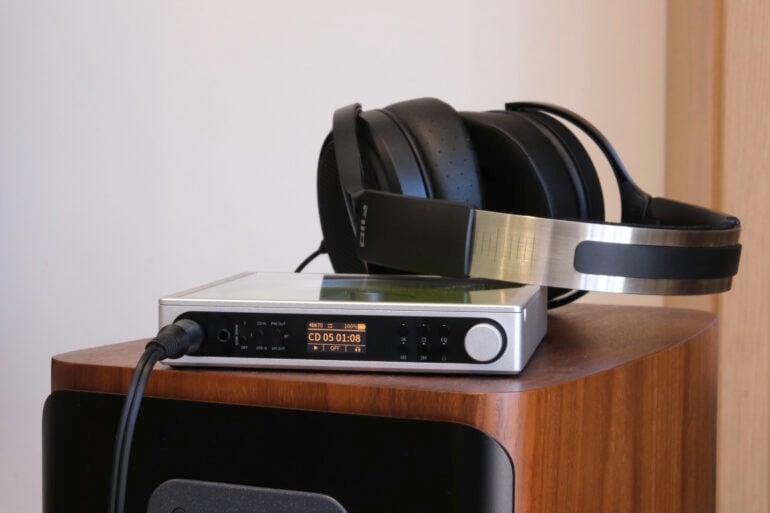
Oftentimes, we review things because they are a priority of our editors, or because they are being pushed by suppliers. But I approached FiiO for this one. I was intrigued by the DM15 R2R portable CD player. I’d previously been playing with the DM13, but it became ‘EOL’ – end of life, as it’s called – before I completed the review. And replaced by the DM15 R2R.
You see, could it be that in addition to being a portable CD player, it might also serve as a starter CD ‘deck’ for a young person keen on getting into physical digital media?
Why CDs? $1 or $2 each at a charity shop is one good reason!
Table of contents
- About the FiiO DM15 R2R portable CD player
- R2R – what’s that all about?
- Playing CDs with the FiiO DM15 R2R
- That damned exception
- Back to basics: listening with headphones
- Measurements
- The FiiO DM15 R2R as a CD Transport
- Pre-emphasis
- The FiiO DM15 R2R as a CD ripper
- The FiiO DM15 R2R as a DAC
- Who is the FiiO DM15 R2R CD player for?
About the FiiO DM15 R2R portable CD player
So, I’ve implied that the FiiO DM15 R2R is more than just a portable CD player. Here are its functions:
- Portable CD player (duh) with lithium battery, rated at 7 hours of operation with CDs, 10 hours with USB playback
- Also plays CD-R discs with compressed music files
- Supports both regular (3.5mm) and balanced (4.4mm) headphones
- Desktop CD player with both regular (3.5mm) and balanced (4.4mm) line outputs
- CD transport with both optical and coaxial digital audio outputs (coax adaptor provided for the 3.5mm socket)
- CD ripper (to USB memory sticks)
- USB DAC for Windows, MacOS, Android & iOS with support up to 384kHz 32-bit PCM, DSD256 (native) and DSD128 (DoP)
| Included accessories | IR remote control, USB-C to USB-A cable, USB-A to USB-C adaptor, Quick Start Guide, cover for transparent lid |
| Price | $439 from Australian retailers |
| Warranty | 12 months |
| Official website | FiiO |
Not bad in one compact, fairly lightweight unit. Note, as far as portable CD players go, it’s not the smallest and most light in weight. Some are barely bigger than a CD. This one adopts the form, looking from the top, of a near square, 144.2mm deep (150.6mm including the rotary volume control) by 137mm wide, and it’s 25.4mm thick. The top is a door which is held closed by magnets near the front. It weighs 473.7 grams empty. Add 17 grams for a typical CD.
The top opens fully, allowing easy access, and a shallow recess under the CD allows you to get a thumb on the side of the disc to help pull it out from the spindle clip. You are careful not to touch the CD surface, aren’t you? Yes, they’re quite robust, but not entirely impervious to damage. I have several CDs that I bought forty years ago, and they still work perfectly … because I take just a little care. The FiiO DM15 R2R helps, also, by the spindle clip holding firmly enough for operation, but not so hard that you have to bend the disc to get it off.
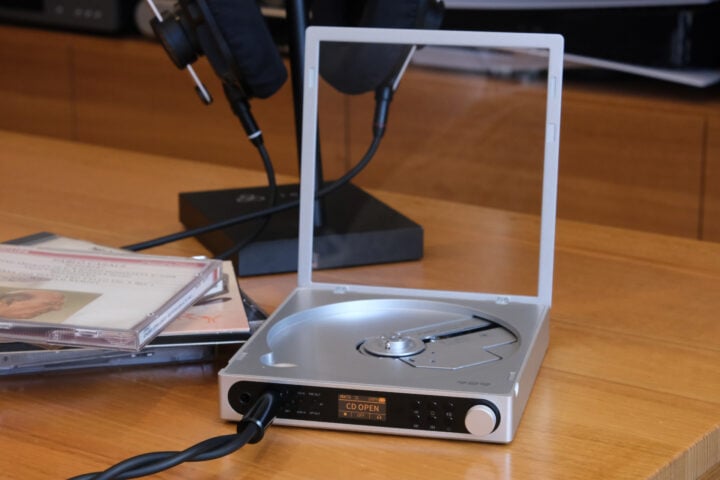
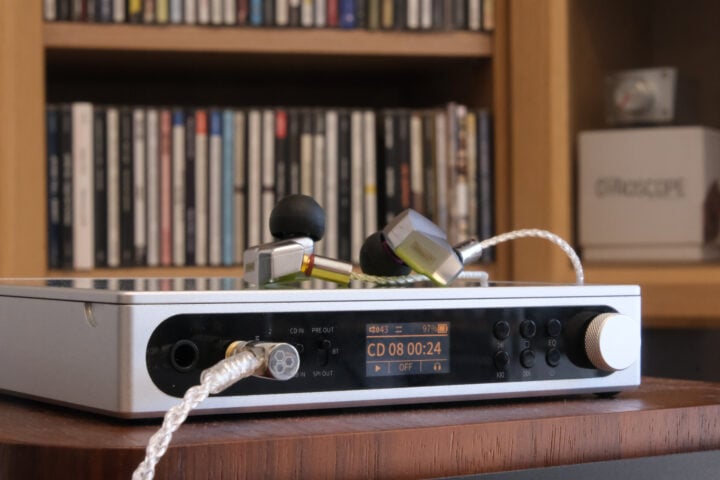
On the front edge of the unit are control buttons, switches and the volume knob, the two headphone outputs and the display. On the back are the balanced 4.4mm line output, the combo 3.5mm unbalanced line, coaxial S/PDIF and optical S/PDIF digital outputs.
Also on the back are switches for ESP mode and Desktop mode and two USB Type-C connections. ESP – Electronic Shock Protection – buffers the digital audio being read from the CD so that, in the case of physical shock, playback can continue uninterrupted while the mechanism finds its place again. FiiO doesn’t say how long the buffer is, but the previous model was specified at 60 seconds.
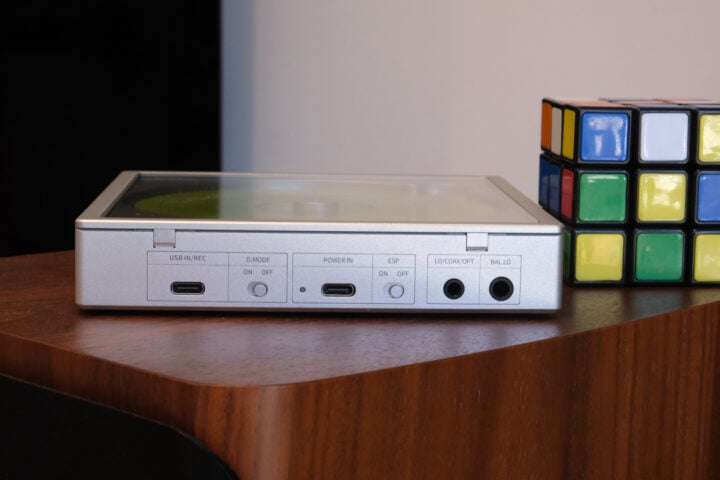
The Desktop mode makes the unit run only from external power, plugged into a USB socket. In that mode, the battery only charges if it’s at zero. The idea is to cut down on charge/discharge cycles, providing a longer healthy lifespan for the battery.
Bluetooth (v.5.4) headphone connectivity supports SBC (of course), aptX, aptX HD and aptX Low Latency, but not AAC.
The printed quick start guide included in the box is rather more informative than such things usually are, and quite elegantly written. The main manual is in the form of an online FAQ, which covers everything quite well. There doesn’t seem to be a downloadable PDF version of the full manual. There is some amusing terminology. On the Parameters page (i.e. specifications), there’s reference to a “custom bald head”. This seems to be a context-free machine translation of the Chinese for “custom optical head”. (I had to ask Grok to help me with that one!)
R2R – what’s that all about?
R2R is a hot new technology which has appeared in a lot of CD and DAC products in recent years. Well, it’s new and … old. R2R uses a resistor ladder to turn the discrete numbers in a digital signal into the discrete analogue voltage levels. After that, done properly, the analogue signal is low-pass filtered to produce a smooth analogue output ready to be sent to an amplifier.
Resistor networks were also used in the early days as well, such as in the Sony CDP-101, the first consumer CD player. But there the arrangement called for impossibly precise resistor accuracy because the resistor values had to be in exact proportion, at up to 65,000:1, just for 16 bits. Various technologies were developed to avoid this problem. The most common is delta-sigma conversion. This turns the multibit PCM stream into a higher frequency, lower bit-depth stream, which is far easier to decode. This is not to be sneered at. There are standalone DACs costing many thousands of dollars that use this technology.
Lately, it has become fashionable to return to the multibit voltage divider concept. But a new, and very clever, arrangement has been developed so that only two values are required in the resistor ladder. One value is double the other. That allows something like the accuracy of delta-sigma chips with far less mathematical manipulation of the signal. Quite a few audiophiles seem to prefer the sound of such DACs.
Playing CDs with the FiiO DM15 R2R
I used the FiiO DM15 R2R in all its many ways. That is, I used the optical output, the coaxial digital output, the single-ended line output, the balanced line output, both the unbalanced and balanced headphone outputs, and, of course, Bluetooth. That last with noise-cancelling Sony over-ear headphones, Bluetooth loudspeakers, and with a connection to a high-quality Bluetooth receiving device connected to my main stereo. A switch on the front panel selects between the output modes.
In terms of usability, it was all there. I played several dozens of CDs, including some of those aforementioned four-decade-old ones. All worked perfectly … except for one. I’ll come to that.
The front panel display is tiny – 25mm diameter – and shows orange lettering and graphics on a black background. It shows three lines: volume level, playback mode (repeat, random, etc.), battery level at the top; play/pause/stop, EQ setting and output mode on the bottom line. In larger font, the middle line shows information about the content. With a CD that’s track number and time in track. With a digital input via USB, that’s digital audio format (PCM or DSD) and sampling frequency.
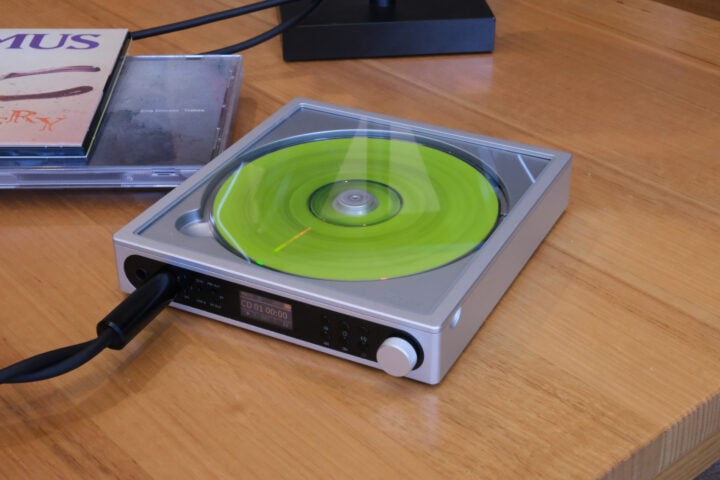
The press buttons on the front for things like play/pause, stop, skip and so on are tiny! But the DM15 R2R comes with a small IR remote control, which makes things much easier. This works well from two or three metres away, so that helps very much in the unit’s Desktop function.
What I loved, though, was the rotary volume control. To be clear, it’s digital, but you can spin it rapidly to raise or lower the volume.
That damned exception
The CD player would not play one track on one of my CDs. I’ve had the CD for approximately forever, and it has never been a problem. And indeed, I checked with my Cambridge Audio CD transport, my Oppo and Panasonic Blu-ray players and a couple of computer disc transports, and it was fine.
The disc was Henry Purcell’s Music for Queen Mary (Erato ECD 88071). The first nine tracks are a selection of lovely, jaunty birthday tunes for the good queen’s birthday in 1694, while the last seven are sombre ones for her funeral the following year. When “See Nature, Rejoicing”, the final birthday track, finishes, the display briefly shows “10” for the following funeral March (famous from A Clockwork Orange), and then instantly skips to track 11. It doesn’t search or struggle; it just skips. Fortunately, the March is played again as the last track, still…
I hate puzzles like this. Was there something special about that particular CD? I grabbed another 17-track CD from my shelf and played it. No problem with track 10. I used the freeware ImgBurn to clone the Purcell CD onto a CD-R. It played the March at track 10 without the slightest problem. I stopped it partway through and popped in the original CD. The player restarts the last-played disc at the position where it was stopped. The cloning was sufficiently good that the FiiO thought that the original disc was the CD-R copy and started playing in the middle of track 10 at the place I’d stopped it. When I skipped back to the start of the track, it resumed its previous behaviour: showing “10” briefly than skipping straight to “11”.
So, I suppose that was a one-off to do with some physical aspect of the disc which other players ignore. Or perhaps it’s the firmware. The behaviour was identical with the DM13.
On the good side, the electronic shock protection seemed to work well. At a couple of points, I did manage to interrupt play, but only because I was shaking the unit so vigorously the CD popped off the spindle!
Back to basics: listening with headphones
Let’s face it, most people are going to plug headphones or earphones into one of the front sockets and never bother with the other functions of the unit. So I did a lot of listening in just that way. The IEMs (in-ear monitors) I used were: Sennheiser IE 300, Audiofly AF-180 Mk 2 and Final Audio B3. For headphones, I used Focal Elear, Sennheiser HD 535, Oppo PM3, FiiO JT7 (review forthcoming) and Final Audio D8000 models. Except for the PM3s, the headphones are all open-back models, the first two dynamic and the last three planar magnetic.
To make sure I wasn’t imagining things too much, I also plugged the balanced 4.4mm line output of the DM15 R2R into the 4.4mm line input of an iFi Zen CAN headphone amplifier (which I enthusiastically reviewed for Australian HI-FI four years ago), which I level-balanced as closely as possible. And then from time to time, I switched the headphones from one to the other. Especially the Final Audio D800 headphones, which I used for final, critical listening.
So, what did I hear?
I started with the CD-EP Bastard Son/Holiday from Australian group George. As a totally independent recording from 2000, at the start of the period when, with a computer and a few thousand dollars of gear, one could record at home decent sound, this is a lovely, if naïve, disc. It’s that naivety – and the great songs – that make this a good test CD. There’s little dynamic compression, little overall processing. And with the FiiO DM15 R2R, there was a first-class transparency to all of this. I could hear all that was in the recording, without qualification.
So I turned it up, especially the track “Holiday” which brought to the attention of the world Katie Noonan’s amazing voice. Jumping the headphones between the Zen and the DM15 R2R revealed almost no difference. If you demanded that I make a choice, I’d say that the ifi ZEN CAN was very slightly cleaner, keeping things more orderly at very high levels. Maybe. There was almost nothing in it.
And remember, throughout this, the FiiO DM15 R2R was running off its battery. The ifi ZEN CAN was running off the mains, using the optional low-noise power supply.
For a very different style of music, I went to the 1971 King Crimson album Islands (not the so-called HDCD version). This had me winding up the volume to 88/99. “The Sailor’s Tale” includes a unique Fripp guitar solo over drums that are recorded not as mere accompaniments, but integral parts of the music. When they fully kick in, the full body of the music is revealed, unimpeded by the headphone amplifier within the DM15 R2R. The CD player was entirely comfortable in this delivery.
Which brings me to Lorde’s latest album, Virgin. I popped it in after the King Crimson without remembering to reduce the volume level, so it was still at 88/100. I imagine most of us are aware that recent (2025 in this case) releases tend to be normalised to a higher level than old stuff.
But Lorde remained perfectly clean (albeit a little sibilant at times – but that’s the recording, not the playback). Around a minute and a bit into the first track, the bass was not only powerful in my ears, but it vibrated the driver on the D8000 headphones so much that my right ear – the pinnae – was vibrating in sympathy!
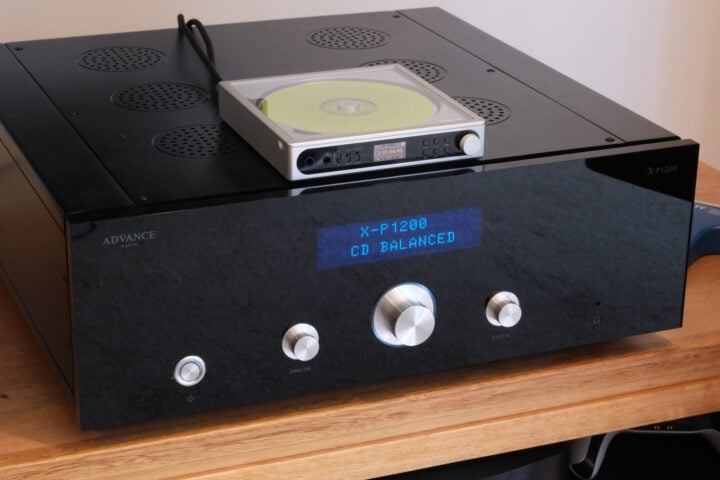
Great sound! But I purchased that CD – the almost completely transparent version of it – specifically to check compatibility, in light of recent suggestions that this disc might cause problems. Fully compatible it was. And a lot of fun. With the transparent lid of the DM15 R2R and the transparent CD, I could see the movement of the optical head… or should I say the bald head!
Another change of pace: Schubert’s String Quintet in C, featuring Pablo Casals (and Paul Szabo) on cello, recorded back in 1961. This stunning recording features an immediacy lacking from the many other versions I’ve purchased over the years. I moved to the Focal Elear headphones for this one. They’re a little brighter than the Final Audio headphones, but still nicely balanced. Being dynamic rather than planar magnetic, they have a variable impedance across the frequency spectrum. Everything, absolutely everything, was there. Prior to each movement, there’s a brief moment of the quintet prepping themselves, and I might as well have been there. The two violins were sweet, and the cello pair propelled the work forward. The ambience of the recording venue was fully delivered.
Finally, I whipped out my twin CD of Vladimir Ashkenazy performing with the LSO the five Prokofiev piano concertos. I particularly love the fifth. As with much of Prokofiev, it has an air of, well, insanity, but a madness that resolves. Again – and I switched frequently between the ifi ZEN CAN and the FiiO DM15 R2R’s own output – the dynamics were first class, as was the tonal balance. A brief surge of volume to the full 99 max kept the control intact, with inaudible distortion. Very brief, though, because the sound was thunderingly loud. (The iFi ZEN CAN went even louder. But I didn’t push that too hard out of concern for my hearing.)
Measurements
My measurement rig is only for the unbalanced output of gadgets. FiiO mentions a 2 x 1150mW output. That turns out to be balanced into a 32 ohms load, something I couldn’t measure.
But I did measure the unbalanced outputs. Into a 300-ohm load, the unit delivered 55mW per channel, which was way more than the 35mW claimed by FiiO. That means it could deliver 17dB higher than the sensitivity rating of high impedance headphones.
Into 16 ohms, it managed slightly more than 600mW per channel with the 100 hertz and 1kHz test frequencies, and 210mW with 10kHz. In the real world, that 10kHz figure is way more than required to support the 600mW at the lower frequencies. And that 600mW means 27dB above headphones’ sensitivity rating. That also exceeds FiiO’s 575mW specification.
I measured the output impedance at 1.5 ohms. FiiO specifies it at less than 1 ohm, but either way it’s low enough that it has minimal impact on the frequency balance of the sound when using dynamic headphones.
The FiiO DM15 R2R as a CD Transport
Let’s say that you have a high-quality digital-to-analogue converter connected to your stereo, or perhaps it has a nice one built into the amplifier. Why not put the FiiO DM15 R2R into desktop mode, select S/PDIF output and use optical or coaxial digital audio for a perfect connection?
After all, that’s the job of a CD transport: grab the coding from the surface of the CD and turn it into a clean PCM stream that perfectly matches the stream originally encoded onto the CD.
Well, that’s the usual way of doing it, but FiiO has done something quite different.
Normally, I check this by recording the digital output of a full track (usually “Solid Rock” from Dire Straits’ Making Movies, the 1996 remaster) to my computer via a professional digital audio interface.
Is the recording perfect? To check, I digitally subtract a digital rip of the track from this recorded one. If only an unending sequence of zeros is left, we’d have a match.
But there was no point doing this because the recording from the digital output was obviously different. A quick measurement showed it was some two decibels lower in level. Obviously, I did a bunch of tests (such as recording the output from my CD transport) to check that the setup was okay. It was.
What was going on?
It turned out that the output stream from the FiiO DM15 R2R was not 44.1kHz, 16-bit. It was 44.1kHz, 24-bit! The unit was converting the 16-bit number space (65,000+ levels) to 24-bit (16.7+ million levels) and lowering the level a bit to provide a bit more headroom. It ought to be able to do that with absolutely no loss of resolution.
But it was doing more than that. The Dire Straits track suffers a little from that 1990s remastering, which was the early days of the loudness wars. To make music sound louder on, say, a jukebox or the radio, they had to raise the average level. But that often meant that the peaks had to be dynamically compressed. Digital audio has a hard limit at the top.
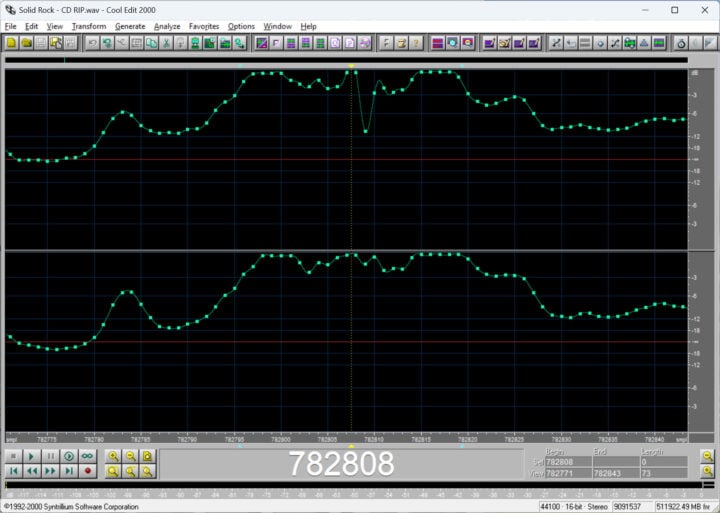
A close comparison of the original digital from a rip and the output of the FiiO DM15 R2R showed that where a couple of samples were right at the top in the 16-bit original, indicating a crushing of the dynamic range, the new 24-bit version would attempt to reconstruct a peak which may have been squeezed out by processing.
For example, here’s one such segment in the original:
And here’s the version served up by the DM15 R2R:
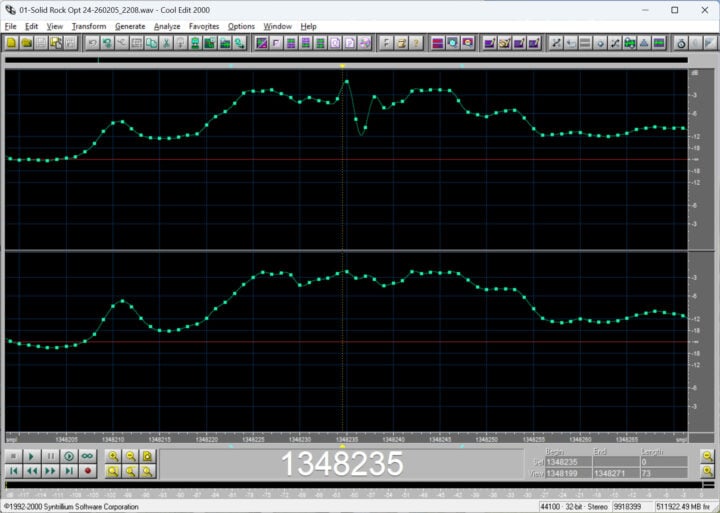
I’m ambivalent about this. The audio purist in me says: just serve up the data, damn it, to the DAC. After all, you might have a DAC that processes the signal better than the DM15 R2R.
On the other hand, this might actually improve the sound with the great majority of DACs.
The main advantage of this is reducing what are called “intersample overs”. The explanation is highly technical, but what it boils down to is where you have those samples up near the hard limits of the CD, a delta-sigma DAC, which boosts the sampling frequency, may well generate illegal values, introducing distortion.
I certainly wouldn’t hesitate to use the FiiO DM15 R2R as CD transport to feed a high-quality DAC. I checked it with an insane test signal (11,025kHz sine wave, -2dBFS). Instead of hitting a brick wall at what would have been 0dBFS, the digital output was a perfect sine wave that peaked at 1dB higher than the former 0dBFS. That’s way worse than a worst-case scenario.
And this whole thing gives us a bit of an insight into what it’s doing to the signal internally before feeding things to its analogue outputs. I checked the analogue sine wave output with this test signal on an oscilloscope, and it was perfect.
Pre-emphasis
One final note on performance. Back in the early days of the CD, engineers were worried that with the hardware then available, there might be excessive noise. So the CD was specified to optionally include “pre-emphasis”. That was a significant boost to the treble prior to the analogue sound being converted to digital. The relevant CD carried flags in its data section marking the tracks which were so treated. On playback, the CD player would see the flag and apply a “de-emphasis” filter to reverse the boost. That reduction in treble would reduce any noise as well.
The FiiO DM15 R2R does not see the flag, nor does it pass it through to any downstream DAC to act upon. So if you have one of the very few early CDs with pre-emphasis, it will likely sound bright. This is a widespread issue with modern equipment.
The FiiO DM15 R2R as a CD ripper
The CD ripping function, though, was absolutely bit-perfect. I ripped the Dire Straits CD to a USB stick and checked out “Solid Rock”. It was a bit-perfect match for my existing CD rip, and a recording from my Cambridge Audio CD transport, and the online TIDAL version, and the online (now lossless!) Spotify version. So that shows that the CD mechanism is perfectly capable of reading the contents of the CD without error.
You can’t select specific tracks: you start it, and the whole CD gets ripped, with tracks titled TRK1.WAV, TRK2.WAV, etc, into a RIP folder. The process operates in regular play time, and you can listen as it’s going. If you rip another CD onto the same memory stick, its tracks are titled TRK1~0.WAV, TRK2~0.WAV, etc.
Incidentally, when I ripped the Purcell disc, all seemingly worked fine, including the Funeral March. But that particular track turned out to be just 13/1000s of a second long, containing nothing but noise.
At this point, I will note that we at GadgetGuy do not encourage CD ripping.
Oh, one caution: do not use the USB-A to USB-C adaptor with your USB stick. It doesn’t work. It only seems to work for using with phones. I used a third-party adaptor with no problems.
The FiiO DM15 R2R as a DAC
So, if FiiO has included a fancy DAC in the DM15 R2R, why limit it to CDs? Indeed, using the supplied cable, you can plug it into a USB-C phone and suddenly get great sound out of the phone. Or you can plug it into a computer.
I tested it with my Samsung Galaxy S25 phone and a Windows 11 notebook computer. It worked brilliantly with both. Initially, I didn’t bother downloading and installing the FiiO drivers on the computer. I just told my player software (JRiver Media Center) to output to the FiiO via WASAPI, and everything worked perfectly, up to 384kHz PCM and DSD128 (via DoP protocols). If you install the FiiO drivers, you can send DSD natively rather than via DoP, which allows decoding of DSD256. If you have such files. I have three for testing, but it’s really hardly worth the bother.
Who is the FiiO DM15 R2R CD player for?
The FiiO DM15 R2R CD player is incredibly versatile. It played everything apart from one track on one CD. It is comfortable in both its portable and in-system modes. If you’re using it at home in desktop mode, you’ll keep the internal battery in good nick for years.
If you’re getting into CDs, this unit provides excellent sound out of the box when matched with good headphones, and can be the main CD source for a quality in-home audio system.
The post FiiO DM15 R2R CD player review: Long live physical media appeared first on GadgetGuy.


0 comments:
Post a Comment