
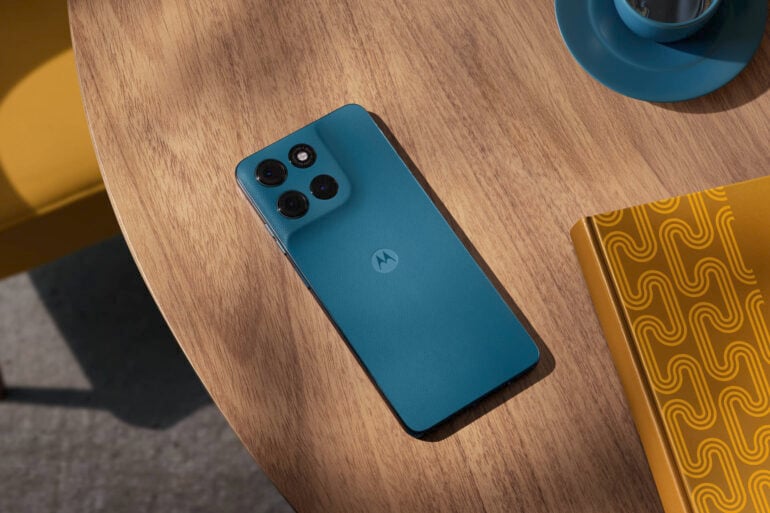
Almost identical to its predecessor, yet significantly worse in a few key ways, the Motorola Moto G57 is one to avoid.
As technologies mature, it’s only natural that each new release becomes evolutionary rather than revolutionary. When it comes to smartphones, you don’t expect leaps and bounds – each year’s new model is typically only an iterative upgrade on its predecessor.
Motorola’s broad range of handsets has been a pretty good example of this over the years, which is why it’s a surprise to see that the new $299 Motorola Moto G57 fails to make any headway on last year’s $299 Motorola Moto G56. Actually, it’s a major step backwards in terms of ruggedness, expandability and software support, which simply isn’t good enough.
Table of contents

Motorola Moto G57 first impressions
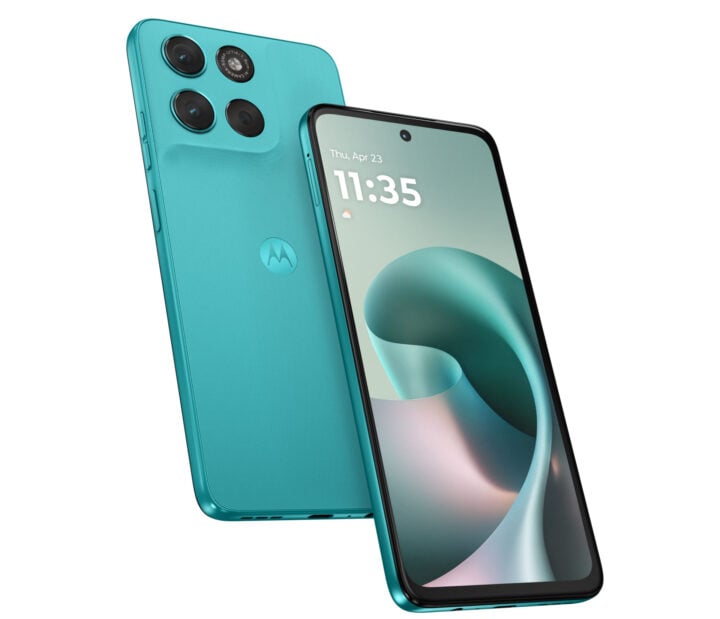
Apart from the fact that it comes in a new range of fancy Pantone colours, the Motorola Moto G57 is indistinguishable from last year’s Moto G56. In turn, the G56 offered a few improvements on the old Moto G55, as it did on the Moto G54.
The new Moto G57 sticks with a 6.7-inch, 20:9 aspect ratio to ensure it’s tall but not too unwieldy. It’s still a plastic frame with a vegan leather back.
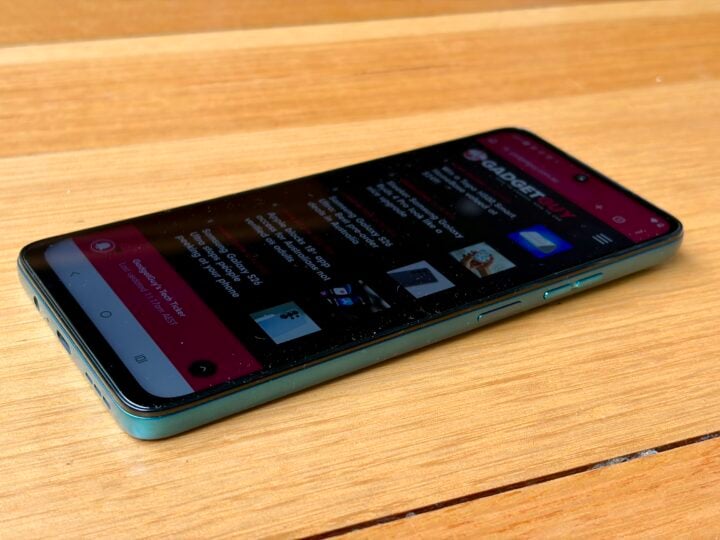
It retains the Moto stock standard configuration of a well-placed power button on the right, incorporating the fingerprint reader, with volume buttons above.
The SIM card slot remains on the left, supporting one nanoSIM and one eSIM, but you lose the added advantage of microSD support for expanding the onboard storage.
Look closer, and it’s the same 2400 × 1080-pixel LCD panel, although it now boasts a High Brightness Mode of “up to 1050 nits”. This is only a smidgen brighter than the Moto G56’s 1000 nits, but still not enough to support HDR watching Netflix.
The rear camera is still dual lens, with the same 50 MP Sony main shooter that still lacks optical image stabilisation. It’s accompanied by an 8 MP ultrawide, along with a depth sensor and flash. Around the front, the selfie camera remains 32 MP.
Across the bottom of the handset, Moto G57 sticks with USB-C 2.0 30 W TurboPower charging, with no AC charger in the box. You’ll also find an old-school 3.5 mm headphone jack.
Motorola still includes a basic transparent protective case, while sticking with Corning Gorilla Glass 7i and MIL-STD 810H6 ruggedness.
One major disappointment is that it abandons the Moto G56’s IP68/IP69 design, which could survive a serious dunking and blasts from high-pressure water jets. Instead, the Moto G57 dials it back to IP64, which means it’s only splashproof and less likely to survive misadventure.
Motorola Moto G57 specifications and price
| Display size | 6.7-inch, 20:9 aspect ratio |
| Display resolution | 2400×1080 pixel, 391 ppi |
| Display technology | LCD 8-bit colour Refresh rate: 120 Hz8 Touch sampling rate: 120 Hz Water Touch High Brightness Mode: up to 1050 nits Display Colour Boost |
| Bands | 2G GSM, 3G WCDMA, 4G LTE, 5G Sub-6 |
| Chipset | Qualcomm Snapdragon 6s Gen 4 (4nm) Mobile Platform with 4×2.4 GHz Cortex-A78 + 4×1.8 GHz Cortex-A55 |
| GPU | Adreno 710 |
| Rear cameras | 50 MP Sony – LYTIA 600 sensor f/1.8 aperture 0.8 µm pixel size Quad Pixel Technology for 1.6 µm Quad PDAF |
| 8 MP Ultra-wide angle (119.5° FOV) f/2.2 aperture 1.12 μm pixel size Fixed Focus |
|
| Front camera | 32 MP f/2.2 aperture 0.7 µm pixel size Quad Pixel Technology for 1.4 µm |
| RAM | 4 GB LPDDR4X RAM expandable up to 12 GB with RAM Boost |
| Onboard storage | 128 GB |
| microSD slot | No |
| SIM | 1 Nano SIM + 1 eSIM |
| Charging | USB-C port (USB 2.0) 30W TurboPower |
| Battery | 5200 mAh |
| Wi-Fi | Wi-Fi 5 – 802.11 a/b/g/n/ac 2.4 GHz | 5 GHz Wi-Fi hotspot |
| Bluetooth | 5.1 |
| Operating system | Android 16 |
| Security | Fingerprint reader Face unlock ThinkShield for mobile Moto Secure |
| Ruggedness | IP64 Water-resistant design MIL-STD-810H2 Corning Gorilla Glass 7i |
| Dimensions | 166.23 x 76.50 x 7.99 mm |
| Weight | 192.4 gm |
| Colours | Pantone Regatta Pantone Fluidity Pantone Corsair |
| Price | $299 RRP |
| Warranty | 2 years |
| Official website | Motorola Australia |
Features
The Moto G57 ships with Android 16 and minimal bloatware thanks to Motorola’s Hello UX. Yet when it comes to operating system updates, you get none. Nada. Zip.
That’s right, Motorola offers absolutely zero Android OS updates. At least it still throws in 2.7 years of bi-monthly security updates and a two-year warranty, but you miss out on the security and feature improvements of Android 17, which you’d get from other smartphone makers, even at this price range.
In comparison, Samsung’s similarly-priced Galaxy A17 gets an impressive six years of operating system updates and six years of security updates. Meanwhile, the Oppo A5 5G receives three Android OS updates and six years of security patches.
Keep in mind, Motorola’s lack of OS updates for the Moto G57 is not a technical limitation of the hardware; it’s a business decision. When Motorola restricted the last batch of budget Moto handsets to only one Android OS update, it told me the decision was “based on value proposition” rather than a hardware issue.
Reducing its support obligations to zero OS updates and downgrading the ruggedness are presumably some of the ways that Motorola has managed to avoid a price increase from last year’s G56.
It’s a shocking way to treat customers and puts them at unnecessary risk, considering that budget handset buyers almost certainly intend to hang on to their phone for more than 12 months. They’re also likely to be less tech-savvy users who are more vulnerable without software updates.
Looking under the bonnet uncovers one of the Moto G57’s few hardware changes, with Motorola swapping out MediaTek silicon for Qualcomm. It has also switched the IMG BXM-8-256 GPU for the Qualcomm Adreno 710. These sound like a step up, but wait until you see the benchmarking results before you get too excited.
Meanwhile, you’re still limited to 4 GB of physical RAM, although it’s now expandable up to 12 GB with RAM Boost, rather than 8 GB. As for onboard storage, you’ve still got 128 GB, but the SIM card slot no longer accepts a microSD card for expanding that.
When it comes to bands, the Moto G57 supports Australia’s sub-6 GHz 5G networks but not faster millimetre wave 5G, as you’d expect at this price point. It’s accompanied by Wi-Fi 5 and Bluetooth 5.1.
To keep things chugging along, you’ve got the same 5200 mAh battery, which should easily be able to go for 24 hours before recharging if you don’t push it too hard.
If you’re looking around online, don’t get the Moto G57 confused with the Moto G57 Power, which packs a much bigger 7,000 mAh battery but isn’t offered in Australia.
Quality
The switch from MediaTek to Qualcomm silicon has been a mixed blessing, with Geekbench 6 results of 1,002 single-core, 2,733 multi-core and 1,798 GPU OpenGL. That’s a slight step down from the G56’s 1,039 single-core, but a step up from its 2,304 multi-core (the G56 wouldn’t run the OpenGL test).
| Device | CPU single-core | CPU multi-score | GPU (OpenCL) |
|---|---|---|---|
| CMF Phone 2 Pro | 1,010 | 2,992 | 2,497 |
| Moto G86 Power | 1,044 | 2,960 | 2,061 |
| Moto G57 | 1,002 | 2,733 | 1,798 |
| Moto G56 5G | 1,039 | 2,304 | N/A |
| Nubia Focus 2 5G | 878 | 2,068 | 1,525 |
| Oppo A5 Pro 5G | 783 | 1,988 | 1,412 |
| Oppo A5 5G | 778 | 1,925 | 1,348 |
| Moto G24 | 411 | 1,405 | 549 |
| Moto G06 | 404 | 1,346 | 955 |
| Moto G15 | 399 | 1,342 | 950 |
All that is enough to muddle through simple day-to-day tasks, but the handset does feel a bit sluggish at times.
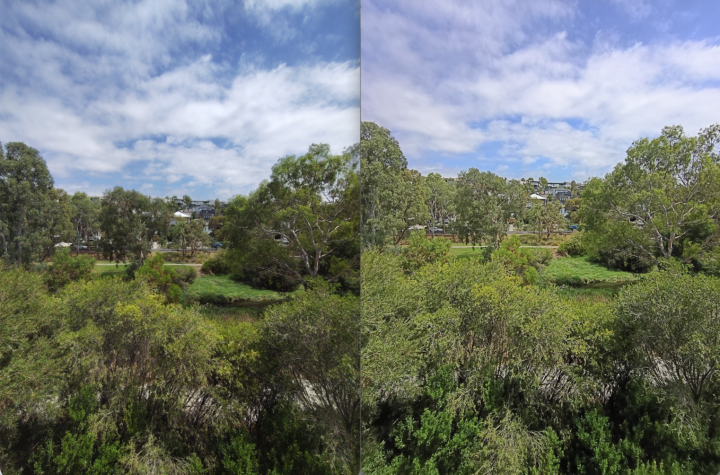
It’s a similar story when it comes to photography. The results are mediocre, although somehow a slight improvement on the old Moto G56 I dug out of its box (which is still running Android 15).

Who is the Motorola Moto G57 for?
While Motorola can be commended for avoiding a price rise, cost-cutting measures mean the Moto G57 is less rugged, less expandable and less supported than its predecessor. Of all these shortcomings, it’s hardest to forgive providing zero Android OS updates, and hopefully, there is enough pushback that Motorola is shamed into doing better next time.
Last year, it felt like the mediocre $299 Moto G56’s primary job was to make the $499 Moto G86 Power look fancy and the $199 Moto G35 feel affordable. This time around, it feels like the mediocre $299 Motorola Moto G57’s job is to see how much Motorola can strip away and expect people not to notice.
The post Motorola Moto G57 review: A step backwards appeared first on GadgetGuy.


0 comments:
Post a Comment