
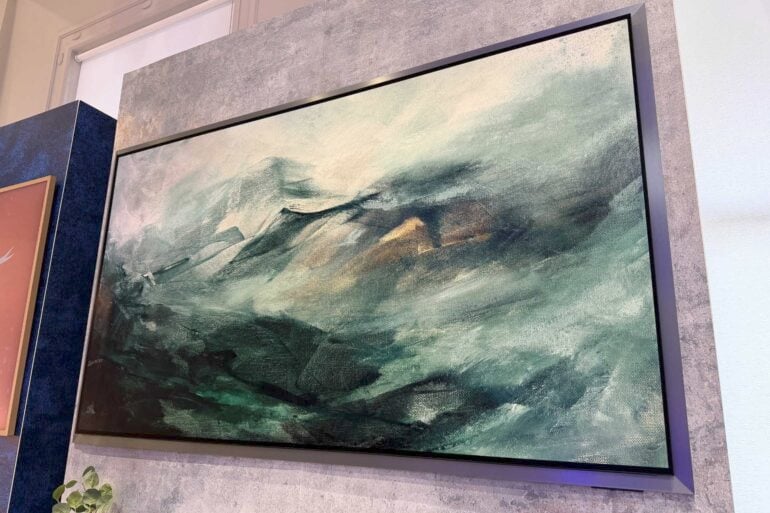
Samsung has declared 2026 the year of no TV glare in Australian living rooms. Of its newly launched TV range, more models are equipped with the brand’s “Glare Free” coating than in previous years, bringing the technology to a lower price.
Samsung previously confirmed that more of its OLED TVs would include the company’s proprietary anti-glare technology — a feature previously only included on its most expensive TVs — but it hasn’t stopped there. According to Samsung, its 2026 Australian range consists of 50 per cent more Glare Free TVs than last year’s range.
Rather than the glossy look seen on most TVs, Samsung’s coating is made to diffuse light. So, instead of clearly seeing the light of the sun or a lamp bouncing back at you, the panel gently spreads the light out to the point of being barely noticeable. The technology in its current form, independently certified by Underwriters Laboratories, debuted with Samsung’s S95D OLED TV in 2024, with only a few sizes and models using the coating.
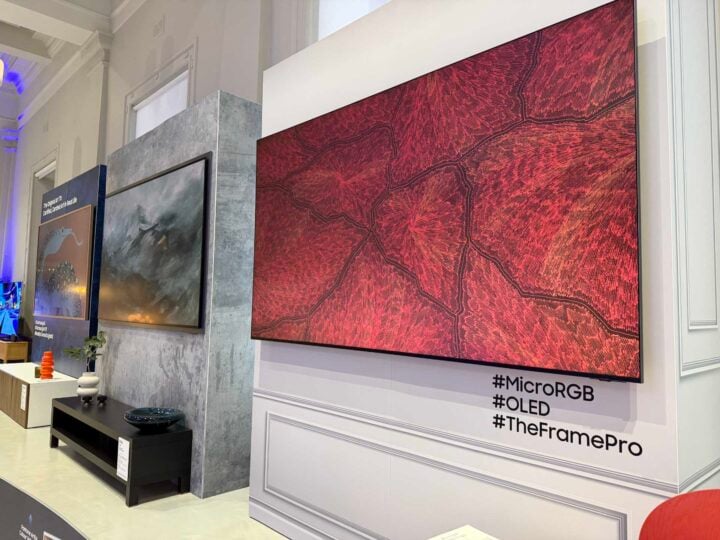
While OLEDs stand to benefit from glare-reducing technologies more than most — they’re usually dimmer than TVs with dedicated backlights — most of Samsung’s Micro RGB and The Frame TVs also get the anti-glare coating this year.
More TVs with the coating means it’s available at more affordable price points. The cheapest Glare Free-certified TV from Samsung is $1,299 for the 43-inch size of The Frame. It’s followed by the $1,999 42-inch S90H OLED.
Samsung’s explanation for the focus on glare is decidedly local: Australia gets a lot more sun than many other countries. Aussies’ larger rooms, preferences for bigger TVs, and the country’s long daylight hours were cited as reasons for bringing out more displays that can tackle light.
Other brands have different ideas about how to combat glare and reflections. For example, Hisense’s modus operandi for years has been to make brighter TVs backed by Mini LED backlights. This year’s LG OLED TVs, on the other hand, rely on a light-absorbing triple polariser technology instead. While Samsung has its fair share of bright backlit TVs, it’s resolved to stamp out reflectivity at the source.
Does Samsung’s Glare Free tech make a difference?
On paper, the idea of a screen capable of preventing glare seems nice. Surely there’s only so much you can do to stop a TV from being a black mirror that shows you at your most unflattering, right?
It’s not until you see a side-by-side comparison that the effect of Samsung’s efforts becomes apparent. At a recent launch event for the brand’s TVs, two OLEDs sat next to each other in a simulated lounge room. One was this year’s new S90H, which has Samsung’s Glare Free coating; the other was last year’s S90F, which does not have the coating.
Let’s show some comparison photos. To start with, here’s a snap that shows both TVs running a gaming showreel simultaneously.
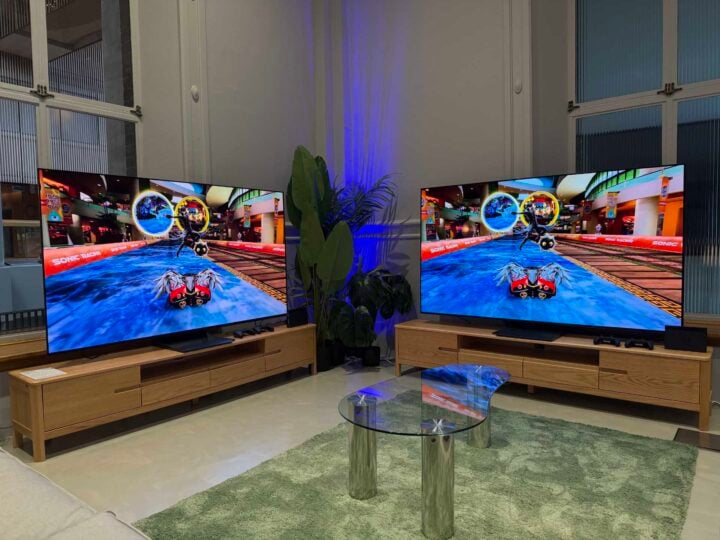
Notice anything? Both TVs look bright and vibrant, and the busyness of Sonic Racing makes it tricky to compare the pair. If you look at the top left corner of the S90F, you can see the reflection of a nearby lamp over the darker part of the image.
Let’s make the comparison a bit easier. Here’s what both TVs look like when turned off.
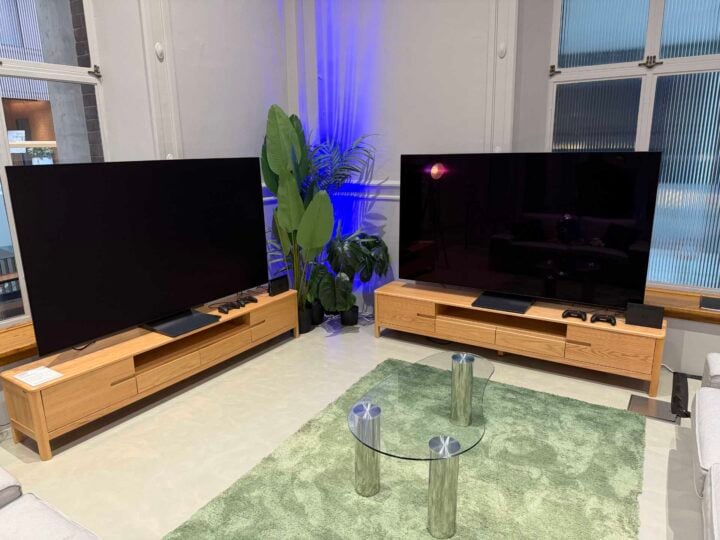
Not only can you see the lamp clearly on the S90F, but you can also see the reflections of the couch opposite it. As for the S90H? Nothing. Samsung’s simulated open-plan living room had light sources positioned everywhere, so one TV wasn’t given an unfair advantage over another.
To give both TVs a fair shot, let’s level the playing field and sit right in front of each one. Starting with the S90F:
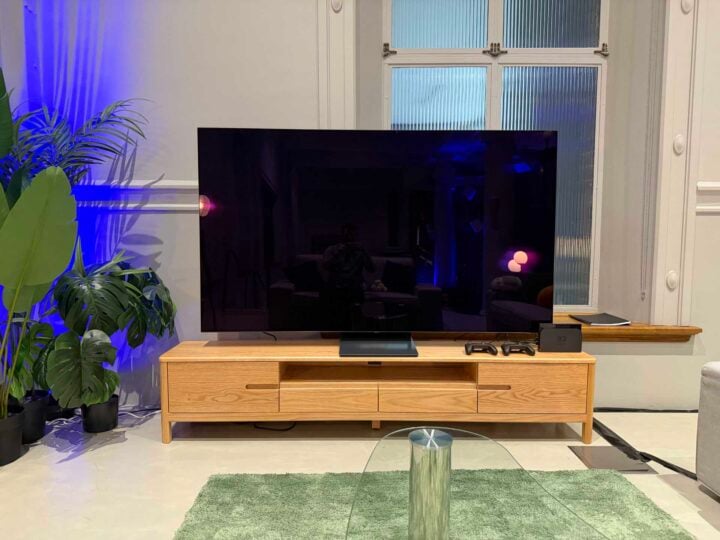
What about a front-on view of the S90H?
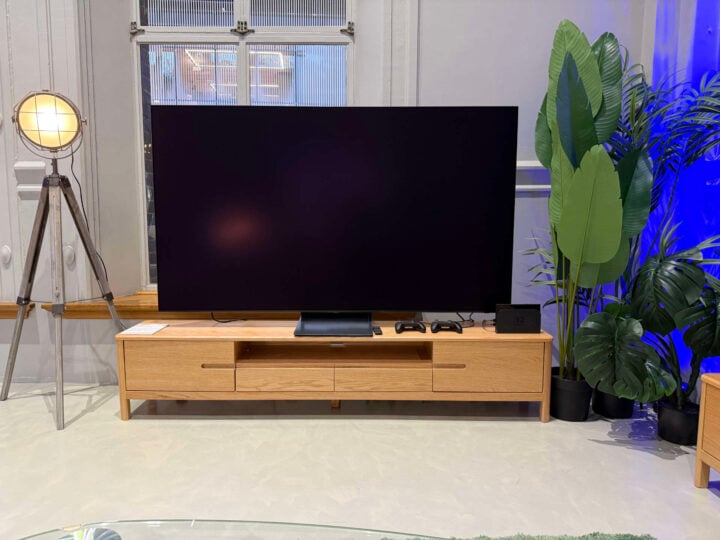
As the photo shows, the TV doesn’t entirely eliminate light or reflections. Samsung hasn’t yet figured out how to defy the laws of physics, after all. But you can see the light diffusion at work, and the moment you turn on the TV, the soft glow of that lamp is rendered practically invisible. It’s an impressive sight.
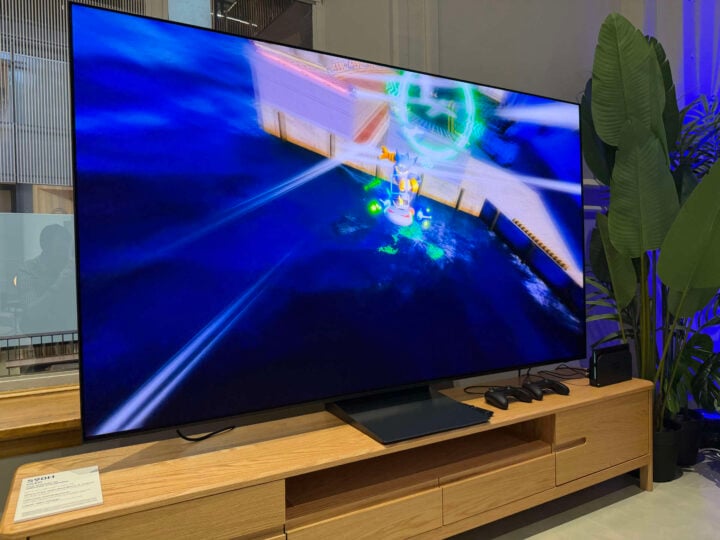
But what about fears that anti-glare technology interferes with a TV’s black levels? To the naked eye, I sure as hell couldn’t notice a difference.
Taking these photos with a phone makes reflections and glare look more prominent than they do in real life. Still, it’s a strong indicator of how much of a difference Samsung’s Glare Free coating makes when compared to TVs without the technology.
Samsung 2026 TV and home audio range prices
Although focused on the big-ticket items, Samsung hasn’t forgotten about the cheaper end of the market. Its cheapest TV starts at $749 for the 43-inch U9000H 4K Crystal UDH, while the large 98-inch variant of the same model costs $3,799.
Samsung’s 2026 TVs are available online and in Australian retailers starting now. Here’s how much each one costs:
Crystal UHD U9000H 4K Smart TV
- 43-inch: $749
- 50-inch: $899
- 55-inch: $999
- 65-inch: $1,299
- 75-inch: $1,699
- 85-inch: $2,499
- 98-inch: $3,799
Mini LED M70H 4K TV
- 43-inch: $749
- 50-inch: $899
- 55-inch: $999
- 65-inch: $1,299
- 75-inch: $1,699
- 85-inch: $2,499
Neo QLED QN80H 4K TV
- 50-inch: $1,599
- 55-inch: $1,799
- 65-inch: $2,199
- 75-inch: $2,999
- 85-inch: $3,999
- 100-inch: $6,999
The Frame 4K TV
- 43-inch: $1,299
- 55-inch: $1,799
- 65-inch: $2,199
- 75-inch: $2,999
- 85-inch: $3,999
The Frame Pro 4K TV
- 55-inch: $2,499
- 65-inch: $3,199
- 75-inch: $3,999
- 85-inch: $4,999
S85H OLED 4K TV
- 48-inch: $1,999
- 55-inch: $2,499
- 65-inch: $3,299
- 77-inch: $4,499
- 83-inch: $6,499
S90H OLED 4K TV
- 42-inch: $1,999
- 48-inch: $2,399
- 55-inch: $3,999
- 65-inch: $3,999
- 77-inch: $5,499
- 83-inch: $7,499
S95H OLED 4K TV
- 55-inch: $3,999
- 65-inch: $5,299
- 77-inch: $7,999
- 83-inch: $9,999
Micro RGB R85H 4K TV
- 55-inch: $2,499
- 65-inch: $3,299
- 75-inch: $4,299
- 85-inch: $4,999
- 100-inch: $12,999
Micro RGB MR95F 4K TV
- 65-inch: $5,299
- 75-inch: $7,999
- 85-inch: $9,999
- 115-inch: $41,999
Chris Button attended a launch event in Sydney with flights provided by Samsung Australia.
The post Samsung’s glare-free TVs are more affordable than ever in Australia appeared first on GadgetGuy.


0 comments:
Post a Comment