
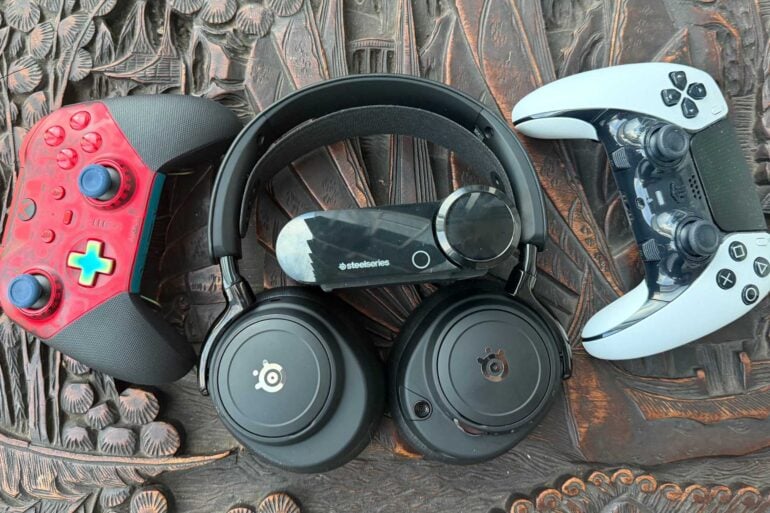
I am a huge fan of SteelSeries headsets, to the point that they’re all I’ll use when I’m not reviewing other headsets. The Arctis Nova Pro range is hugely expensive, but it’s also absolutely excellent. So, I was ecstatic when SteelSeries announced the Arctis Nova Elite. That’s because it sounded like it was going to be like the Arctis Nova Pro, but with Hi-Res audio and better drivers. With a price tag of $1,349 and those specs, I assumed it would be a wireless audiophile headset, which is, frankly, the dream.
However, in the eight months that I’ve used it, it hasn’t lived up to my hopes. At this price, roughly $600 over the next most expensive gaming headset from a mainstream brand, it would have to be perfect, and it just isn’t.
Table of contents
- First impressions
- Specifications and price
- Music
- Gaming
- Microphone
- Noise cancellation
- Comfort
- Who is the SteelSeries Arctis Nova Elite for?
First impressions
My first impression was just of how premium this headset feels, and it would want to. It’s heavier than the Nova Pro wireless I’m used to, but not unpleasantly so. It just accentuates the more premium materials.
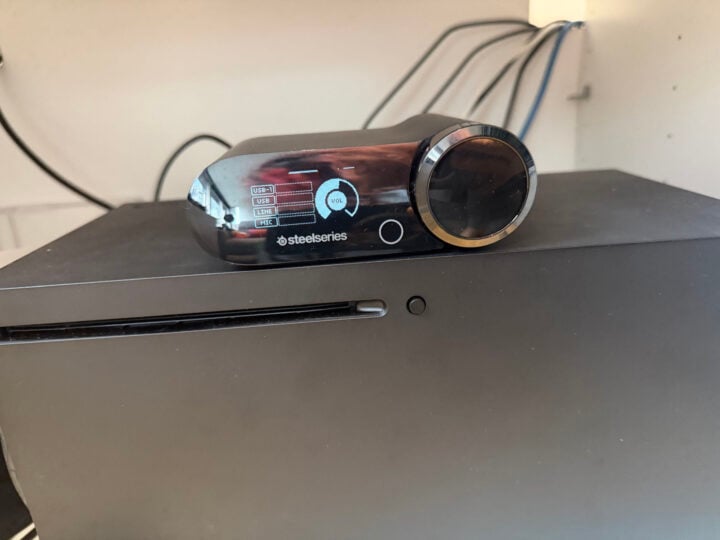
Set up was easy, but not plug-and-play. Before I could use the headset with my Xbox, I had to plug it into a PC to update the firmware. But then that also meant I could see which game profiles were available in the Sonar app to enhance the playing experience, and there’s a huge variety. There’s something to cover almost every type of gamer.
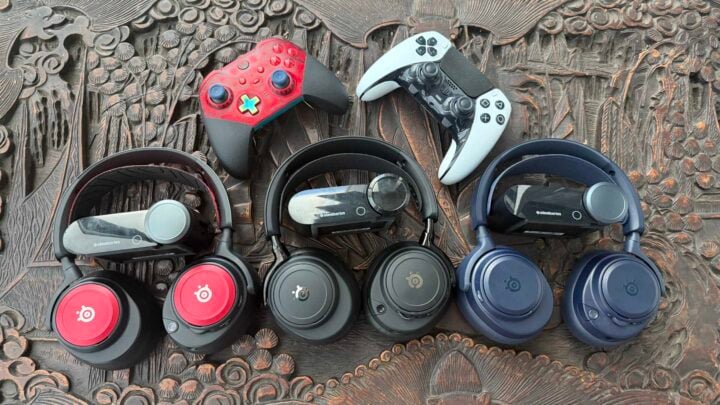
I also want to call out the hot-swappable second battery. This is probably the best feature of the fancier SteelSeries Arctis Nova headsets. The battery lasts for ages, but then when it runs out, you just take the spent battery out of the headset, swap it over with the fully charged one in the DAC, and then charge the empty one in the DAC until you’re ready for the changeover.
SteelSeries Arctis Nova Elite specifications and price
| Drivers | 40mm Carbon fibre drivers |
| Headphone Frequency Response | 10-40,000 Hz |
| Headphone Impedance | 38 Ohms |
| Battery Life | Infinite Power System – 2x hot-swappable batteries with 60 hours (30 hours per battery) |
| Weight | 380g – headphones |
| Price (RRP) | $1,349 |
| Warranty | Two years in addition to your Australian consumer law rights |
| Official website | SteelSeries Australia |
I’m still marvelling at that battery life number. 30 is a lot of hours, and with the hot-swappable battery it also doesn’t really matter unless you lose the second battery. But even then, the battery is relatively cheap to replace.
It also needs to be called out that this was the first mass-market wireless Hi-Res audio headset when it launched. Gamers, I love that for us.
Music
Ordinarily, I would put the gaming audio category much higher than music for a gaming headset, but I am so extremely impressed by the musical performance of the SteelSeries Arctis Nova Elite that I can’t not put music at the top.
Wireless Hi-Res audio is something that is incredibly difficult to pull off, and really only possible with the 2.4 GHz wireless connection that gaming headsets rely on. It’s not really possible over current Bluetooth connections. Pairing that with these carbon drivers, the Arctis Nova Elite is one of the best pairs of audiophile headphones I have, and certainly one of the best available under $1,500.

The soundstage is so wide, there is so little distortion, and each sound is defined. As you would expect on a gaming headset, the default EQ tends towards being bass-heavy, but it’s very easy to switch to a flatter profile in the app.
With this headset, I noticed new things in songs I have heard 1,000s of times. Right now, I have a new appreciation for the bass line in “You Outta Know” by Alanis Morissette. The stage is so wide that I feel like I’m sitting in the recording studio in the middle of the band, watching fingers move on frets and seeing the vibration of the reverb head on the bass.
Going track-by-track on my usual headphone testing playlist:
“Simmer” by Hayley Williams is rendered spectacularly. This is a song that loves space; the magic is in the quiet spaces between the notes. There is absolutely no distortion or hum beyond what’s supposed to be in the music, and it exposes how noisy some other headphones are. I can hear details on this track that I haven’t considered before – I’m pretty sure the drummer is playing with wood-tip drumsticks instead of nylon. I used to think it was nylon, but after listening on these headphones I’d bet wood with confidence. The way the sound moves in the stereo separation is far more defined on these headphones than others I’ve tried. I can pause and pick out each individual instrument. They don’t blur into one like they sometimes do on lesser headphones.
“Full Heart Fancy” by Lucky Chops is a song where the emotion really changes depending on the headphones. On the default EQ, it’s just a little bass-heavy and grounded. After switching to a flatter EQ, it’s joyous. The sousaphone soars. It’s an expression of pure joy. All the little hi-hat details shine through perfectly when they can sometimes get lost on other headphones.
“Paralyzed” by Conquer Divide: going to something a bit heavier, Conquer Divide can be a tricky band for lesser speakers because there is a lot going on, and huge contrasts. The chorus frequently devolves into a wall of noise, but here, while the recording limitations are still noticeable, I can make out the sounds of the different cymbals and separate the guitars and bass. The lead singer’s voice rings clear, and is rendered with the same detail as the deeper screaming in the bridge.
All up, there hasn’t been a single song or genre that I’ve played that hasn’t absolutely floored me.
These are the kinds of headphones that can make you fall in love and cry with songs you’d written off as being nothing, because you can hear all the depth. They’re the kind of headphones that make you fall in love with music again. The kind that makes music feel like a breath of fresh country air. I love them.
Gaming
As you would expect from the makers of the best gaming headsets, this is the best gaming headset in terms of pure audio that I have ever used. The spatial effect is perfectly rendered, and each sound is given its own, distinct space, making it easier to tell where enemies are on the map. It genuinely gives me an edge in multiplayer games like Fortnite, and makes soundscape games like Forza Horizon 6 more epic to play.
Everything I said about the music audio quality carries over to games. This is a marvel of engineering, and if it wasn’t for the next three sections of criteria, I would say this is the best and most perfect gaming headset of all time.
Microphone
This is where the SteelSeries Arctis Nova Elite falls down. The microphone just isn’t that good. It’s quieter and less clear than the Nova Pro Wireless microphone to the point that my friends will ask me to switch headsets whenever I use the Arctis Nova Elite. Talking at my normal speaking volume, my friends have to turn down their game audio down to 50% (or lower) to hear me clearly, despite me turning up the gain in the app.
I was playing with a friend the other day doing a blind A/B comparison, and they said the Elite sounded fine, a bit compressed as is normal for headset mics, and very quiet, but pretty good. Then I switched to the Nova Pro Omni, and they were like “oh wow, this is night and day; you can really tell this is the fancier headset because this microphone is so much clearer and louder”. I then had to tell them that the Omni was almost half the price and supposedly less fancy. They were shocked.
Speaking quietly so as not to wake the baby, the microphone will constantly cut out, no longer able to distinguish me from background noise, whereas my older Nova Pro Wireless doesn’t have that problem.
SteelSeries insists that this is a platform problem, or an issue because the microphone is simply better and therefore has better thresholds, so platforms will noise gate earlier. I’m guessing the built-in AI noise rejection system takes issue with the frequency of my voice.
I note that no other reviews I’ve seen have called out this issue, and that my male friends have not had this problem.
But I have tried three different Arctis Nova Elite headsets on two different PCs, two Xboxes, a PS5 Pro, a Nintendo Switch 2, two Macs and an iPhone, over Zoom calls, Teams calls, Discord, FaceTime, Forza Horizon 5, Forza Horizon 6, Fortnite, Mario Kart World, and a whole bunch of other games over eight months, talking to multiple other people on a variety of setups, and have had the same problem consistently. My wife has also had the same problem.
If this were a $500 headset, this wouldn’t be a deal-breaker. But for a $1,350 headset, I expect the best microphone possible, and the fact that there is a better, clearer microphone on a ‘cheaper’ headset by the same brand is baffling to me. SteelSeries knows how to get it right; they just missed the mark here.
Noise cancellation
This is another area where I am disappointed. SteelSeries isn’t an everyday consumer headphones brand, so I don’t expect the company to produce the best noise cancelling in the market at this point. It would be unkind to do direct comparisons to Bose, Sony and Apple given those companies have specialised in this area for many years.
However, if I’m paying $1,350 for a pair of headphones that claim they can do everything, I wouldn’t be grading them on a curve; I expect them to at least match the noise-cancelling capabilities of $550 headphones, and they just don’t. They get close. But I’m listening to music on 65% volume right now, and I can hear the clacking of my keyboard and the sounds of my family in the other room. I can hear the hum of the air purifier a few metres away.
I got my wife to try them, and she asked me to turn on the noise cancelling so she could see what it was like. The noise cancelling was already on, and she hadn’t realised through our whole conversation.
The noise cancelling isn’t completely terrible by any means. The passive isolation of the ear cups is very good, and the active cancellation is better than I would expect from SteelSeries, certainly much better than the original Arctis Nova Pro Wireless.
They also definitely have the best noise cancellation of any gaming headset I have ever used.
But if a product is going to be priced so much higher than the best-performing noise-cancelling headphones in the market, those are going to be the comparison.
Comfort
For the last piece of bad news, overall these headphones are pretty comfortable. But the weight does get onerous over time. It’s harder to wear these very heavy headphones for three-plus hours, because I get a headache.
Even after eight months, I find the clamping feeling on the sides of my head to get a bit much after a while. I do think the tradeoff for comfort is worth it for the audio quality, and it’s good to be encouraged to take breaks. But I look forward to the improvements in the inevitable second generation of the product.
Who is the SteelSeries Arctis Nova Elite for?
It is so hard to put a score and a recommendation on this headset. On one hand, based on a pure audio level, they are so incredible that I get tears in my eyes listening to pop music. Their audio quality is comparable to that of wired audiophile ear monitors I have, and these are wireless. It’s a revelation. I want to use them to play every game, and listen to every song I can think of. I love the sound of these headphones more than any pair of headphones I’ve reviewed in years.
But these aren’t just headphones, and everything else isn’t as good as headsets and headphones at roughly half the price. Because of all the issues I’ve had with the microphone, I cannot recommend them to people who play a lot of multiplayer; the SteelSeries Arctis Nova Pro Omni is a far, far better all-rounder for that. I also really wouldn’t want to use these on a plane, or travelling, or in other situations where I would want active noise cancelling or the comfort to sleep in and wear them for 12 hours+.
There is so much room to grow for the second generation, and I’m confident that these problems will be solved in version two.
If they were $900, I’d be recommending them over the Apple AirPods Max. But for $1,350, I guess they’re for rich people who don’t mind making compromises, and for anyone who wants near audiophile-quality listening, but wireless, which is an absolutely wild thing to have available in JB Hi-Fi.
The post SteelSeries Arctis Nova Elite review: Excellent headset, poor mic appeared first on GadgetGuy.


0 comments:
Post a Comment