
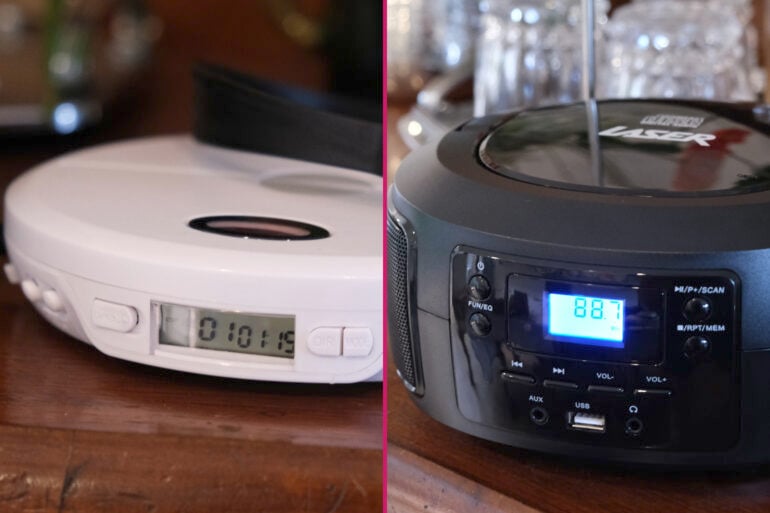
For thirty years, I’ve been writing about audio gear, almost exclusively ranging from decent to high-end. But isn’t this gear sometimes a rip-off? Why spend hundreds, or even thousands of dollars on something when you can get a seemingly similar thing for just tens of dollars?
So let’s do something that no one in the audio or hi-fi space ever does: let’s do an in-depth look at a couple of ultra-cheap CD players.
I recommend CDs highly. With modern, good-quality players, they sound great. If you buy a CD, with just the slightest of care, you’ll still own the music decades hence. And they’re cheap, especially second-hand.
But the players I usually review and use aren’t cheap. A portable player I reviewed costs over $400. My own Cambridge Audio transport CD costs a thousand dollars, and it runs through a two-thousand-dollar DAC (digital to analogue converter).
Let me say up front that I wasn’t expecting miracles from cheap gear. I anticipated it being noticeably lower in quality than the stuff I normally look at. But I expected the basics to be okay. After all, surely there are now cheap chipsets for, say, CD players that provide reasonable performance for only a few bucks to the manufacturer.
So let’s dig in and see if I’m to be disappointed.
Table of contents
- How cheap?
- The Anko Portable CD Player
- Listening to the Anko Player
- The Laser Bluetooth Boombox
- Some measurements
- Are these cheap CD players worth it?
How cheap?
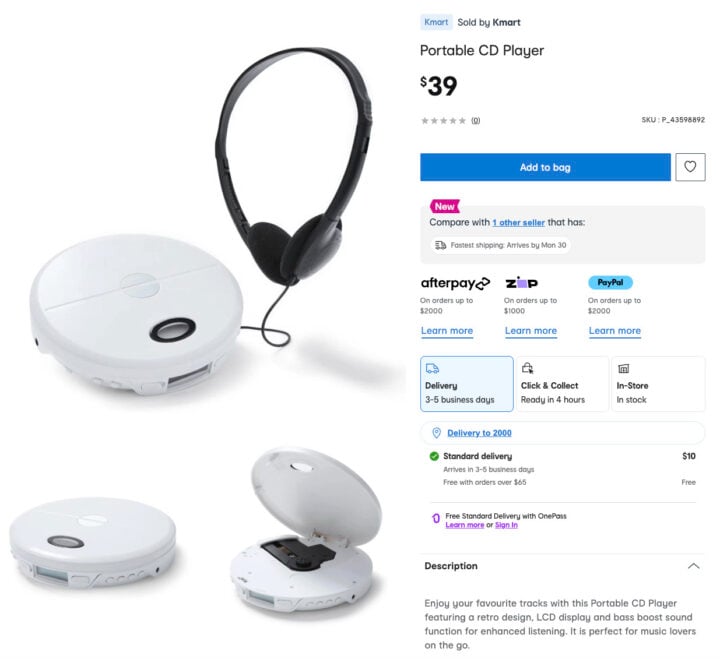
Actually, I bought two. In Kmart, I grabbed an Anko Portable CD Player, model JLR-80877. It cost $39, including ‘retro’ headphones! This thing isn’t much bigger than a CD. The barcode on the box is 9 341111 370752. I mention that, because the model number does not appear on the box, only on the slim manual. Anything I say here may not be relevant to any other Anko model.
The other is from Big W. The Laser Bluetooth CD/MP3 Boombox with FM Radio, model CDBB-BT500 (the model number is above the barcode on the box). This one is mains powered, although it can also run off four C batteries. It cost $45.
I was purposely naïve in my purchases. I did no research. I just wanted the cheapest CD players that were on offer, subject to them having a headphone or line output so I could properly measure their performance. (There were even cheaper ‘CD boomboxes’ in Big W and Kmart – $29 – but neither had such an output).
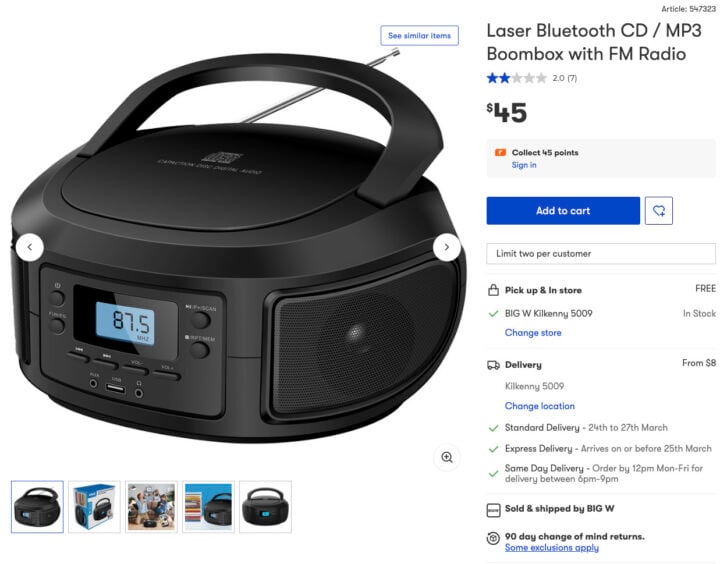
On checking now, I find that the Anko player has no reviews on the Kmart website, while the Laser one has seven, with an average score of 2/5. The complaints are mostly about it not working properly. We’ll see if mine does. The other two reviews found the sound quality inadequate, particularly with bass (‘tinny’). Who could have imagined that a $45 boom box might lack a little boom?
I, for one, assumed that the speakers would be terrible. But I’m interested, if the functions work, in how the unit works with headphones, or plugged into a quality stereo.
The Anko Portable CD Player
Anko is the house brand for Kmart and Target. I googled the model number and found it nowhere else, but presumably, it is a generic player also sold under other brands.
It’s plastic and round and runs off a couple of AA batteries (not included). There is a small window on the lid through which you can see the whirring CD, and a very small display on the leading edge. Connections consist of a 3.5mm stereo headphone output and a socket for a 4.5-volt external power supply. With alkaline batteries, it’s rated for eight hours of operation.
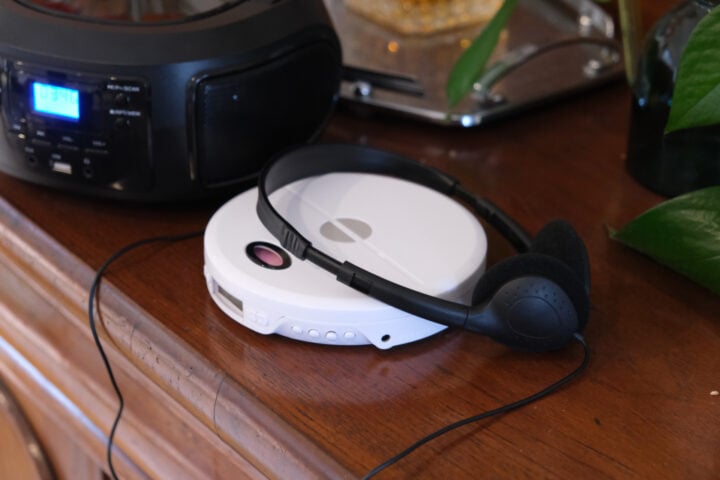
There are buttons for play/pause, stop, skip forwards and backwards (fast scanning if held), volume up and down, repeat/random mode, and folder selection for CD-R discs with MP3s. (The specs didn’t mention CD-R/W, and I don’t have any such discs to check.) There’s also a wired switch for bass boost.
The headphone output is “compatible with” 16 to 32 ohms headphones and is rated at 16mW per channel “Max Safe Output”. That doesn’t sound like much power, but for 16-ohm headphones, it’s more than provided by an iPhone 6 (back when they had headphone outputs) or a 4th-generation iPod Classic.
Listening to the Anko Player
As for the headphones, if “retro” is supposed to mean absolutely terrible, I agree. They weigh nothing, and produce a muddled, lumpy, upper bass and midrange, with no treble and no real bass. If you use this player with those headphones, you’ll conclude very quickly that you made a very poor purchase.
So I used the player with rather better headphones and earphones. Keeping in mind the suggested impedance range, I mostly used FiiO JT7 over-ear, open-backed, planar magnetic headphones, and Final Audio B3 in-ear monitors. They have impedances of 18 and 19 ohms, respectively. I also tried some of my other headphones – one pair costs two orders of magnitude more than the player – and even with moderate impedances, they generally produced enough volume.
I was genuinely interested in what I was about to hear. In theory, a cheap chipset should still produce quite reasonable performance with a CD player, but who knows what might happen in a model costing $40?
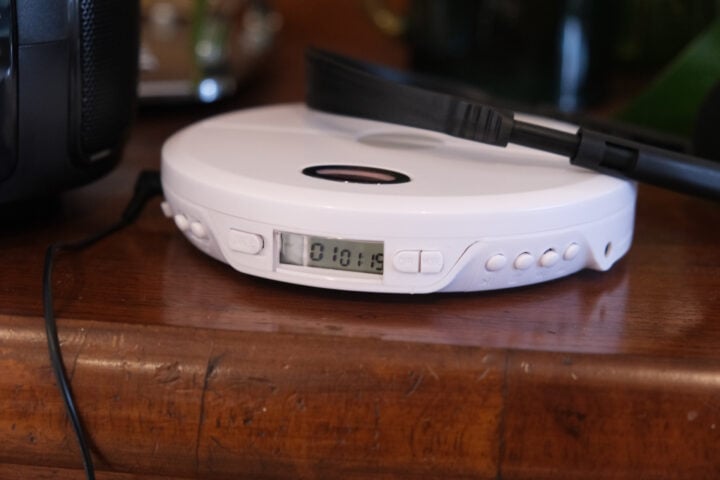
Well, the thing actually sounded quite adequate. I span up the self-titled Dire Straits album – it was one of the first batch of CDs I bought in 1984 – and there was a slight thump once the circuitry engaged, and then the tap-tapping of the second track emerged from the silence. The FiiO headphones aren’t particularly efficient, so I had to wind the volume up to near the maximum. The sound was clean and surprisingly spacious.
Did you notice? The CD player started on the second track, not the first. Nor would it play the first track when I skipped back, or forward through the whole disc and back to the start. It was fine with all the others. So I popped in the Music for Queen Mary (Henry Purcell) CD, thinking I’d see how it worked with Track 10, which simply wouldn’t play on either of the two FiiO CD players I’ve previously used. And the player skipped the first track again! After checking I didn’t have playback on ‘Random’ or something, I skipped through to Track 10, which worked perfectly. But several other tracks didn’t work, including Track 9.
Two CDs. Two Track 1 failures!
But they were both CDs I purchased way back in the 1980s. So I popped in Lorde’s latest, Virgin – the transparent CD – and Track 1 worked perfectly, as did all the others. I ran into no more problems with skipped tracks apart from those two CDs.
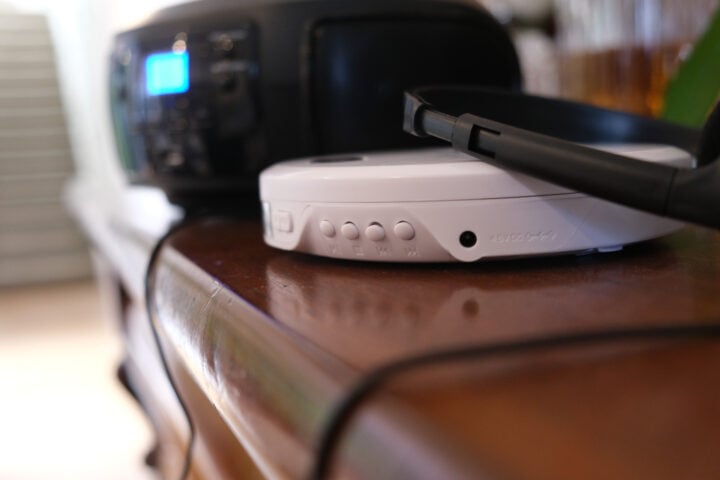
By the way, the Dire Straits first track worked fine on my Cambridge Audio transport and on the FiiO DM15 R2R CD player. And also on the Laser Boombox.
The Dire Straits album was from the vinyl era, pre-CD, so it doesn’t have much in the way of deep bass. The Lorde CD does have plenty of that, and it was rather recessed with this CD player. Oddly, even with the bass boost circuit engaged. That’s surprising. One problem with a lot of mid-fi gear, especially headphones, is that they are engineered to, if anything, overdo the bass. But there was an absence of deep bass. Even with the bass boost switched on.
I had noticed that one of the listed features was “skip protection”. This typically reads a CD in advance of playback and buffers a certain amount of the music in memory to carry things over, should a bump cause the read head to lose its place. There is no switch to stop it from working. It soon became clear that this does work. One way of telling is that the CD would often stop for thirty seconds at a time while playback would continue from the buffer. Nice engineering, since it extends battery life a little.
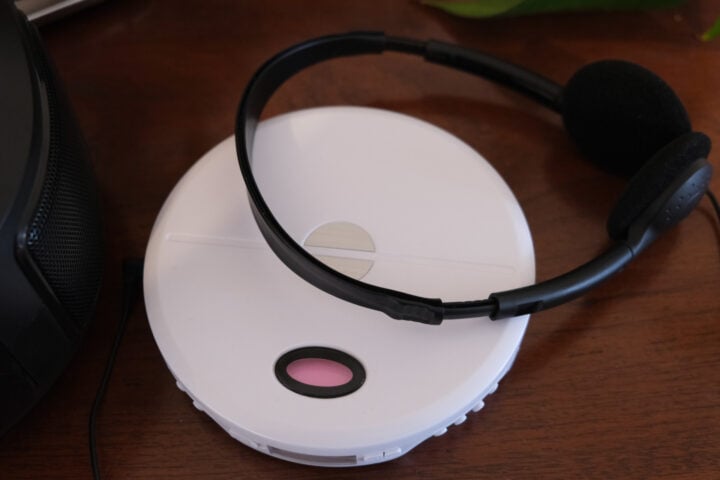
So, in summary, seemingly adequate sound, if far from fully high fidelity. Even with the headphone output plugged into my main stereo.
The Laser Bluetooth Boombox
This is, seriously, a full-featured unit. Especially when you consider the price. It plays CDs, includes an FM radio tuner, acts as a Bluetooth speaker, and you can even play MP3 and WMA music files from a USB stick!
Pity about that whole loudspeaker thing. It’s stereo, and each side is handled by a single 65mm driver. It sounds like it. I concur with the purchaser who accused it of sounding “tinny”. But that wasn’t why I wanted it. I used it either with headphones or with the headphone output plugged into my stereo – that’s about $25K in sound equipment.
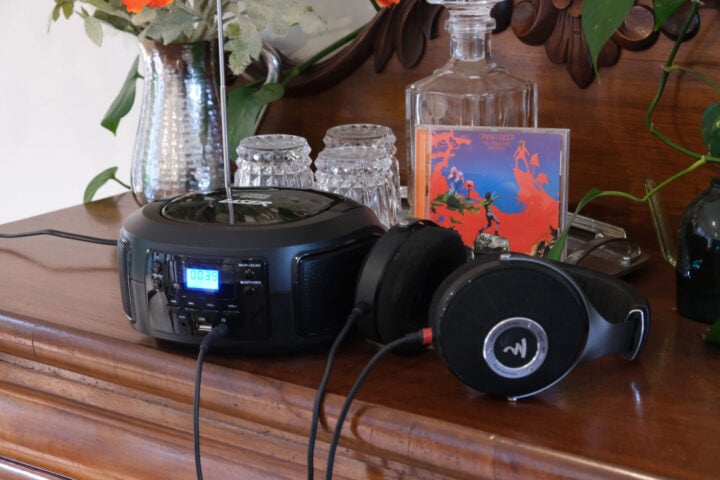
Briefly, the FM radio worked well enough. It has a scan feature, and thereafter you can just skip from station to station. There’s also an auxiliary input (3.5mm – cable included!) so you can play music back from other devices. As if.
Unlike the Anko CD player, it happily consumed every track of every CD I popped into its top-loaded bay. That bay has a lid that opens to about 40 degrees, if that. Some dexterity is required to get CDs out without scraping their surfaces.
Sound quality? Hmmm. With headphones, and plugged into the stereo, it was … interesting.
With my Final Audio D8000 over-ear planar magnetic headphones, it sounded kind of nice, at least to the extent that you aren’t familiar with how the CD should sound. Holly Cole’s Temptation seemed nice. Bass seemed okay, and there was a decent amount of air in the sound, with little harshness. But when I thought back to how this CD normally sounds, I realised that there was a complete absence of deep bass, and this is on headphones that are extremely good at that. When I switched to some Focal Elear headphones, the upper midrange became noticeably harsh.
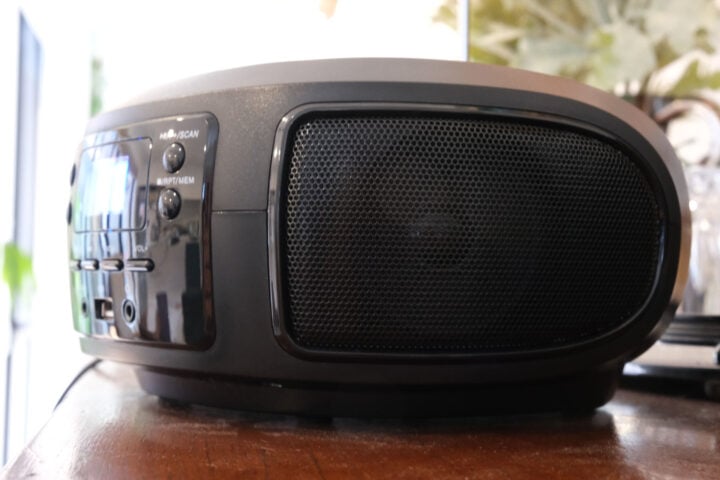
The sound was quite dependent upon the headphones used. With the fairly low-impedance FiiO JT7 headphones, the maximum level was unsatisfyingly low, even though the balance was similar to that of the Final Audio headphones. With Sennheiser IE 300 in-ear monitors, the sound was terrible. Really, not a whole lot better than through the unit’s own speakers. Their low overall impedance, which is quite variable across the frequency range, meant that everything they produced emphasised the weaknesses of the Laser unit itself: all midrange, and a harsh midrange at that. The sound was a little more tolerable with Final Audio B3 in-ear monitors, but it was clearly all midrange with almost no bass or upper treble, producing that damned tinny sound again.
Plugged into my main system, the performance was closer to that with the D8000 headphones, but with music with which I was familiar, the bass and treble were both significantly recessed.
Some measurements
As I keep saying, I feel like the basics of audio reproduction have been solved. And probably ought to have been solved even in the cheapest of gear. It ought not cost a lot of money to produce effective chipsets, especially in bulk.
So I was actually surprised once I measured the two units. Here’s the frequency response of each. Both are driving into a high impedance input, so this is the very best that they can do. To be clear, this is the output of the electronics, independent of anything plugged into them. Flatter is better.
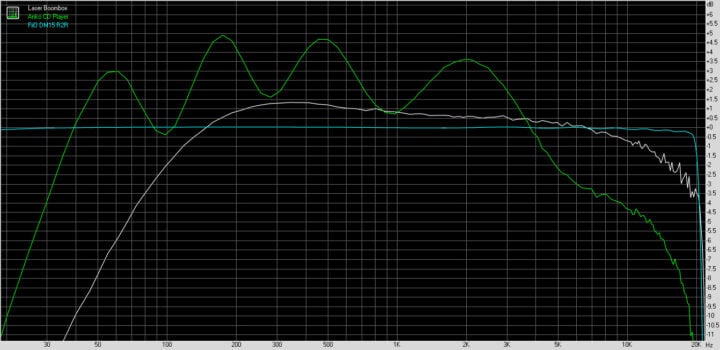
As you can see, the Laser Boombox produces midrange, and nothing much else. The Anko CD player delivers a weird frequency response, also lacking in deep bass and high frequencies. I guess the basics haven’t been solved for cheap gear.
That flat line in the middle is for the FiiO CD player, just to provide a standard for comparison. Flatter is better.
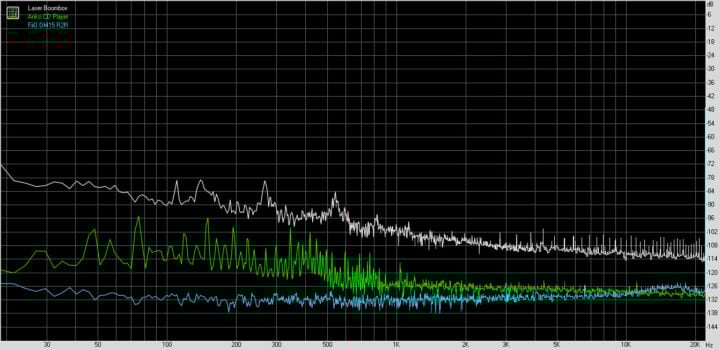
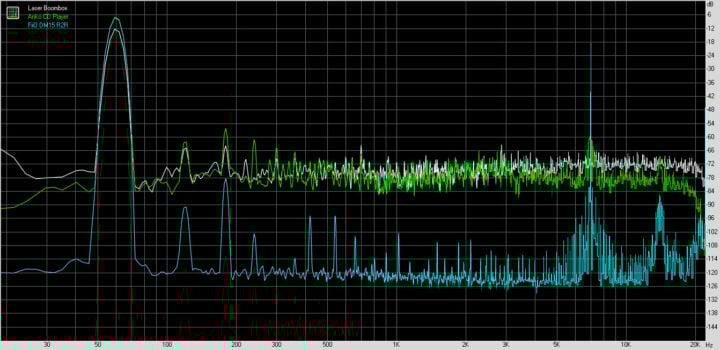
The noise performance of both units broke no records, but was adequate enough to keep intrusions below the level of audibility. Even the Laser unit, which delivered significantly worse figures. I measured -72.2dBA for the Laser, -92.8dBA for the Anko and -96.9dBA for the FiiO DM15 R2R. That last figure is, roughly, the theoretical best possible for a CD. Here’s what the noise performance looked like as a graph (lower is better):
Anko-Laser noise.png
What about distortion? There are two figures for this: harmonic distortion and intermodulation distortion. For comparison, the FiiO player managed 0.06% for total harmonic distortion, and 0.05% for intermodulation distortion. The Anko was way worse at 0.385% and 1.4%, while the Laser Boombox was at 0.39% and 4.0%, respectively!
Here’s the harmonic distortion graph:
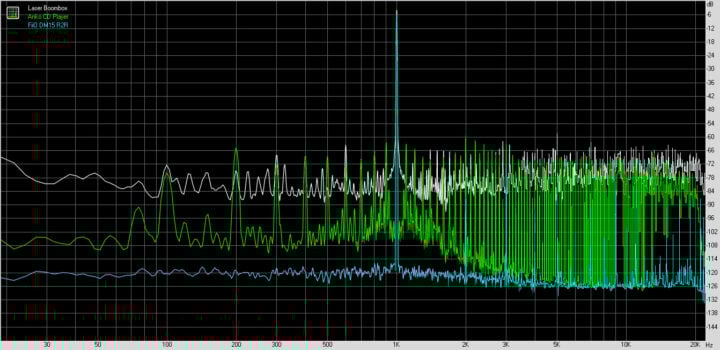
And here’s the intermodulation distortion graph:
Part of the reason for the poor performance with the Sennheiser IEMs turned out to be because of the highish output impedance of both units, which both affected their frequency balance and reduced the maximum power they could deliver. The output impedance of really high-quality headphone amplifiers is typically less than one ohm, and pretty much all decent headphone amps are well under ten ohms.
The Anko CD player had an output impedance of a mediocre 19 ohms, which meant a maximum output of around 6mW (not the claimed 6mW) into low impedance (16 ohm) earphones. That will produce at most around 8dB above the sensitivity rating of the headphones.
The Laser Boombox was way worse: 96 ohms. The result was at best less than 2mW into those low impedances, or a couple of decibels above headphone sensitivity rating. You’ll want quite sensitive headphones with an impedance of 80 ohms or more to get (semi-)decent sound out of this unit.
On the technical front, there’s only one thing left: pre-emphasis handling. That’s where an extremely small number of CDs from the early days had a boosted treble, along with a flag that told the CD player to reduce the treble (thereby reducing any random noise). Many modern CD player makers seem to have forgotten about this, so those (again, extremely rare) CDs sound harsh with overdone treble.
The Anko CD player does not act on that flag, so that odd CD will sound harsh. And, interestingly, neither does the FiiO DM15 R2R. But whoever designed the Laser Boombox apparently paid attention to the CD Red Book, which defines CD player requirements, and did indeed include the appropriate flag detection and ‘deemphasis’ circuit.
Are these cheap CD players worth it?
Yes, I know they were dirt cheap. But, still, I’m disappointed. I can kind of understand things like higher noise and distortion levels. Presumably, higher-quality component selection costs money.
The same applies to the lowish output levels and high output impedances.
But the weird frequency response weaknesses?
Come on! Aren’t there cheap chipsets that provide the expected frequency response? Or, at least, something approximating it?
So I guess I’ve been disillusioned, disabused of my notion that high fidelity might be achievable on the cheap.
The post Cheap CD player showdown: Kmart vs Big W audiophile test appeared first on GadgetGuy.


0 comments:
Post a Comment