

One image was all it took to ignite a global controversy. Technically, it was two visuals stitched together in a side-by-side comparison. But it was enough to stoke the flames of outrage towards a global AI superpower.
One part of the image showed a young, blonde-haired woman in the rain, staring beyond the camera in a gloomily lit scene. Next to the image was another visual of the same scene, yet noticeably different. The scene’s lighting had changed, as had the woman’s features. Her lips looked fuller and redder, her hair contained more colour than was previously present, and her eyebrows more arched.
Depicted in the visuals was Grace Ashcroft, one of the protagonists of Resident Evil Requiem, the latest entry in the long-running horror game series. Aside from her terrifyingly starring role in the game, she’s now the centre of a storm surrounding DLSS 5, an AI technology recently unveiled by Nvidia.


Criticism came swiftly following DLSS 5’s reveal; gamers and game developers all over the world decried the altered version of Ashcroft as an example of ‘AI slop’. This sentiment wasn’t confined to one corner of the internet, either. Posts in popular gaming subreddits lampooning DLSS 5 have upvotes in the tens of thousands, memes flooded social media, and even the comments on Nvidia’s reveal video are overwhelmingly negative.
In the face of all this criticism from players, the leather jacket-clad Nvidia CEO Jensen Huang dismissed the response as “completely wrong”.
But gamers aren’t the only ones incensed about DLSS 5’s visual interference; those who make games have reacted strongly, from “disgust” to thinking the upscaled images were a “joke”. And there are fears that the impact of Nvidia’s new technology will reach much further than changing the way games look.
What is DLSS meant to do?
DLSS, short for ‘Deep Learning Super Sampling‘, is a suite of Nvidia technologies designed to help games run smoother and look clearer. Rather than being one all-encompassing tool, it’s a collection of AI-based rendering technologies that achieve slightly different outcomes.
Some, like ‘Super Resolution’, sample images at a lower resolution to then upscale them to a higher quality. It’s meant to be less taxing on a device’s (usually a PC) graphics processing unit (GPU), so games can run smoother, in more frames per second, at a higher resolution output.
Game developers can opt in to use DLSS technologies, and players can tweak and toggle DLSS on and off via a game’s settings menu. Theoretically, the technology is meant to improve the performance of games, even on lower-powered hardware.
So far, DLSS has largely been used to upscale images or generate additional frames to make games look smoother. But not all game developers see it as a net positive.
“I’ve always felt a little bit uncomfortable with DLSS technology,” said Jack Kirby Crosby, a Melbourne-based artist working on Summerhill. “It feels like a technology that you go over to your grandparents’ and turn off motion smoothing on the TV.”

With the announcement of DLSS 5, performance and upscaling were no longer the main features. According to Nvidia, DLSS 5 included a “real-time neural rendering model” that aims to turn video game graphics into “cinematic” and “photoreal” visuals.
Crosby, who was also the Art Director on Moving Out 2, felt “disgust” upon seeing Nvidia’s demos, joining a chorus of people who believe that the technology makes wholesale changes to the source material.
“The concept of a program or a piece of software that’s heavily integrated with a graphics card, creating new stuff inside a game that may not have been there from the start, makes me deeply uncomfortable.”

He wasn’t the only one who reacted negatively to Nvidia’s latest technology. Legions of gamers voiced their collective displeasure, with many considering DLSS 5 an overreach of the technology by drastically changing a game’s visual style.
“I genuinely thought [the DLSS 5 demo] was a joke when I saw some screenshots,” said Dean Walshe, a Canberra-based 3D artist who worked on the highly stylised Void Bastards and its follow-up, Wild Bastards. “I assumed the original would be much more restrained and the internet was just doing their thing of goofing on it.”
What does DLSS 5 do to a game’s graphics?
Much of the heated discussion surrounding DLSS 5 centres on exactly how the technology is changing the original visuals. When responding to the initial wave of criticism, Huang explained that the technology “fuses controllability of the geometry and textures and everything about the game with generative AI”.
“It’s not post-processing, it’s not post-processing at the frame level, it’s generative control at the geometry level.”
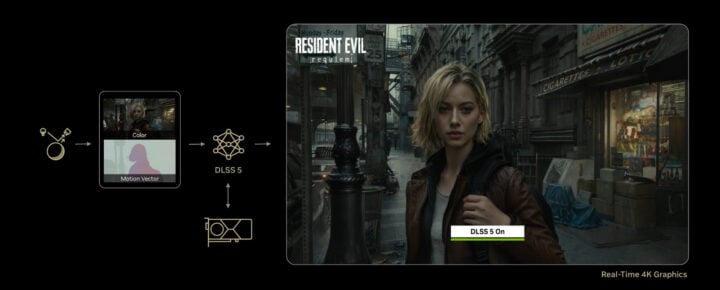
However, further clarification provided by Nvidia seems to contradict Huang’s remarks. A more recent explanation suggests that DLSS 5 applies changes based on analysis of a 2D frame, without factoring in details outside of the frame.
While many have taken issue with the process, including its use of generative AI, the output has attracted the most attention. Using the controversial Grace Ashcroft comparison as an example, Walshe explained why the processed image looks so different.
“All her skin has higher specular contrast and a finer micro detail applied to it,” he said. “Most people have seen this sort of stuff with face filters already on their phones and it’s having a similar result here in erasing and overwriting a lot of the original look.”


To Crosby, DLSS 5’s output is a broader reflection of the style associated with AI-generated imagery.
“To my eyes, it looks like what that’s doing is looking at the ambient light that’s happening inside of the game and trying to move it closer to what this algorithm has been programmed to perceive as quote-unquote ‘more realistic’,” he said.
“It’s taking so much data that it’s actually averaging the look and making it feel almost generic in its styling. So as with all AI stuff, you’re kind of looking at the average of things, and I think average is just kind of boring.”
Walshe agreed, extending his criticism to the rest of Nvidia’s demos and how the technology attempts to depict a cohesive scene in a video game.

“The biggest part with all of these examples though is even if you liked the result, you now have this giant disconnect between game character models and their environment,” he said.
“None of them seem connected to the world around them, but rather badly photoshopped stock actors into a game. They sit next to a shelf that still has 3D aliasing issues and a low-poly glass with terrible transparency.”
A graphical arms race
Compounding the criticism of the next-gen DLSS technology is its high barrier to entry. An early demo available to attendees at Nvidia’s GTC conference ran on PCs equipped with two GeForce RTX 5090 graphics cards. One GPU rendered the game, while the other ran the DLSS model.
In Australia, an RTX 5090 costs upwards of $6,000. They launched closer to $4,000 in 2025, but multiple factors, including the global memory shortage, have caused the prices of PC components to skyrocket.

Nvidia claims that “DLSS 5 will be optimised to run on a single GPU” when it launches, but the prohibitively high hardware cost remains.
Putting the dollar figure aside for a moment, Nvidia’s strategy is one familiar to Dr Brendan Keogh, an Associate Professor in the School of Communication at Queensland University of Technology. As both a games researcher and a developer, he has seen this technological hype cycle many times before.
“Ultimately, companies are trying to make a profit,” Dr Keogh said. “Game developers want to make a good game, but their employers want to make the cheapest game capable of making the most profit.”
He adds that technology improvements do come with upsides, like helping make independent games more viable for smaller teams. But the main issue, according to Dr Keogh, is when platform holders keep making lofty promises to sell new hardware at regular intervals. It’s part of what he calls “a multi-year scam that DLSS 5 is but one minor chapter of”.

“…photorealism, and especially cinematic photorealism become the forever-out-of-reach promise of each new technology that encourages players to buy new hardware, to buy new remasters, to buy new sequels,” Dr Keogh said.
According to Crosby, handing over the visual style of a game to generative AI technology removes the intentionality and human element of game development.
“Every project that you work on is arrived at through a plethora of decision making,” he said. “What’s appropriate for the gameplay? What’s appropriate for the feeling or mood we’re trying to engender in our players? What will players get excited about?”
On Moving Out 2, a chaotic furniture removal multiplayer game, Crosby described how the art team emphasised the characters’ wacky expressions. Building on the first game, the team hand-animated the eyes and mouths as 2D textures separate from the rest of the character models, leading to a more comedic effect.

Human emotion and interpretation also factor into game development, even on remasters of older games. Early in Crosby’s career, he worked on The Legend of Zelda: Twilight Princess HD remaster for the Nintendo Wii U. The original 2006 version is deeply personal to Crosby, having played it with his cousin, whose best friend had recently died by suicide.
“I have a personal connection to that game in having played it, and artificial intelligence cannot have that experience,” Crosby said. “It can’t have a human connection to what it is because it’s not human.”
Even with people involved when modernising older games, he believes that the original version of any game will be the most authentic representation of the artists’ original vision. Technological limitations require teams to collaborate and find creative solutions, which is part of what Crosby feels is the “deeply human and personal” aspect of game development.
In the pursuit of fidelity and realism, he laments the “diminishing returns” the industry has reached.
“…over the decades we’ve been pursuing realism at a rapid pace, trying to make games look and feel more hyper realistic in a sort of graphical arms race to kind of achieve the most perfect representation of reality,” Crosby said.
Many of the artists and developers spoken with for this story agreed that a game’s overall style outweighs any attempts at pushing graphical boundaries.

“The games from decades past that have stood the test of time are those that reject ‘photorealism’ in favour of having an actual style: Katamari Damacy, Rez, Super Mario 64, practically every Nintendo IP,” Dr Keogh said. “And look at the most popular games today: mobile casual games, Minecraft, Roblox, and weird cheap games on Steam.”
“Photorealism doesn’t sell games anymore, but it’s the only trick the biggest companies have up their sleeve.”
The games industry’s Ship of Theseus moment
The discussion surrounding DLSS 5 conjures shades of Microsoft’s poorly received AI-generated demo of Quake II. Demoed as a potential tool to assist with game preservation, Microsoft’s generative AI technology was criticised for how useful it would actually be to implement.
Similarly, technologies like DLSS 5 are causing headaches for preservationists who are trying to figure out what it means for how games are shown to future generations.
“If these new AI technologies become essential for making and playing games, it has the potential to not only add another layer of potential copyright complexity but bring into question what version of a game should be preserved,” said Chloe Appleby, Program Curator at Sydney’s Powerhouse Museum.

“Do we preserve both DLSS off and on? Is the DLSS 5 version consistent amongst players and if not, what version represents the collective experience?”
On top of determining what gets preserved, the proliferation of AI technologies also complicates the historical element of showing games. Appleby’s work involves sourcing items for collection, as well as organising events such as ALT: GAMES, a grassroots festival for the New South Wales video game community. From her perspective, technologies like DLSS 5 add more variables to her job.

“Experiences and intent from both the maker and the player changes significantly with this tech which impacts curatorial justifications and interpretations,” Appleby said. “In an exhibition context, how do you present this tech with the game? If you must display it, is the maker’s intent or the audience’s collective memory being compromised?”
What is the long-term impact of DLSS 5?
Backlash to DLSS 5 and the high price of compatible hardware equals a lot of unknowns as to the impact of Nvidia’s technology. Even so, it’s sparked a lot of speculation about AI technologies and working conditions more broadly.
At the time of Nvidia’s announcement, Bethesda, Capcom, and Ubisoft were among the major companies supporting DLSS 5. Reportedly, some developers at studios supporting DLSS 5 found out about the technology at the same time the public did.


Dr Keogh is circumspect about whether DLSS 5 will tangibly change game development, “especially considering the huge negative backlash to how terrible it looks”.
“What will be important is for players to be vocal about the fact they want games made by actual human beings, that don’t require burning down whole forests and using huge amounts of water just to render bad shadows.”
“A painting isn’t automatically better if it has more colours and a video game isn’t automatically better if it has more pixels,” Dr Keogh said.
It’s a sentiment shared by Crosby, who criticised the act of trying to assign objective value to a subjective medium.
“Imagine you look at a Frida Kahlo painting and you’re like, ‘that’s only a 7 out of 10 because the rendering on her eyebrows doesn’t feel realistic – there aren’t that many people with monobrows, and so therefore that’s not that realistic’,” Crosby said. “It’s just absurd!”
There’s also precedent for game development studios replacing human labour with AI technology. In 2024, King, the mobile developer known for Candy Crush, claimed that a playtesting bot helped increase level iteration speed by 50 per cent. Then, in 2025, reports emerged about more than 200 layoffs at King, with some employees claiming they were replaced by AI tools they helped build.
“This is precisely what game development employers are hoping generative AI will achieve, and it’s up to game developers themselves to organise and prevent this in their workplace,” Dr Keogh said.



Unionisation was also brought up by Crosby, who described capitalism as “the elephant in the room”. With so much of game development shrouded in secrecy, he believes that workers having more control over their work would help push back on perceptions that more detailed graphics equals better games.
“I think we’ve gotten there because we don’t get to talk to the artists that make these games,” Crosby said. “We don’t get to talk to the artists and hear from them and hear what their intent was when they’re making a texture at eleven o’clock at night on a Sunday.”
More than changing how video games look, DLSS 5 is also a lightning rod of criticism for what generative AI represents. It’s the large data sets trained on copyrighted data. It’s the high energy demands to run AI servers. And, as Walshe mentions, it’s the flow-on effects of unaffordable consumer products.
“I would like to be able to buy RAM at a reasonable price again, and I am sure people that play games would rather be able to afford a console or computer than have this trash.”
The post “Disgust” over Nvidia’s DLSS 5 has the games industry on edge appeared first on GadgetGuy.


0 comments:
Post a Comment