
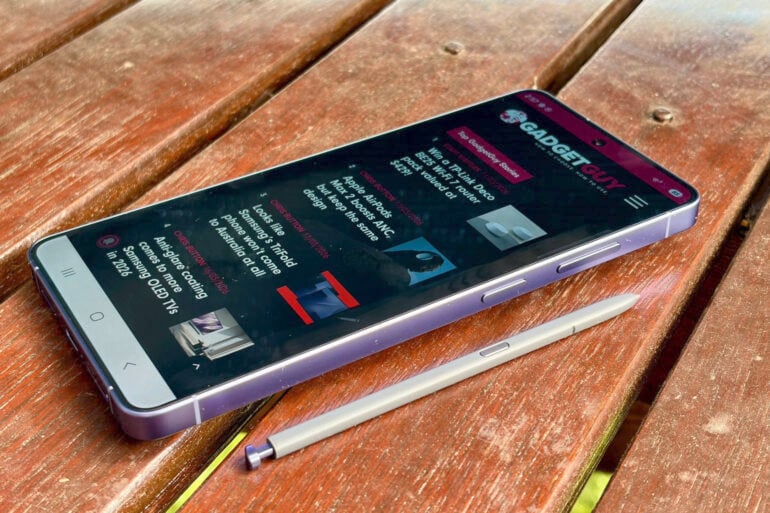
Packing tons of firepower and an innovative privacy screen to keep prying eyes at bay, the Samsung Galaxy S26 Ultra tweaks a winning design.
Smartphone makers have felt the crunch this year, with most new models looking at first glance like a carbon copy of their predecessors. As economic pressures bite hard, they’re typically limiting their hardware improvements in favour of new AI tricks, while trying to keep the price tag in check.
Starting at $2,199, the new flagship Samsung Galaxy S26 Ultra is $50 more expensive than the Samsung Galaxy S25 Ultra. In this economy? Spending north of two large on a smartphone is a big ask at the moment, especially when interest rates and petrol prices are headed north.
At first, it seems that very little has changed with the Galaxy S26 Ultra, to the point where the privacy screen technology is touted as the headline new feature. But when you pop the bonnet, you discover a ton of extra grunt at your disposal to underpin its AI ambitions.
Table of contents
- First impressions
- Specifications and price
- Features
- Quality
- Who is the Samsung Galaxy S26 Ultra for?
Samsung Galaxy S26 Ultra first impressions
After its predecessor went with a titanium frame, the Samsung Galaxy S26 Ultra returns to aluminium – delivering a hefty 6.9-inch handset which somehow manages to tip the scales at only 214 gm.
The S26 Ultra is a smidgen taller and wider than the S25 Ultra, which won’t bother the Ultra faithful, but newcomers should be warned that it’s a biggun. It doesn’t feel unwieldy to me, but those with small hands and small pockets should definitely check it out in person before taking the plunge on a 6.9-inch behemoth.
On the outside, Samsung has stuck with the tried and true Ultra design. You find the power button just above the centre on the right, with the volume buttons above. The fingerprint reader is built into the screen, rather than the power button.
There’s no sign of an additional Camera or Action button, as is becoming common with many high-end handsets.
Across the bottom of the handset, you’ll still find the trusty S-Pen tucked away in its slot, a USB-C connector and the dual nano-SIM slot, but don’t hold out hope for an old-school 3.5 mm headphone jack.
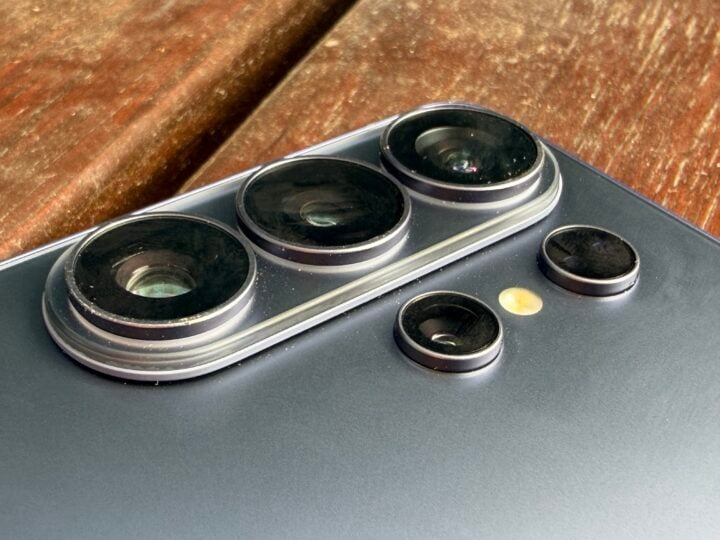
The key external design difference is that the rear vertical triple-camera array is now surrounded by a glass island that makes it look more prominent.
The purpose of the glass island is seemingly so that the lenses don’t appear to stick out as far, considering that the actual body is thinner than the S25 Ultra, but the lenses are thicker due to their wider aperture. That’s good news in terms of photo quality, but the trade-off is a lot of wobble when sitting on a flat surface.
Fire up the Galaxy S26 Ultra, and you’re faced with a beautiful 3120 x 1440 pixel Dynamic AMOLED 2X display. It still sticks with 8-bit colour rather than 10-bit, but employs Frame Rate Control (FRC) kung fu to simulate a higher colour depth by rapidly cycling between different colour shades.
Combined with a 2,600 nits peak brightness and 2,000,000:1 contrast ratio, the display supports Samsung’s HDR 10+ but not rival Dolby Vision.
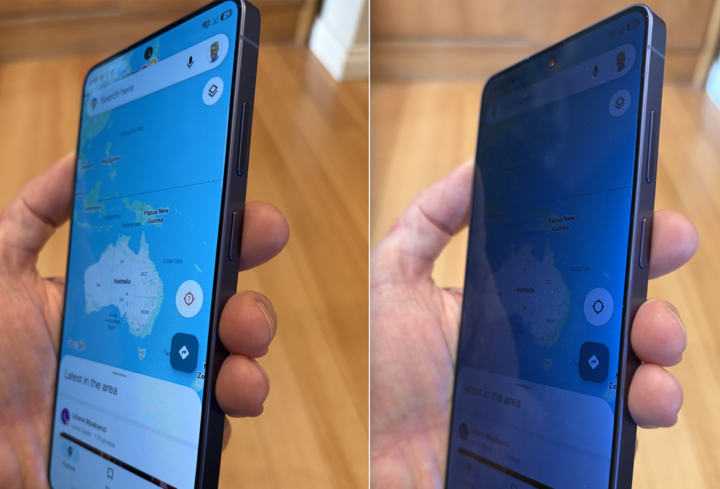
Admittedly, it’s the same display as the old S25 Ultra, but the new S26 Ultra comes with a new ‘Privacy Display’ feature that stops people peeking at your phone from the side (but not over your shoulder).
Traditionally, smartphone privacy shields have been physical, adhesive screen protectors that limit the viewing angles people can’t glance at from the sides or above.
Samsung’s Privacy Display is different in that it actually changes the screen settings to create the same effect. So rather than an all-or-nothing approach, you can apply Privacy Display to specific apps and adjust the strength. You can even set it so that only notifications are blocked out, while the rest of the screen is easily viewable.
When Privacy Display is active, the screen gets a tad dimmer, even from front-on. Apart from that, it doesn’t really get in the way, switching on and off very smoothly.
Using the Modes and Routines feature, you can also enable Privacy Display according to location, which might be more practical, considering people might find it most valuable when commuting, rather than at home or in the office.
When it comes to ruggedness, the S26 Ultra retains the S25 Ultra’s Corning Gorilla Armor 2 for scratch protection, while adding Corning Gorilla Glass Victus 2 for drop protection. The handset retains an IP68 dust and water resistance, meaning it can survive a dunking in 1.5 metres of water for up to 30 minutes.
Samsung Galaxy S26 Ultra specifications and price
| Display size | 6.9 inch |
| Display resolution | 3120 x 1440 QHD+, 500 ppi |
| Display technology | Dynamic AMOLED 2X 2,600 nits peak brightness 1~120 Hz Adaptive Refresh Rate 2,000,000:1 contrast ratio HDR 10+ |
| Bands | Sub-6 5G |
| Chipset | Octa-Core Snapdragon Elite Gen 5 for Galaxy |
| GPU | Adreno 840 |
| Rear cameras | 200 MP wideF/1.4 |
| 50 MP ultrawide F/1.9 |
|
| 50 MP telephoto 5x optical zoom F/2.9 10 MP telephoto 3x optical zoom |
|
| Front camera | 12 MP |
| RAM | 12 / 16 GB |
| Onboard storage | 256 GB / 512 GB / 1 TB |
| microSD slot | No |
| SIM | Dual nano-SIM + eSIM |
| Charging | USB-C 3.2 60 W Super Fast Charging 3.0 25 W Qi2 wireless charging |
| Battery | 5000 mAh |
| Connectivity | Wi-Fi 7Bluetooth 6.0 Ultrawide Band |
| Operating system | Android 16 running One UI 8.5 |
| Security | Fingerprint reader Face ID Knox security |
| Ruggedness | IP68 Corning Gorilla Armor 2 Corning Gorilla Glass Victus 2 |
| Dimensions | 163.6 x 78.1 x 7.9 mm |
| Weight | 214 gm |
| Colours | Cobalt Violet, White, Black, Sky Blue (plus Pink Gold and Silver Shadow, exclusive to Samsung’s online store) |
| Price | from $2,199 RRP |
| Warranty | 2 years |
| Official website | Samsung Australia |
Features
The Samsung Galaxy S26 Ultra runs Android 16 out of the box, with Samsung matching Google in promising an impressive seven years of Android OS updates and security fixes. Over the top is Samsung’s bright and cheerful One UI 8.5, which feels a little Apple-esque in places.
Under the bonnet, the Galaxy S26 Ultra steps up to the eight-core Snapdragon 8 Elite Gen 5 for Galaxy processor (spoiler alert, it completely smokes the old S25 Ultra’s Snapdragon processor).
The processor is still accompanied by 256 GB, 512 GB or 1 TB of storage, but Samsung has added the option to set up from 12 GB to 16 GB of RAM.
Samsung has also redesigned the internal vapour chamber to manage device heat more efficiently from the Snapdragon power plant.
At first glance, there’s absolutely no change in the photography department, where you typically look for improvements in new phones. Admittedly, it’s no slouch, sticking with a 200 MP wide main rear shooter, 50 MP ultra-wide shooter and a pair of 50 MP / 10 MP telephoto cameras – delivering a maximum of 100x digital zoom. You’ve still got 12 MP around the front.
The subtle change is that some of the lenses increase the aperture to let in more light, with Samsung citing a 47 per cent improvement on the 200 MP main camera and 37 per cent improvement on the 50 MP telephoto.
As for connectivity, you’ve got a great spread with 5G, Wi-Fi 7, Bluetooth 6 and Ultra Wideband – the latter of which offers a range of uses, including getting the most from Google’s Find My Device network.
When it comes to juice, you’re still relying on the same 5,000 mAh tank, which should get you through the longest days. There was a time when 5,000 mAh was super-generous, but these days it’s one where Samsung is starting to lag behind the competition (having been burned by battery issues in the past).
The battery is supported by 60 W ‘Super Fast Charging 3.0’, which can get it from zero to 75 per cent in 30 minutes. Naturally, the charger’s not included.
You’ve also got 25 W Qi2 wireless charging, but surprisingly, the handset still lacks magnetic alignment for charging. If you need it, you’ll want to look at compatible cases.
As with most handsets these days, the Galaxy S26 Ultra’s new features revolve less around hardware improvements and more around AI.
The star of the show is still the Galaxy AI suite of tools, mostly focused on generative AI creativity, such as polishing photos, including Photo Assist, which lets you edit photos by describing the changes you want.
Generative AI also assists with writing, translating and cute creations like stickers. From a more technical perspective, AI image signal processing promises more natural selfies, while nighttime videos are clearer thanks to AI post-processing scrubbing out noise.
Of course, you’ve got Samsung’s Bixby smart assistant and Google’s Gemini, now joined by Perplexity.
As with Google’s Pixel range, Samsung’s AI tries to make life easier in all kinds of little ways. The improved Now Nudge works similarly to Google’s Magic Cue, attempting to surface useful information when you’re using messaging apps. Meanwhile, the improved Now Brief scans your inbox, messages and calendar to help you prepare for the day.
Quality
The Samsung Galaxy S26 Ultra’s Geekbench 6 results are stunning, returning scores of 3,770 single-core and 11,422 multi-core – both more than a 30 per cent improvement on the S25 Ultra. Meanwhile, OpenGL leaps almost 40 per cent to 23,805. The only thing that comes close to this kind of firepower is the Apple iPhone 17 Pro Max – with a similar hefty price tag.
| Phone | CPU single-core | CPU multi-core | GPU |
| Samsung Galaxy S26 Ultra | 3,770 | 11,422 | 23,805 |
| Apple iPhone 17 Pro Max | 3,768 | 9,443 | 45,451 |
| Apple iPhone 17 | 3,520 | 9,057 | 37,161 |
| Oppo Find X9 Pro | 3,165 | 9,418 | 20,447 |
| Samsung Galaxy S25 Ultra | 2,360 | 8,911 | 14,671 |
| Apple iPhone 16e | 2,679 | 6,144 | 23,732 |
| Google Pixel 10 Pro | 2,317 | 6,455 | 3,233 |
| Oppo Reno 15 Pro | 1,555 | 6,330 | 11,828 |
| Motorola Edge 60 Pro | 1,432 | 4,695 | 9,107 |
| Google Pixel 10a | 1,730 | 4,501 | 8,795 |
| Samsung Galaxy A56 | 1,364 | 3,898 | 6,539 |
Of course, when it comes to the Galaxy S Ultra range, those cameras are always a big selling point, and the S26 Ultra doesn’t disappoint. The camera loves my photogenic dogs, even if it’s difficult to get them to pose.


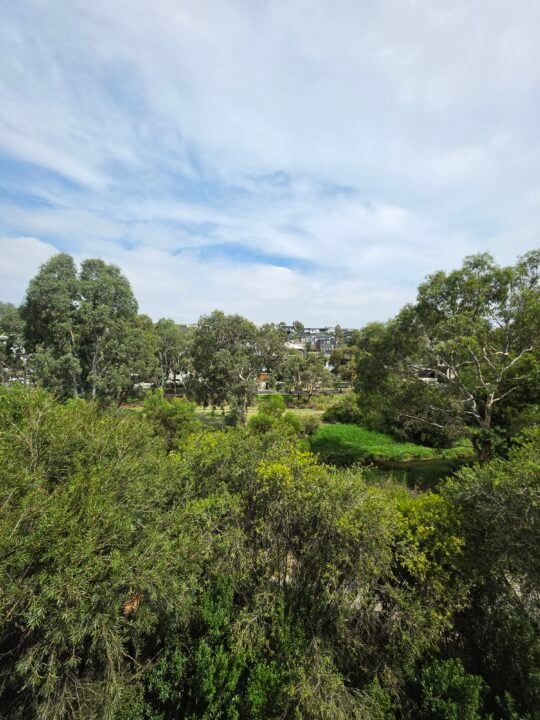
Step outside to give the rear array a good workout, and you’re rewarded with impressive colour, contrast and depth. Scrolling through below, you see not just the impressive picture quality but also the impressive consistency when stepping through the lenses. Admittedly, there’s a slight drop-off in vividness when you get to the telephoto lenses, but the handset handles the transition better than most.
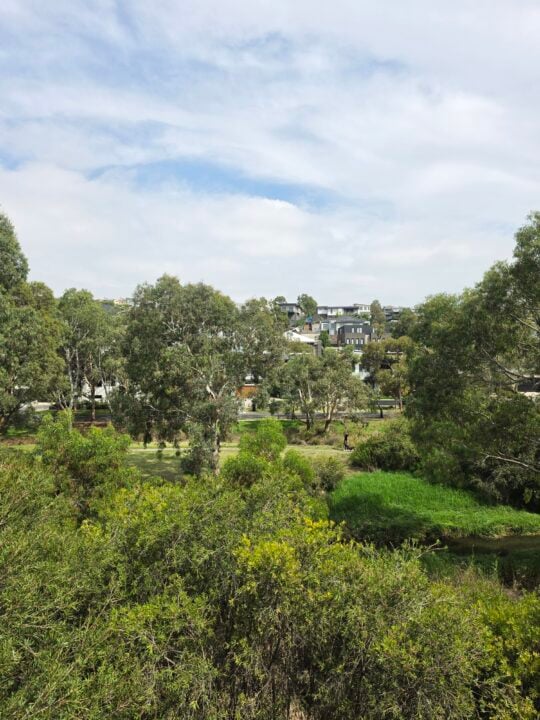
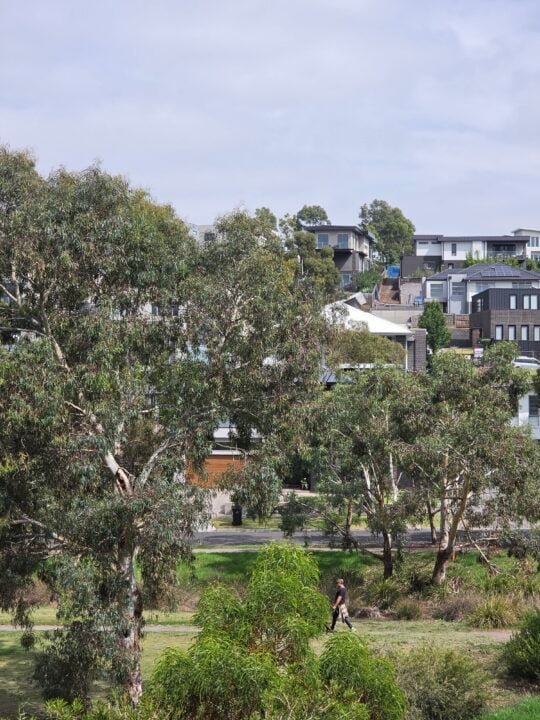
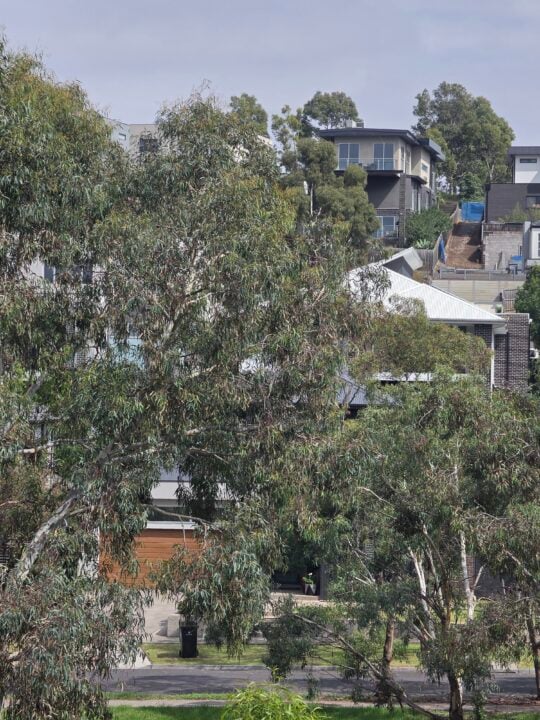
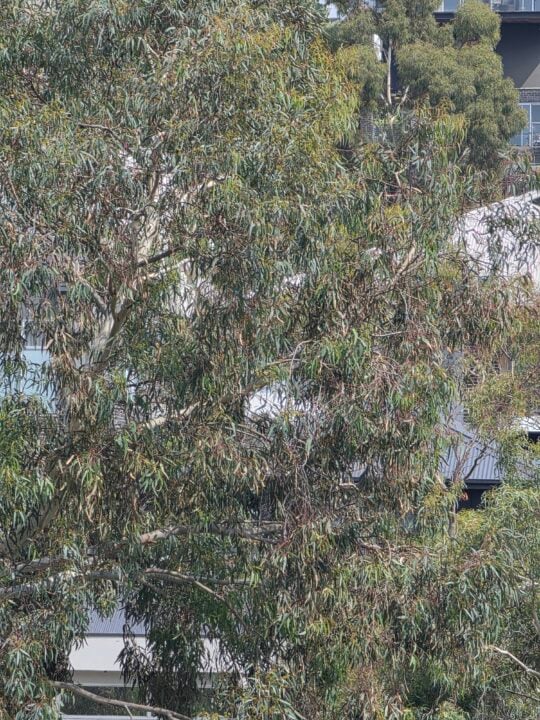
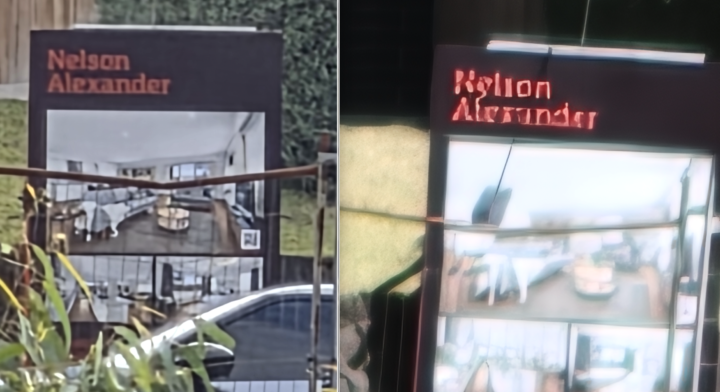
Meanwhile, the 100x super zoom results are very impressive at 150 metres. Super zoom can always take a good guess at geometric shapes, but the Galaxy S26 Ultra (below left) does a much a much better job of interpreting this real estate sign in the distance than the 120x super zoom on the Oppo Reno 15 Pro – admitedlly, perhaps assisted just as much by the quality of the S26 Ultra’s lenses than its AI smarts.
Night-time is when the Galaxy S26 Ultra really knocks it out of the park thanks to those wider aperture lenses.
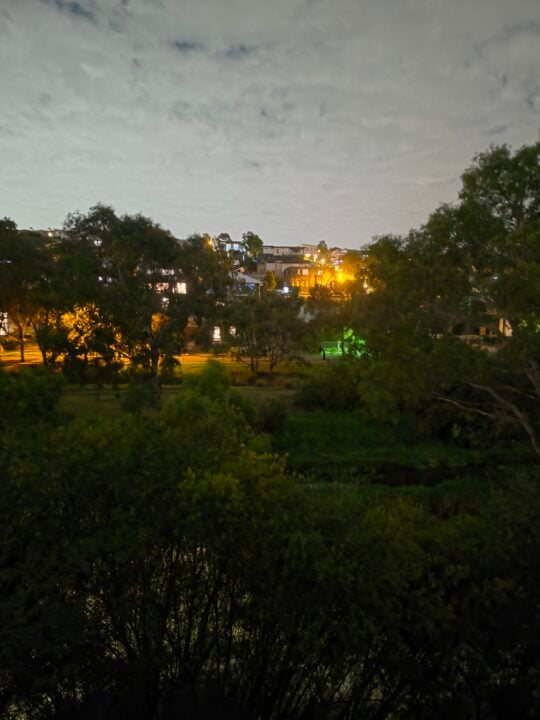
If anything, it’s too good. The photo above looks like it was taken at dusk, but it’s actually 10 pm, with the camera picking up much more than I could see with my naked eye. My admittedly nitpicking complaint is that it brightened up the clouds too much in an attempt to reveal detail – but keep in mind this is on auto mode without dipping into the advanced camera settings.

Who is the Samsung Galaxy S26 Ultra for?
The Samsung Galaxy S26 Ultra is one with the lot, but has a price tag to match. Along with deep pockets, you need a thirst for grunt, a taste for high-end photography and a hankering for the latest in AI assistance. You’re also paying a premium for the S Pen and a few other features compared to the rest of the more affordable Galaxy S26 range.
If you’re primarily keen on the latest AI advancements, the $2,199 price tag makes the Galaxy S26 Ultra considerably more expensive than the AI-powered Google Pixel 10 Pro. Keep in mind, the Pixel flagship is no match when it comes to the Galaxy S26 Ultra’s impressive grunt and extensive camera array.
GadgetGuy occasionally uses affiliate links and may receive a small commission from purchased products.
The post Samsung Galaxy S26 Ultra review: Private eye appeared first on GadgetGuy.


0 comments:
Post a Comment