
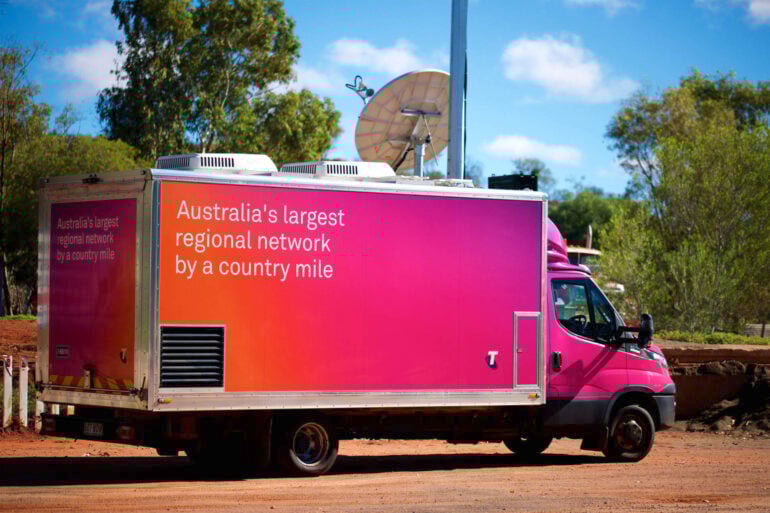
Vodafone’s parent company, TPG Telecom, has hit out at Telstra’s network coverage claims as part of a submission to Australia’s communications regulator that could change the way telcos show coverage information to consumers.
When you look at a phone network coverage map, you might expect it to clearly explain where you will and won’t get a signal. But coverage maps are predictive by nature, and some telcos use different approaches when presenting this information.
The Australian Communications and Media Authority (ACMA) wants to simplify coverage information by making telcos display a standardised set of service categories ranging from “good” service to “none”. It recently closed submissions for the draft Telecommunications (Mobile Network Coverage Maps) Standard 2026, which will help inform the finalised standard scheduled for 31 March.
TPG Telecom’s submission directly questions Telstra’s network coverage map, following TPG’s claim last year that Telstra allegedly misled customers with inflated coverage statistics over a 15-year period. As part of its submission, TPG Telecom alleges that its engineers could not make phone calls in areas covered by Telstra’s “full coverage” map.
What does the ACMA’s draft standard say?
ACMA’s efforts seek to bring parity to Australian network coverage maps. Per its consultation paper, “current industry practices vary significantly”.
“Differences in modelling approaches, underlying assumptions and presentation conventions mean that coverage maps are not directly comparable between operators,” the ACMA’s document said. “This weakens the usefulness of coverage maps for consumers and undermines broader policy goals such as improving transparency and supporting informed choice.”
Limitations with the predictive techniques used in coverage maps are another issue the ACMA wants to tackle. To help consumers understand the likelihood of getting phone coverage in any given area, the regulator proposed four categories of phone signal:
- Good
- Moderate
- Usable
- None
In this example, ‘good’ refers to “reliable” and “high-quality” connections for voice calls, SMS and data. Go down the list, and ‘Usable’ means “reduced reliability and variable performance”.
Under the currently proposed standard, these categories would correspond with signal strength, measured in decibel-milliwatts (dBm). ‘Good’ is used when the signal is greater than -95dBm, while a signal strength between -95dBm and -105dBm fits the ‘Moderate’ category. Based on the ACMA’s current draft, ‘no coverage’ includes signals weaker than -115dBM.
The ACMA acknowledged that signal strength isn’t the only factor impacting whether a phone call will go through. Different phones have different antenna technologies, and being indoors or outdoors also has an impact.
TPG Telecom’s issue with Telstra
Telstra largely agrees with the ACMA’s goal of making information about phone coverage clear and consistent. The telco’s submission expresses agreement with consistent mobile coverage standards designed to help consumers, with some caveats.
Telstra’s biggest issue is with ACMA setting the ‘no coverage’ limit at -115dBM. Via its submission, Telstra claims that “around one million square kilometres of predicted outdoor coverage”, equal to “an area greater than the entire state of NSW”, would no longer be included on its coverage map if -115dBM was used as a cutoff point.
According to Telstra, usable mobile service is still possible on lower signal strengths. It recommended that -122dBM be used as a “lower boundary” instead, claiming it distinguished “basic but usable outdoor service from areas with genuinely no coverage.”
Conversely, TPG Telecom supports -115dBM as the lower end of what it suggested be a two-tiered network coverage system of “good outdoor” and “usable outdoor”. But it stopped short of agreeing that signal strength weaker than -115dBM should be referred to as ‘no coverage’.
Instead, it recommended that mobile network operators display a disclaimer so that consumers know it might still be possible to connect, pending factors like hardware and location.
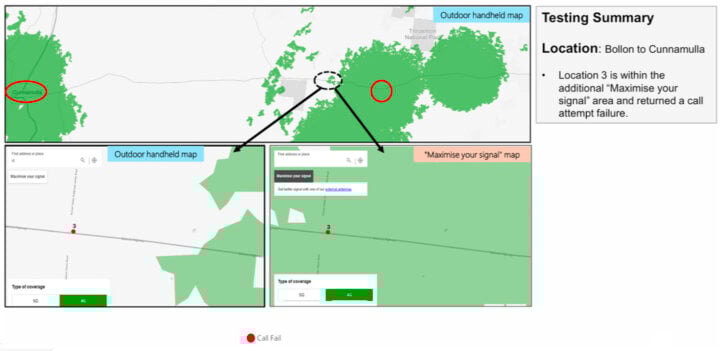
Also included in TPG Telecom’s submission to the ACMA is the claim that its engineers couldn’t reliably connect to Telstra’s network across “over 20 unique locations” included on Telstra’s “full coverage” map.
Telstra splits its coverage map into two distinct views: initial view and full coverage view. Areas depicted on the initial view are deemed sufficient for calls, texts, and video streaming. Telstra classifies full coverage as being “ordinarily sufficient for voice calls, texting and web-browsing, although higher-data activities involving video or high-resolution graphics may be slower or less consistent”.
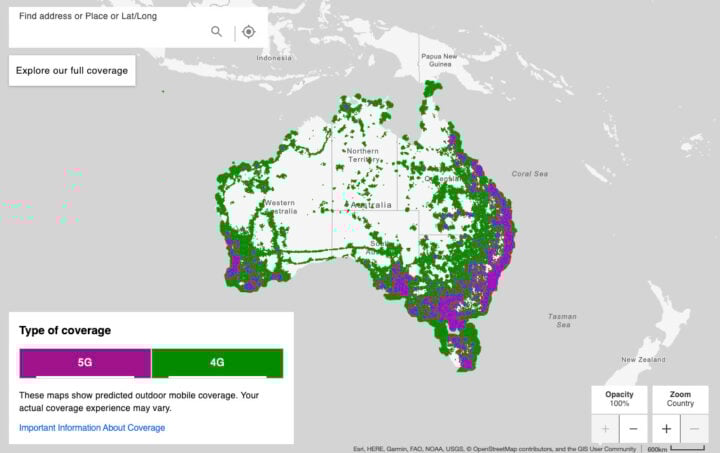
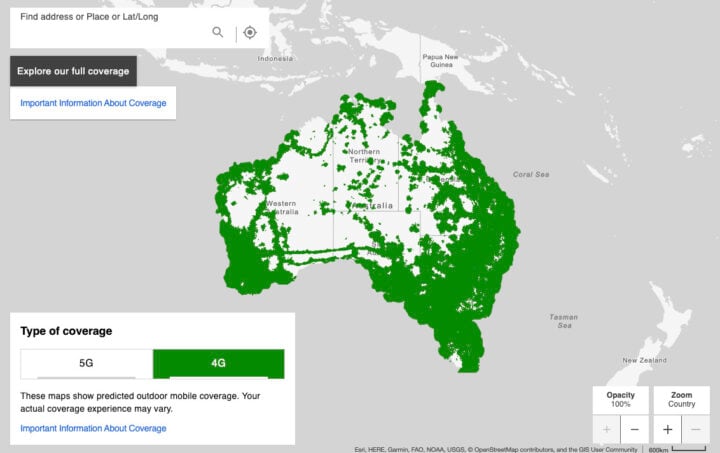
Network performance in this latter category is the crux of TPG’s issue with Telstra, while Telstra argues that the ACMA should be more lenient in its coverage definitions.
Once the ACMA confirms the new standard by 31 March, it will be put into practice starting on 30 June.
The post Telstra and TPG Telecom clash over coverage map definitions appeared first on GadgetGuy.


0 comments:
Post a Comment