
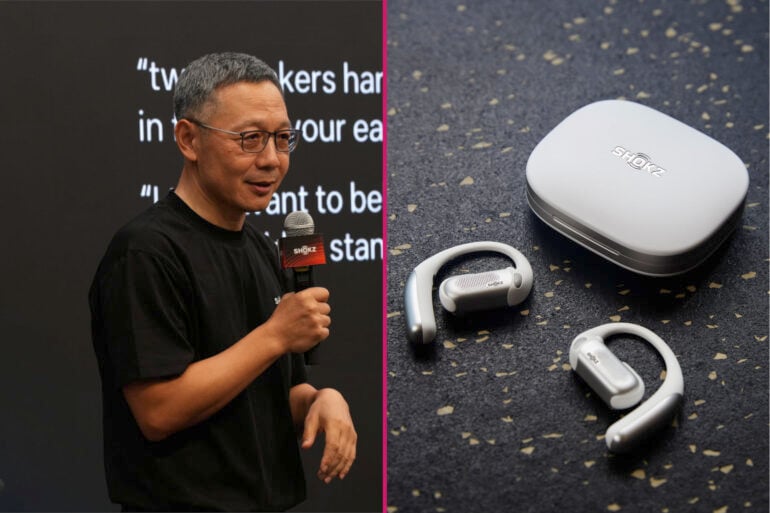
Shokz has gone from being a company known only by serious runners to a mainstream headphone brand that’s introduced the world to the joys of open-ear listening. But, to Shokz co-founder and Chief Technology Officer, Ken Chen, the company is still a challenger, a dragon-slayer, even though most of the brand’s original primary competitors in the bone conduction space went out of business long ago.
At a recent tech day in Shenzhen, China, Chen took the assembled journalists through the company’s history with refreshing honesty and humility.
The beginning of Shokz
The company started in 2004, founded by three university friends who met while studying mechanical engineering before dispersing to different fields. Chen ended up in New York, working in finance. The company originally started as a factory making headphones for other companies, though the founders dreamed of one day making their own product, under their own name.
“We tried a lot of new stuff, but none of them were successful with our customers,” Chen said. “It turns out that they just want something that’s popular, so you just need to copy, you don’t need to create anything, because whatever you create is not popular, at the beginning at least.”
After long despairing at doing what was popular, rather than what was interesting, Chen and his business partners founded AfterShokz in New York in 2011, inspired by bone conduction technology.
“As engineers, we thought that we could do more with technology, and we have passion,” he said. “This imagination echoes with our inner heart.”

According to Chen, the reason for choosing to incorporate in New York was due to China’s limited headphone adoption. It still is today; everywhere I went in Shenzhen, there were people playing things out of their phone speaker and talking on speakerphone in public instead of using headphones or putting the phone to their ear.
Being based in the US, where headphones had been a regular part of daily life since the Walkman made a splash in the 1980s, made more sense to the founders. New York is also where Chen went to university (he got his master’s at Clarkson, and did his PhD at Columbia), so it was a familiar place.
Learning from failure
The next step was to get a booth at CES to share their wares, which they did in 2011. It did not go well.
“We had the smallest booth possible, and we were showcasing the headphones, but nobody understood what we were doing,” Chen said. “Nobody knew anything about bone conduction.”
“There were lots and lots of people in CES, and they actually came up in front of us, but they came up to apply protection film for their smartphone [from another booth] right in front of us. Nobody paid any attention to what we were trying to say.”
Determined to make the next year different, the company invested heavily in marketing and had a better showing at the next CES, with a busy booth and lots of sales. After that show, they spent the next year building Bluez, a product so mediocre that it nearly sank the company.
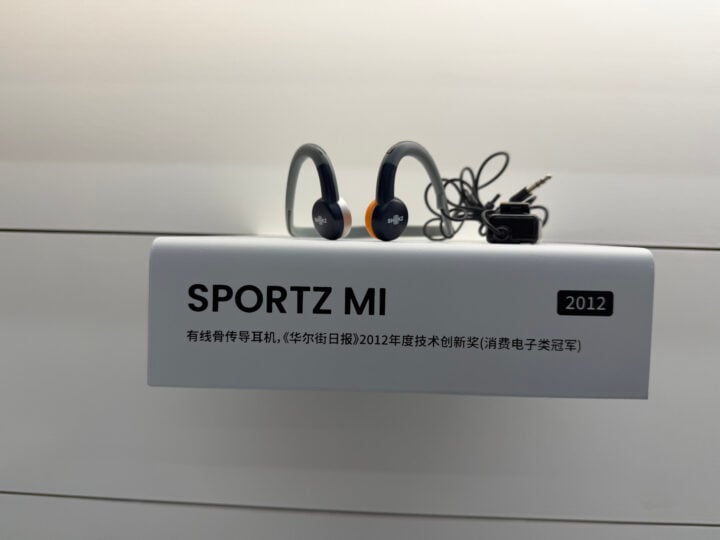
The product itself was a revolutionary idea: the first Bluetooth stereo bone conduction headset. Previous models (including the Sportz MI, which I first reviewed back in 2012) had been wired, and the Bluez were the first in the market to be untethered. Unfortunately, they suffered from poor battery life, terrible sound quality, and discomfort for the wearer.
“It was not a great product. We still had to go to the market with the goods, even though it was a product that was not that great,” Chen recalled.
“I wore the damn headphones to Macau, and I came back and told our engineer, ‘This is not working, we’ll have to redo the damn thing’. The user experience was so bad, I refused to say it had anything to do with sports. That’s why we named it Bluez. I couldn’t imagine myself being able to run with something like that.”
Stores rely on sales numbers to determine how much space a product gets, and whether they’ll keep carrying it. The expectation at the time was to sell at least one device per week per store, and then the company would continue to carry it.
When the US Office Depot report came out for the first week of Bluez sales, it showed that they had sold just 18 pairs across the United States, despite being stocked in 1,000 stores. After that, AfterShokz products spent the next three years going in and out of Best Buy and Apple Stores.
“We moved from one distributor to another, from one sports store to another. We simply couldn’t find stability. I remember one moment clearly — I was in New York, discussing our ‘grassroots approach,’ when Bruce received a call from Best Buy. We were kicked out. The decision was final. The timing was almost ironic.”
When I asked why they went to market with a product they knew was bad, Chen was refreshingly honest.
“There were two products we didn’t release, and there were also several products that I regretted that we released them,” he said. “Back then, if your whole company worked on [a product] for one whole year, was it really a choice to not release it? If you raised a lot of capital and stuff, you could. But not us.”
But Chen did make a fair point about the competition, conceding that while “Bluez was horrible”, “at that time, all these stereo Bluetooth headphones were horrible”. He then went on to compare Bluez to the Motorola S7, saying Bluez was more comfortable, which is certainly something.
Feeling the AfterShokz
It is said that failure breeds success, and that’s true for Shokz, too. While it would be easy to give up after releasing a series of bad products that tanked in the market, the company redoubled its efforts
“Instead of giving up, we went back to the fundamentals,” Chen said. “We focused heavily on improving the underlying technology itself. Bone conduction had major problems: it leaked sound, it lacked bass, and it caused vibration discomfort. So, we worked on all of it.”
Chen shared that the company puts a lot of stock in Amazon reviews. More than media reviews or feedback from distribution partners, he always tied everything back to Amazon reviews. We were shown multiple charts of how consumer sentiment ebbed and flowed over time.
In 2016, AfterShokz (as it was known then) released Trekz. It was initially launched on Indiegogo as a crowdfunded product and sold out within hours.
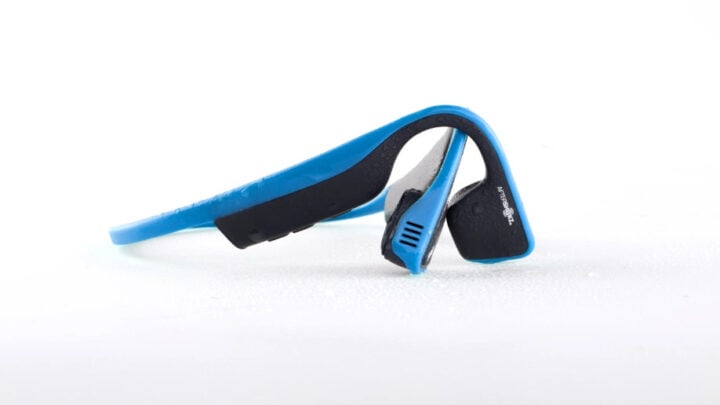
“For the first time, consumers felt ‘This actually works.’” Chen said. “That moment changed our business.”
But the company was still struggling on the business side, getting distributors, stores and potential customers to trust them again. So, Chen and his co-founders came up with a demonstration setup that could be sent out to stores so customers could actually hear what bone conduction headphones sounded like before buying.
Now, that idea sounds quite standard; anyone who’s been to a bike shop has seen the testing stands. But back then, it was an out-of-the-box idea that turned things around for the company.
Trekz then sold for eight years with great success. The company rebranded to Shokz in 2021, aiming to be easier to spell and communicate in different languages.
Conducting a bigger headphone market
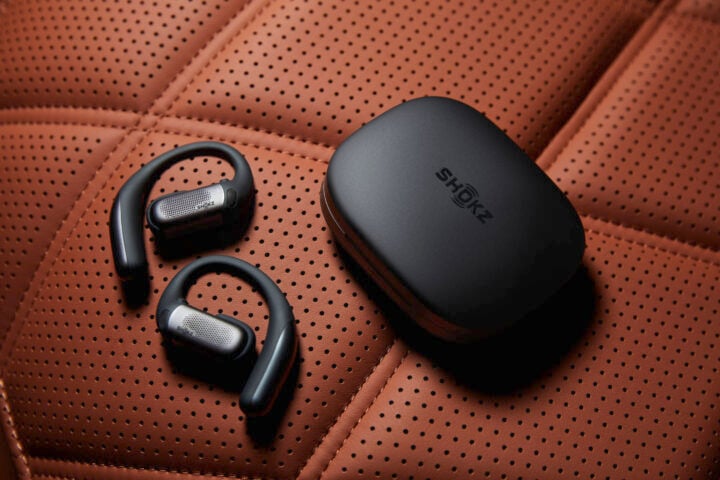
In 2023, Shokz then pivoted to also include true wireless and air conduction headphones in the lineup, like the Shokz OpenFit. It was a slight departure from the previous commitment to all bone conduction, all the time.
For Chen, the move to air conduction was one to reach the broader market.
“There are no single headphones that work for everyone,” he said. “Even for something as mighty as AirPods, a lot of people still feel, ‘My ear is the wrong size,’ or ‘I am going to lose it,’ and they often need to try it before they know whether it truly fits them.”
Beyond the current lineup, Chen and the rest of Shokz see AI as the future. He spoke about the company’s plans to make AI glasses, similar to Meta’s glasses. The company has already gone through several iterations, with the category still in the very early stages.
When Vincent Xiong, CEO of the American arm of the business, took the stage, he told the assembled journalists that the digital world is now more important than the physical one. Xiong spoke about how the future of open-ear headphones is to keep people connected to their AI assistants, so they could always be connected to their digital world, even when they have to be present in the physical one.
He also spoke about how headphones could one day record everything you say and create an avatar for you that could respond on your behalf. He also said that there would be products that would be AI-free, like OpenSwim. The fear of being left behind on AI seemed to be a primary driver in a lot of decisions being made, which is common across the board for tech companies in 2026.
But, beyond whatever the company does or does not do with AI in the future, the focus for now is on ensuring people can find an open-ear format that works for them, whether that’s bone conduction, ear hook air conduction, or the popular Dots ear clip design. It’s that ethos of keeping people connected to the physical world, while still being able to enjoy music, that has been the throughline of Shokz for the last 15 years.
As Chen said, “inspiration is easy; innovation is really hard”. Shokz has been willing to put in the hard work.
Alice Clarke travelled to China as a guest of Shokz.
The post How Shokz learned from failure to become a tech dragon slayer appeared first on GadgetGuy.


0 comments:
Post a Comment