
Travel SIM cards have been growing in popularity for obvious reasons — people love going places and hate being without internet. But the question of what kind of trip makes these kinds of SIMs worth it also comes up a lot, so I used Simify for my whole family for a trip to Taiwan, and then for myself on business trips across Japan, China and Hong Kong.
The answer is that travel SIMs like Simify aren’t suited to every trip, but they come in clutch for very specific kinds of travel.
Using Simify in Taiwan, Hong Kong and Japan
What I loved about using Simify for my family holiday in Taiwan was how easy it was to set up. This was particularly great for my mother, because while she’s more tech savvy than many almost-80-year-olds, having me be able to order SIMs for her, my wife, and me in one go, and then text the links to them, which set up seamlessly in the app, was such a relief. The app’s instructions for the setup were clear, and both her iPhone 12 Pro Max and my iPhone 17 Pro Max were ready to go within minutes.
We got an Unlimited Asia eSIM because we wanted to be able to use it in Hong Kong if our layovers got extended or rerouted. I like to be prepared for any eventuality, and I don’t trust airlines to stick to a timetable (and I am so right for that).
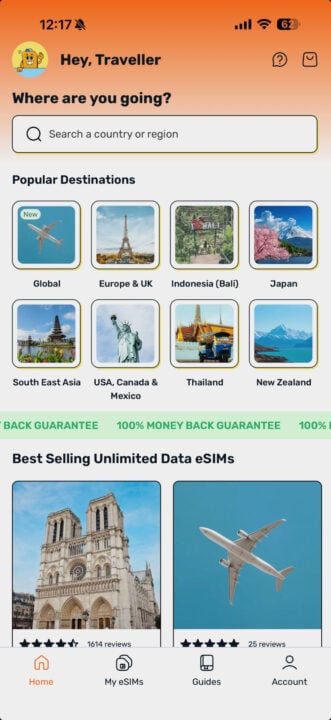
It wasn’t without a hitch, though, and while it’s certainly a lot less work than buying a prepaid SIM when you get to your destination, it lacks a lot of perks that are available to those willing to put in the effort.
For starters, not having a local phone number meant it was much harder to use Taipei’s bike rental scheme. This was another issue that came up in Japan, because I didn’t have access to any phone number, so I just couldn’t use the bikes there. There are workarounds, of course, but they’re a lot more labour-intensive and often not as good.
The second issue was that it was a lot more expensive than buying a local SIM, and also more expensive than some competitor products. Simify is cheaper than Holafly on some plans, but more expensive than some of the options on SimCorner, for example. On the Asia plan, at its most expensive, it’s $5.40 a day. It’s cheapest if you stay for 180 days, making it $2.19 a day.
My third issue was that Simify uses the old definition of “unlimited”. To me, unlimited data means that I can use an unlimited amount of data at the advertised 4G/5G speeds. To Simify, unlimited data is 1GB at full speed, and then unlimited data at a trickle so slow that Google Maps won’t load.
That said, it is very easy to message Simify in the app (over Wi-Fi, because the app also won’t load on the throttled speeds), and ask them to reset your data cap, and they’ll usually respond either instantly or the next day.
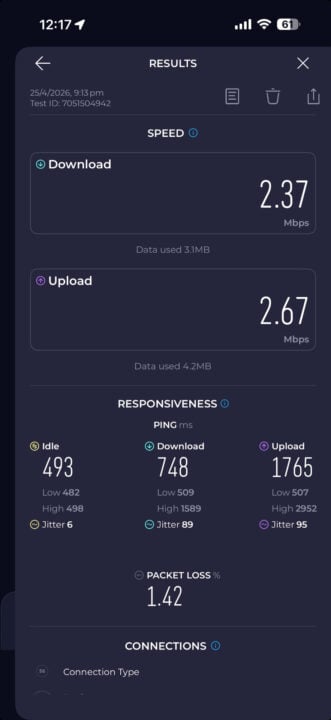
Another issue is that for shorter trips (16 days or less), it’s actually more expensive than using Optus or Vodafone’s roaming options. With Optus, $5 a day gives me 5GB of data and unlimited calls and texts. With Simify, $5(ish) a day gives me 1GB at full speed and then not much else. But it does make a lot of sense on longer trips when you don’t need much data, because you can be connected for as little as $2.20 a day if you’re staying somewhere for more than 90 days.
While that doesn’t make sense if you’re just staying in the one country, because it would be cheaper and more effective to just get a local SIM, an around-the-world trip with many stops and a need for flexibility is the perfect use case for Simify.
The final issue is a bit nitpicky, but the app needs to chill with the notifications. If I am actively on a trip, using a Simify SIM card, I do not need daily (and sometimes more frequent) ads to buy a SIM card, regardless of what discounts are being offered. I needed to keep notifications on so I could know when customer support replied to my messages asking for more data, and it was just aggravating to have the privilege of push notifications be abused like that. It showed a lack of respect for the customer.
China
Those gripes aside, it was great using Simify in China, because all my roaming traffic was routed through various European countries by default, which meant I could browse the internet unimpeded.
On Wi-Fi, the Great Firewall of China blocked me from much of my social media and some other websites, but using Simify, I was able to (very slowly) browse like I was home without having to faff about with VPNs.
Simify Unlimited Asia eSIM verdict
While Simify isn’t the best option for every use case, I mostly found it very easy to use, and can absolutely see which situations it would be ideal for, as long as people are aware of the limitations.
If Simify upped the data cap for what is available at full speed, it would be a lot easier to recommend, given that 1GB is nothing in 2026. But aside from that, Simify is a great option for your next multi-country trip longer than 16 days.
The post I tested Simify’s travel eSIM across Asia: Is it worth the price? appeared first on GadgetGuy.


0 comments:
Post a Comment