
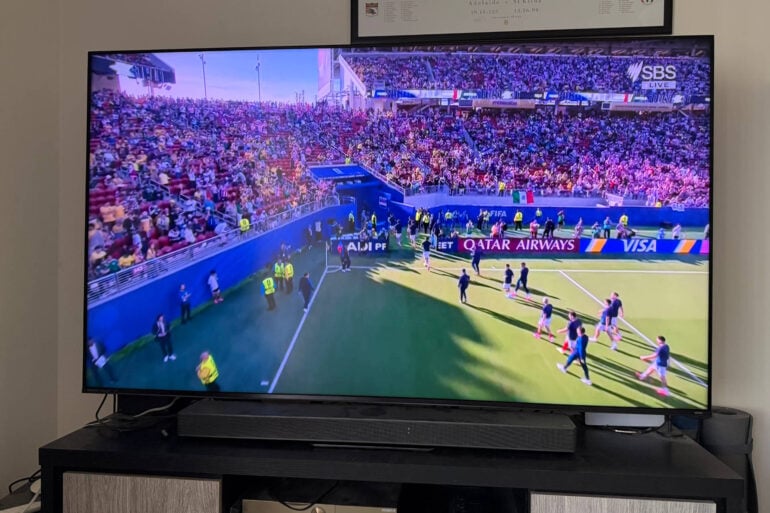
You’re settling in to watch the World Cup (hopefully to cheer on the Socceroos), snacks in hand, anxiously awaiting kick-off. You’ve gone to the effort of sorting out your TV signal, with SBS ready to go. But there’s one TV setting you’re still agonising over: motion smoothing or no motion smoothing?
It’s a controversial technology in many circles, just ask any cinephile. Motion smoothing, frame interpolation, or whatever you want to call it, is a TV technology that uses post-processing in an effort to make footage smoother.
Across most TV brands, it takes the source material, whether from a broadcast TV feed or an online stream, and generates additional frames to create the effect of smoothness. However, depending on what you’re watching, the resulting effect can look quite strange.
Motion smoothing divides TV enthusiasts almost as much as the World Cup draws competitive lines between nations. Some like the look the technology produces, while others vehemently detest it. Patrick Chen, Product Trainer at TCL Electronics Australia, believes it’s best to let the TV do the heavy-lifting.
“A lot of people think turning up the motion settings will make sport look better, but the opposite can be true,” Chen said. “Sports broadcasts are already shot at a specific framerate and TVs automatically adjust to accommodate this – layering extra motion settings on top can throw a spanner in the works.”
Australian free-to-air TV’s HD channels broadcast in 1080i at 50fps, while SBS On Demand’s online streams are in 1080p at 25fps. TVs can adapt to the format of source media, much like the ‘Filmmaker Mode’ removes post-processing and runs at 24fps (which most movies are shot at). Motion smoothing attempts to boost the framerate of the source material and reduce motion blur.
Should you use motion smoothing with the World Cup?
While Chen said “it’s best just to watch the Socceroos as the broadcaster intended”, he added that a TV’s sports mode can help improve the sports-watching experience.
“What it does is adjust the brightness and sharpens the picture so you can clearly follow the ball and see every bit of the action,” he said. “It also handles the motion processing, which helps stop the players from turning into a blurry mess when they’re sprinting down the field.”
Rather than cautioning viewers away from motion smoothing entirely, Chen advised sports fans to avoid going too far and turning up the existing processing applied by the TV.
“’Overcranking’ the TV like this can lead to an unnatural viewing experience, where the television’s frame insertion software overcompensates to expected enhancements by adding frames that aren’t there,” he said. “This is why fast movement – like the ball or players moving across the pitch – can look unnatural or jarring.”
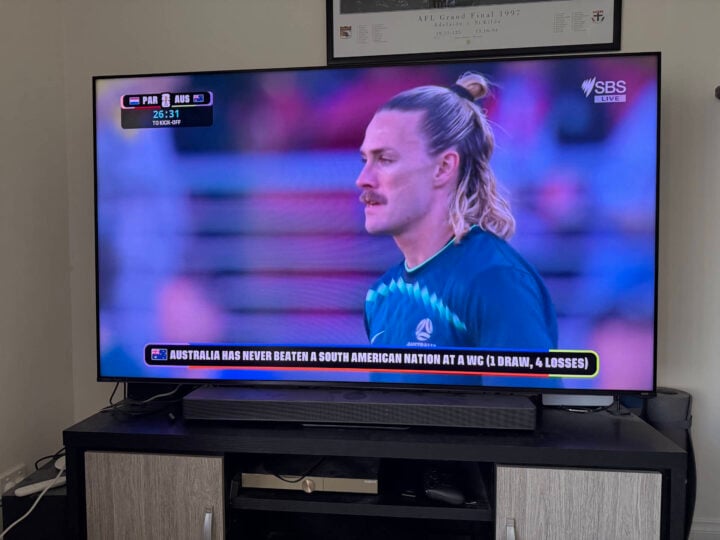
Nick O’Connor, the National Training Manager from Hisense, the official TV sponsor of this year’s World Cup, took a more hands-off approach. Content to let viewers decide what looks best to them, he pointed to the brand’s sports-optimising technology.
“No matter the source, Hisense’s proprietary Hi-View Engine, the TVs can recognise livestreamed sports; in the case of FIFA, through SBS On Demand, and in conjunction with AI Sports Mode, automatically optimise and minimise distractions and disruptions so you don’t miss a thing,” O’Connor said.
He mentioned that Hisense’s TVs use a combination of AI technologies to automatically adjust to sports broadcasts. It’s meant to make the ball look clearer to view in motion, make commentary sound clearer from crowd noise, and help scoreboard graphics stand out from live play.
As for whether you should leave motion smoothing off, on, or adjust it when watching sports, the common consensus is that it’s up to personal preference.
“While it can help with motion processing and is best to be left alone, sometimes (rarely) this ‘smoothing’ can make the picture look a bit artificial — like everything is moving a bit too fast or too slick,” Chen said. “If you think it’s a bit over the top, you can always go into your TV’s settings and turn the motion smoothing down a notch until it looks just right to you.”
The post When watching the World Cup, should you use motion smoothing? appeared first on GadgetGuy.


0 comments:
Post a Comment