
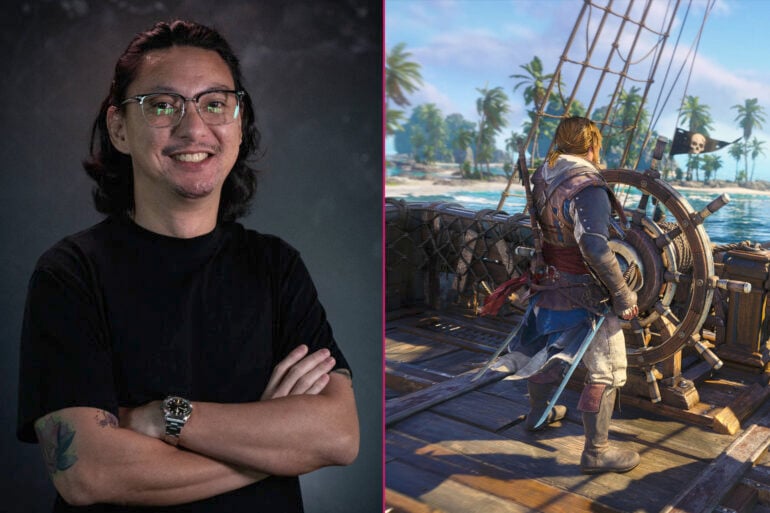
Cannons blasting, the clang of steel-on-steel, and the gentle caress of water lapping against a boat: there’s a lot that goes into producing the audio of a blockbuster video game. Done well, the mix of music and sound effects harmonises, elevating the on-screen action. But there’s a lot more to the craft than trying to make the most realistic-sounding game, as explained by Erik-Jon Evangelista, Audio Director on Assassin’s Creed Black Flag Resynced.
“True realism is not necessarily what you might want to have in a game to provide gameplay feedback,” he said.
Despite significant strides in visual and audio fidelity, making a game as realistic as possible doesn’t necessarily make it good to play. It echoes a similar sentiment expressed by the team behind Kingdom Come: Deliverance 2, where the developers deliberately deviated from real-world sword-fighting, simply because it didn’t translate well to the interactive medium.
From a sound design perspective, Evangelista instead mixed the Black Flag remake’s audio for player clarity. Citing the chaotic nature of naval combat, it was more important that players could hear what was most important to the gameplay, rather than hearing every sound at full volume, all the time.

For example, the audio team at Ubisoft Singapore made it so that additional sound effects, like wind and water, are lowered during naval combat so the player can hear audio cues more clearly. Evangelista also described creating “frequency pockets”, where impact sounds sit in a higher register, while cannon fire occupies the lower end.
“You feel the power and the oomph and the weight of the weapons when you fire them,” he said. “But the impacts are more just to tell you, ‘Hey, you’re getting hit’, rather than to completely obliterate your ears.”
Based on my three-hour Resynced preview session last month, I can confirm that the audio still packed a punch.
How do you recreate the sounds of 17th-century guns?
Muskets, cannons, and cutlasses aren’t all that common today, so producing the audio of Black Flag Resynced required a fair bit of creativity. Thinking outside the box is a skill Evangelista has developed since working on the original Black Flag as one of his first major projects over a decade ago.
“I was still pretty green at that time, not necessarily thinking from a creative aspect, more like I’m just creating the sounds for this specific feature that I’m working on,” he said.
A lot of the recordings remain from the original 2013 game that Evangelista was part of, but Resynced includes plenty of modern touches. This includes sounds from more recent Assassin’s Creed games, in addition to entirely new recordings.
You might think that replicating the ear-splitting boom of a cannon might require access to a real-world cannon. Believe it or not, the team recorded real cannon fire in the past, only to scrap it later.
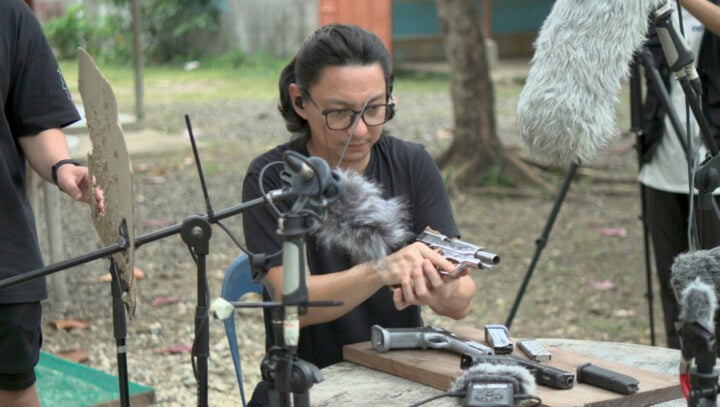
“The more cannons that we record, the more we realise we don’t really want to use most of it,” Evangelista said. “Or we end up using less of it or less bass frequencies because it just takes up way too much sonic space.”
To solve this problem, the Ubisoft Singapore audio team went to a shooting range in the Philippines to get the audio of different pistols and rifles. By recording the weapons with a Sanken CO-100K microphone in a 192KHz format, they could pitch the gunfire down without losing quality to get a cannon-like effect that didn’t completely overwhelm the audio mix.
Turning Edward Kenway into a pirate John Wick
One of the high-priority items on Evangelista’s exhaustive “laundry list” of improvements he wanted to make on Black Flag Resynced was more music variety. He stressed that the original compositions by Bryan Tyler were great and not to be tampered with, but the way the music looped during combat could sound repetitive.
Taking inspiration from the John Wick movies, where the music blurs the line between diegetic and non-diegetic during tightly choreographed fight scenes, Evangelista wanted more flourishes to Black Flag protagonist Edward Kenway’s battle moves.

“We wanted to do something that’s very John Wick-like,” he said. “Because of course John Wick didn’t come out back then, and now that’s your action movie benchmark standard.”
In the original Black Flag, the combat music looped without much variety. Now, in Resynced, the music responds to each enemy takedown, adding more weight and tension to encounters. Stephen Lukach composed these stingers that add to Tyler’s music — replacing the latter’s work was entirely out of the question.
Black Flag Resynced combines new and old audio tech
More technology than ever is available to modern game developers. While technological limitations, whether they be graphical or audio, often led to innovative tricks to achieve the best result possible, newer tools and formats make audio designers feel like kids in a candy store.
One of the most significant audio developments in recent years is the availability of Dolby Atmos. Known as an object-based audio format, Dolby Atmos lets producers and audio designers place sound at specific coordinates, rather than being limited to specific channels or the binary choice of choosing a specific speaker to play through. As such, with a compatible sound system, Dolby Atmos media produces more precise directionality, including height.
Last year, Ubisoft Singapore opened Sound Studio Blue, regarded as the first Dolby Atmos gaming studio in Southeast Asia. It’s where Evangelista and the team worked on Black Flag Resynced’s audio mix to ensure that every sound effect was placed precisely.
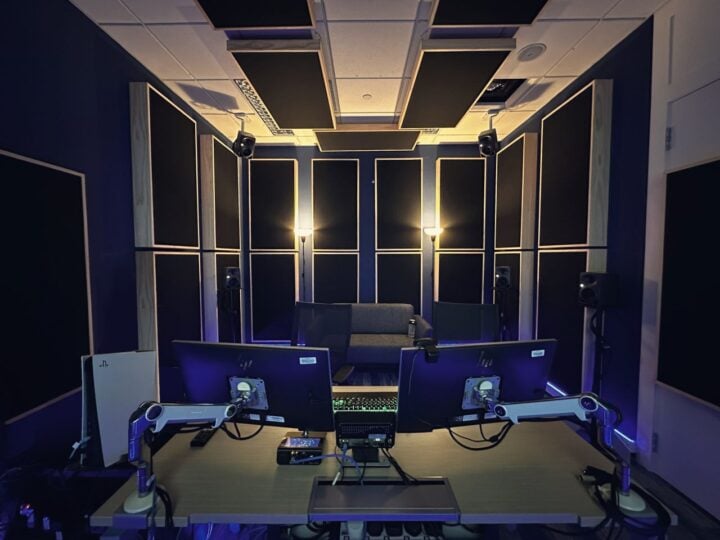
But with so many devices, including phones, brandishing a Dolby Atmos label, it’s easy to think of the technology as a marketing tactic bandied about carelessly. Evangelista was adamant that Resynced used the audio format to its full potential, not just for the sake of using it.
“[Dolby Atmos is] not just a gimmick,” he said. “We don’t just want to play it like a Beatles record and have the drums all on the left. We want to be able to make sure that we creatively use it well.”
When I visited Ubisoft Singapore last month and stepped into Sound Studio Blue, surrounded by soundproofed walls and meticulously placed speakers, the effect was immediately evident. During underwater gameplay sections, the exact separation of where the audio came from was remarkable. It felt like I was enveloped in a sphere of liquid, hearing faint sounds from the surface while the sea surrounded Kenway.

As distant cannon fire approached, I could pinpoint exactly where it was coming from, letting me either prepare evasive manoeuvres, or panic. More often than not, it was the latter.
If you’re more composed than I, Black Flag Resynced’s intricate sound design makes quite the difference.
Chris Button attended a preview event in May in Singapore as a guest of Ubisoft.
The post Inspired by John Wick, Black Flag Resynced’s audio packs a punch appeared first on GadgetGuy.


0 comments:
Post a Comment