
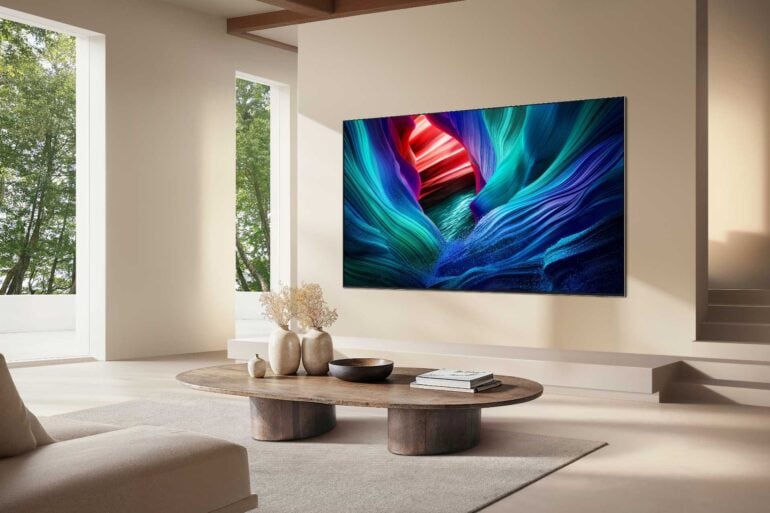
If you told me five years ago that I would one day love high-resolution TVs with an anti-glare coating, I would have laughed at you. Anti-glare coatings used to be something you’d only use if you didn’t care about distorting colour or sharpness. But now, Samsung has sold something to some kind of deity to produce the ultimate anti-glare coating that still allows an excellent picture to shine through while stopping the sun from ruining it. Finally, we have defeated the sun.
Samsung’s Micro RGB R95H TV is a technical marvel. Though this latest flagship TV is not perfect, it’s still very good.
Table of contents
- First impressions
- Specifications and price
- Subjective viewing
- Gaming
- Objective testing
- Software, remote, and user experience
- Sound
- Who is the Samsung Micro RGB R95H for?
First impressions
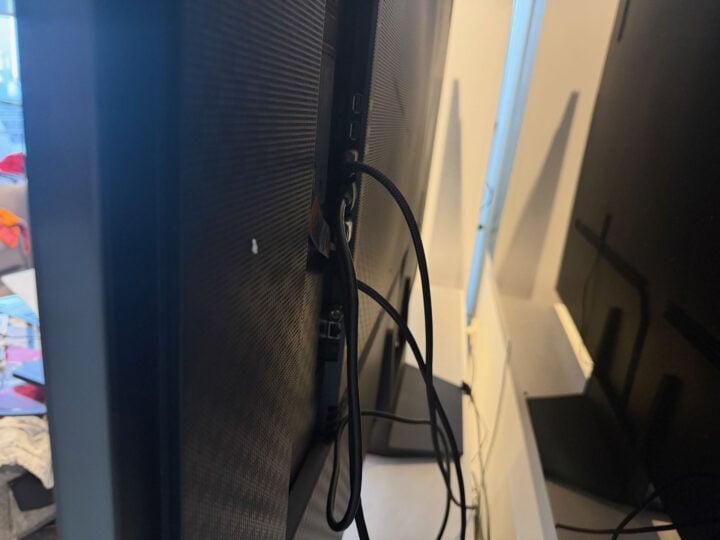
I reviewed the 85-inch model, and my first impression was that the Samsung Micro RGB R95H is big yet impressively thin, with all its insides tucked into the panel. It’s essentially a supermodel. However, I do really miss the One Connect box found on other Samsung models. Having to go behind the TV to plug in HDMI cables and whatnot feels so old-fashioned after years of enjoying the separate wireless box that came with my older big-screen Samsung TV.
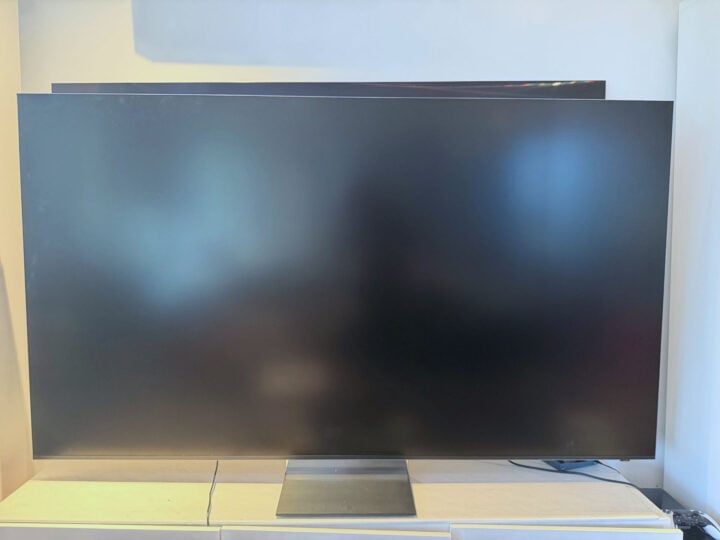
Setup was super easy, as expected. After attaching the stand and putting the TV on my TV cabinet, I logged into my Samsung account and streaming apps, and was ready to go.
Samsung Micro RGB R95H specifications and price
| Backlight technology | Micro RGB |
| Sizes | 65 inches 75 inches 85 inches (review model) |
| Resolution | 3840 x 2160 (4K) |
| Native Refresh Rate | 165 Hz VRR (100 Hz Native) |
| HDR technologies | Micro RGB HDR Pro HDR10+ (Adaptive / Gaming / Advanced) AI Auto HDR Remastering Pro |
| Operating system | Tizen Smart TV |
| Connectivity | Bluetooth 5.3 4x HDMI 2.1 ports 2x USB-A eARC |
| Price (RRP) | $5,299 (65 inches) $7,999 (75 inches) $9,999 (85 inches) |
| Warranty | 2 years in addition to your Australian Consumer Law rights |
| Manufacturer’s website | Samsung Australia |
The whole point of Micro RGB is that it can have the most accurate colours and highest brightness, while getting very close to the light control of OLED. Having the cost of Micro RGB come down this much this quickly, even if it is still horrendously high, is a great sign for people wanting an alternative to OLED for bright rooms.
Subjective viewing
I essentially live in a glasshouse. It’s one of those apartments where all the external walls are windows, which is great until you want to watch TV at lunchtime. Having the Micro RGB R95H standing in front of my normal, pro-glare Samsung TV, the contrast is stark. My older TV is a black mirror reflecting the world around it, while the 85-inch R95H is unfazed by the glorious sunlight that surrounds it. I will miss this TV when it goes.
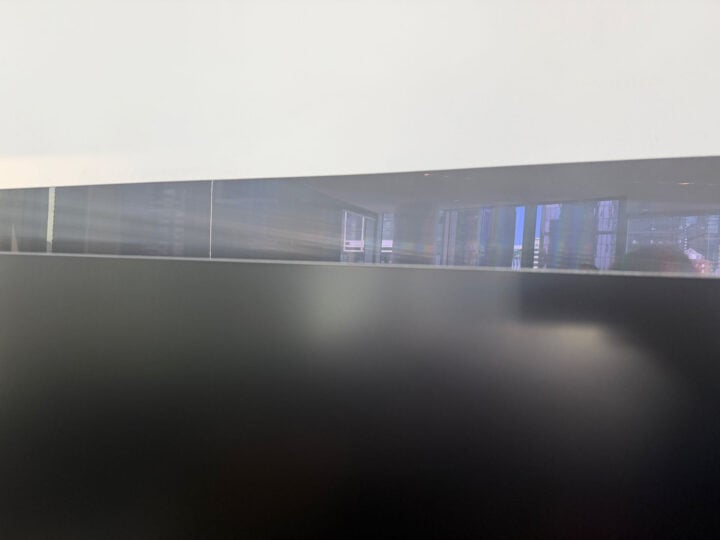
Actually sitting down to watch TV, the improved light and colour performance and control are evident.
Watching Gravity on 4K Blu-Ray, a movie where the darkness of space is as important as the literal sun and bright debris, is a perfect test. I was impressed by just how black the blacks were, and how little haloing there was on the bright white patches throughout the scene. One of the most obvious ways to tell if a TV is good is that when you try to find little details on the screen in a scene, you keep forgetting because you get lost in the scene. This was one of those TVs.
In Supergirl (2026), I was taken by how vibrant the colours are. Some TVs wash out the reds and blues of Supergirl’s uniform, and yet here they were allowed to be aggressive primary colours on the Micro RGB R95H.
Sports was less of a win; the ball got a bit blurry when watching the footy on free-to-air over the weekend.
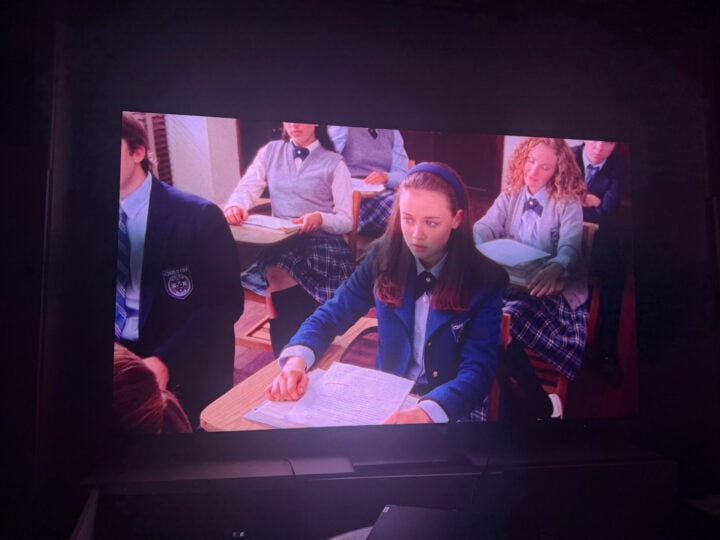
However, upscaling on older shows was great. Season one of both One Tree Hill and Buffy the Vampire Slayer was noisy as hell because of all those beautiful film artefacts, as expected. But they both still looked crisp and like they were filmed to be shown on an 85-inch TV rather than the microscopic CRT TVs they were originally destined for. They had a clarity I don’t see on cheaper TVs with worse upscaling.
The Carmilla web series on YouTube was made for approximately 20 cents a decade ago, and yet upscaled to 4K, you wouldn’t know its technical limitations. That Micro RGB AI Engine clearly has the goods to bring older, lower-quality footage into this decade.
Gaming
Here is where the true test of the TV came: playing games on Xbox Series X and PlayStation 5 Pro.
The first thing that hit me when switching over to game mode was the brightness. The TV gets so bright, it’s like a physical presence. It is a face punch of brightness. HDR textures are vivid in game mode, but at the cost of my retinas when playing at night. It’s like staring directly into the sun.
After adjusting the brightness down a bit, I was extremely impressed by how well it displays textures. One of my favourite things about the NBA 2K series is the level of detail that’s put into the arenas, down to the brand of light bulb used, and that shines so clearly on this TV. It really does look like I’m at the Staples Centre watching the Clippers snatch defeat from the jaws of victory.
The refresh rate is excellent, even if the processing is a bit noticeable at times.
Jumping into Forza Horizon 6, I noticed that the motion blur was far more intense on the Micro RGB R95H than on my older 8K Samsung QLED TV. The scenery was much sharper, and the textures had way more detail, but the motion on the car made me feel a little sick.
Objective testing
Moving to the GadgetGuy TV test patterns, I’m very impressed, for the most part.
First I put the TV on Filmmaker Mode, which has a brightness of 30, contrast of 45, sharpness of 0, colour 25, Tint (G/R) 0/0, and I switched the colour tone to Standard.
In a dark room (as dark as my living room gets), I was incredibly impressed by the colour accuracy and how good the light control is when viewed head-on. However, from non-optimal viewing angles (sitting 1m in front of the TV, head on to the left side of the screen, occasionally looking to the right), I could see how the anti-reflective coating hampered some of the colour accuracy because of the light diffusion.
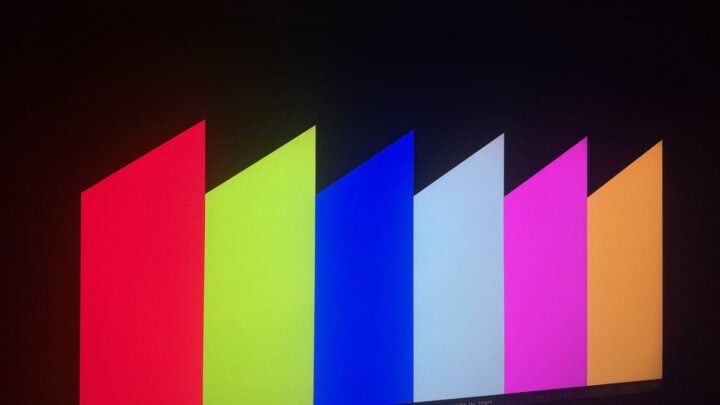
Looking at the primary colour ramps, each colour stayed in its own bar and graduated neatly between the various hues. The red stayed red regardless of its brightness.
The white field was uniform from optimal viewing angles, but lost that uniformity when sitting at a non-optimal angle. Same with red, green, grey and blue.
The black level was certainly very deeply black, with no clouding.
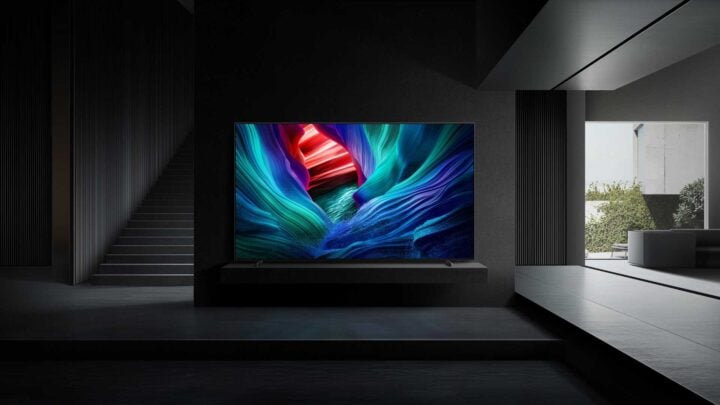
On the 1px checkerboard test, there was no shimmering; all the pixels remained neatly in their spots.
On the dark saturated colours test, the darkest red box did take on a slight brown hue, which was suboptimal.
The only test that really disappointed me, though, was the moving box test. It was extremely juddery, had some blur, and was generally not smooth at all. Not even a little bit smooth.
Motion scrolling text had the same problem, juddering all the way up the screen. The text was very clear in spite of the judder, and there was very minimal haloing.
In fact, on every test there was the slightest amount of haloing, but nothing major, and far less than almost any other LED TV I can remember testing.
Overall, aside from motion, I am extremely impressed by this TV.
Software, remote, and user experience
I still hate how many ads are built into the home screen of Samsung TVs. My strong belief is that if you have bought a premium TV, you should be able to use it without additional advertising. I understand that selling user data and presenting users with ads is a big money maker for Samsung; I just also think that perhaps buying a $9,999 TV should be enough of a contribution to Samsung’s bottom line.
My strong feelings extend to the streaming service buttons on the remote. I think users should be able to reprogram those buttons to the services and apps they actually use. Again, I understand that these streaming companies are paying a lot of money to be on the remote in the hope that users choose the path of least resistance and just sign up, and that it’s the same across all TV manufacturers. I just think that’s a bit of a gross practice.
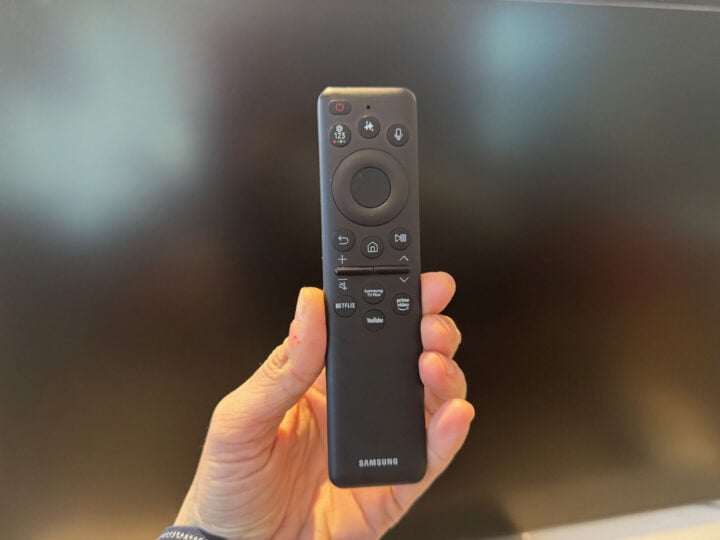
That said, the menu screens are a lot easier to navigate this year, and are less cluttered. It’s quicker and easier to get to inputs and settings, and generally seems more user-friendly. The Samsung TV Plus channels are always welcome. At the moment there’s a channel dedicated to just showing reruns of Law & Order, and I think that’s delightful. Great background viewing.
The new remote shape is more ergonomic, and I like it a lot. There is an AI button on there for people who like that kind of thing.
Sound
Usually, it’s not even worth bothering to review the speakers in a super thin TV, because they are generally garbage. However, I am really impressed with the built-in speakers in the 85-inch Micro RGB R95H. Way more bass than I would normally expect from TV speakers.
I would still want a soundbar, and Samsung sells one in the Q-Series Soundbar HW-Q990H for $1,999, which is very good for the price. Those buying a $9,999 TV likely would be better served by a more premium setup, like a Sonos system, or something more bespoke from a premium Hi-Fi shop. But the Samsung Q-Series Soundbar HW-Q990H is a very good choice for less than $2,000.
Who is the Samsung Micro RGB R95H for?
This is the TV for people who want accurate colours in bright rooms. It’s the TV for gamers and ultra-high-definition movie enjoyers.
I’m not entirely convinced it’s the TV for sports fans. But it is definitely the TV for people who have a lot of money and want to be on the cutting edge of screen technology. I also cannot emphasise enough how good this anti-reflective screen is for bright rooms.
GadgetGuy occasionally uses affiliate links and may receive a small commission from purchased products.
The post Samsung Micro RGB R95H review: A mostly great premium TV appeared first on GadgetGuy.


0 comments:
Post a Comment