This is default featured slide 1 title

Go to Blogger edit html and find these sentences.Now replace these sentences with your own descriptions.

This is default featured slide 2 title

Go to Blogger edit html and find these sentences.Now replace these sentences with your own descriptions.

This is default featured slide 3 title

Go to Blogger edit html and find these sentences.Now replace these sentences with your own descriptions.

This is default featured slide 4 title

Go to Blogger edit html and find these sentences.Now replace these sentences with your own descriptions.

This is default featured slide 5 title

Go to Blogger edit html and find these sentences.Now replace these sentences with your own descriptions.

Thursday, 27 March 2025

Lenovo Yoga Slim 7i Aura Edition review: Plus 100 aura points

8.3

It’s a bold move to label a product “aura” in this day and age. Used as slang online to describe a strong and confident presence, if you include aura in your name, you better deliver. Fortunately, that’s just what Lenovo has done with the Yoga Slim 7i Aura Edition.

Part of a collaboration with Intel, Aura Edition denotes Lenovo’s top-of-the-line laptops that perform above the rest. High-quality designs, fast processing speeds, and long battery lives; it’s another moniker to remember when browsing your local retailer.

While you can take or leave the exclusive software features that come included, the fact that the Lenovo Yoga Slim 7i Aura Edition lives up to its premium claims does indeed earn it some aura points.

First impressions

If I can give you one tip when powering on this laptop for the first time: don’t rely on muscle memory. Its power button sits on the right-hand edge of the laptop, barely protruding out. Hardly visible to the eye and tough to locate through feel alone, the power button threw me for a loop.

Upon opening the Yoga Slim 7, I expected to see a power button in the top-right corner, just above the keyboard, like just about every laptop I’ve ever used. To my horror, I saw no such thing.

“Does the laptop turn on just by opening the lid? Did Lenovo forget to install a power button? Am I an idiot? Have I been found out for the impostor I long suspected I was?”

power button
The sneaky power button in question. Image: Chris Button.

These questions and more flooded my panicked mind. Unable to figure out how the laptop powered on, I dreaded the thought of contacting Lenovo’s PR to ask what I anticipated would be the dumbest question they had ever received. So innocuous was the Yoga Slim’s power button that I repeatedly overlooked it in my frantic confusion.

Thank the laptop deities that I’m not the only one who has encountered such an issue. A quick internet search (on my phone, as the laptop was still off at this stage) revealed my folly. Panic made way for relief, accompanied by a generous helping of embarrassment.

Instead of what I consider to be a traditional power button replacement, the Lenovo Yoga Slim 7 has a keyboard, a decent-sized trackpad, and grills for its speakers. Admittedly, it makes for a clean aesthetic, albeit one that initially puzzled the hell out of me.

Lenovo Yoga Slim 7i Aura Edition (Gen 9) specifications and price

Display 15.3-inch, 2.8K (2880 x 1800)
IPS touchscreen (upgradeable to OLED)
120Hz refresh rate
Dimensions 343.8 x 235.4 x 13.9 mm
1.5kg
Processor Intel Core Ultra 7 258V
Graphics Integrated Intel Arc 140V
RAM  32GB LPDDR5X
Storage 1TB SSD M.2 2242 PCIe Gen4 TLC
Battery 4-cell 70Wh battery
65W USB-C AC adaptor
Connectivity 1 x USB-A (USB 5Gbps / USB 3.2 Gen 1)
2 x USB-C (Thunderbolt 4 / USB4 40Gbps), with USB PD 3.1 and DisplayPort 2.1
1 x HDMI 2.1, up to 4K/60Hz
1 x Headphone / mic combo jack (3.5mm)
Wi-Fi 7
Bluetooth 5.4
Price (RRP) $2,999
Warranty One year
Official website Lenovo Australia

Design

Other than a very small power button, the Aura Edition of the Lenovo Yoga Slim 7 has an extremely nice design. Its smooth metallic finish feels nice to touch, and the subtle silver-grey colouring makes for a slick look.

On the right-hand side is a USB-A port, a USB-C port, that tricksy power button, and a camera privacy toggle. Moving over to the left, you get an HDMI port, another USB-C port, and a 3.5mm audio jack. Not a bad array of ports all up.

I’m not normally one for larger laptops – 14-inch displays are my limit – but this 15-inch device doesn’t carry much bulk. 1.5kg, to be precise. Perhaps that’s why it needs two hands to open: it’s actually not heavy enough.

Lenovo Yoga Slim 7i Aura Edition top angle
Not being able to open the lid one-handed might present some accessibility issues. Image: Chris Button.

Despite the lid housing an easily-gripped section to lift upwards, trying to open it one-handed lifts the rest of the laptop up with it. Yes, you can easily open the lid with two hands, but it might present an accessibility issue for people with limited motor function.

This Yoga has a nice and colourful screen, but it’s highly reflective, which makes it hard to use when near a window during the day. It’s not a bright screen either, so you need to plan to ensure you’re not in an environment that’ll force you to squint all day.

Performance

Two things caught my attention when using this laptop: the keyboard and a set of impressive speakers.

I still tip my hat to the M2 MacBook Pro I tested a while ago for setting the standard for laptop speakers. But the Lenovo Yoga Slim 7i Aura Edition holds its own. Dedicating space on either side of the keyboard for the speaker vents, the Yoga pumps out clear and full-sounding audio, which is more than many laptops can claim.

More importantly, the keyboard is one of the nicest I’ve had the pleasure of using on a laptop. It combines a gentle concave design with a soft-touch material that still retains a satisfying tactility. Typing feels smooth and responsive, registering each stroke without issue.

Lenovo Yoga Slim 7i Aura Edition keyboard and trackpad
This keyboard is extremely nice to type on. Image: Chris Button.

Lenovo advertises its premium laptop as having “all-day battery life”, which I found to be bang on the money. I’m usually tethered to a desk with a Thunderbolt dock, but I comfortably got through taking notes at a full-day conference with plenty of juice to spare.

I only got limited use out of the Aura Edition-specific software features that include various modes, like a distraction-free setting or a power-optimisation mode. They’re there to act as a series of presets so you don’t have to go swimming around in settings menus to find what you want.

Maybe it’s because I’m fairly confident when adjusting settings, but I often forgot the different modes were there. That’s not a bad thing; the last thing we need is more needless bloatware that just gets in the way. Based on my experience, these modes are easy to ignore, so if you don’t find them useful, they don’t cause any annoyance.

Benchmarks

CPU

Lenovo didn’t opt for the top-of-the-line Intel Core Ultra chipset, choosing the Ultra 7 model, but it’s a decent performer nonetheless. What you’ll notice across the following Geekbench and Cinebench comparisons is that the single-core performance is stronger than last year’s Intel-equipped laptops, while the multi-core performance is slightly down.

It’s likely a result of Intel chasing greater efficiency over raw power, which is fine for general consumers. Most people would likely take better battery life over an extra 5-10% of performance that would likely be negligible across daily tasks.

Device CPU (Single-core) CPU (Multi-core)
Apple MacBook M4 3,751 14,789
Dell XPS 14 (2024) 2,349 12,941
Acer Swift Go 14 (2024) 2,421 12,639
Lenovo Yoga Slim 7i Aura Edition 2,658 11,109
Acer Swift 16 AI 2,708 10,961
Asus ROG Zephyrus G14 (2024) 2,581 12,160
Microsoft Surface Laptop Studio 2 1,567 8,761
Geekbench 6.
Device CPU (Single-core) CPU (Multi-core)
Asus ROG Zephyrus G14 86 927
Acer Swift Go 14 104 903
Asus Zenbook Duo (UX8406) 105 763
Apple MacBook M4 173 746
Dell XPS 14 102 660
Lenovo Yoga Slim 7i Aura Edition 120 618
Acer Swift 16 AI 121 513
Cinebench 2024.

Graphics

Relying on Intel’s integrated Arc GPU, the Yoga Slim 7i Aura Edition stands up to moderately intensive graphical tasks. Photo and video editing isn’t a trouble; you just need to wait longer for rendering and exporting than compared to a laptop with a discrete GPU.

While its GPU benchmark score through Geekbench may look lower than most laptops, the following table is meant to illustrate the difference between having a dedicated graphics card versus relying on the chipset’s integrated graphics. Integrated graphics tax the battery far less, an advantage to not going all guns blazing on a fancy GPU.

Device GPU (OpenCL)
Lenovo Legion Pro 7i (Gen 8, RTX 4070) 158,787
Acer Predator Helios Neo 16 (RTX 4070) 119,970
Asus ROG Zephyrus G14 (RTX 4060) 96,452
Dell XPS 14 (RTX 4050) 65,396
Acer Swift Go 14 34,388
Acer Swift 16 AI 29,111
Lenovo Yoga Slim 7i Aura Edition 26,933
Geekbench 6.

You’d also be fine playing most games at 1080p, based on the Yoga’s 3DMark benchmarks. A little while ago, 3DMark sunset its long-used Time Spy benchmark in favour of a new one called Steel Nomad. This newer test comes in a couple of flavours, “Light” being the one for most everyday laptops.

Device Score
Lenovo Yoga Slim 7i Aura Edition 3,281
Acer Swift 16 AI 3,230
Acer TravelMate 2,993
Asus Vivobook S 15 2,037
3DMark Steel Nomad (Light).

A score above 3,000 is reasonable for a laptop using integrated graphics. If you’re considering the Yoga Slim 7i Aura Edition, you’re clearly not looking for a gaming laptop, but it’s nice to have the option of playing some games if it takes your fancy.

Storage speed

Using the CrystalDiskMark software to measure disk speed, Lenovo’s laptop returned sequential write speeds of up to 4,500 MB/s, and read speeds reaching 5,200 MB/s.

That’s pretty much par for the course for higher-level consumer laptops. Any slower would be disappointing, while there are certainly faster laptop SSDs out there. It’s fine for most people’s use cases; you’d only really wish for faster speeds if your daily workflow required transferring large files all the time.

Who is the Lenovo Yoga Slim 7i Aura Edition for?

Aptly named, the Lenovo Yoga Slim 7i Aura Edition is a slick laptop designed for all-day use. Even putting aside some of its design quirks, I found it extremely comfortable to use. Especially its keyboard. My goodness, plenty of other brands could learn from that keyboard.

This specific version of Yoga is suited to folks who want a laptop that handles the regular gamut of daily tasks, and have some battery to spare by the time the sun goes down. It’s good for work, play and multimedia consumption.

Truly, it is a laptop brimming with aura.

Lenovo Yoga Slim 7i Aura Edition
In addition to one of the nicest laptop keyboards I've used, the Lenovo Yoga Slim 7i Aura Edition is a strong all-rounder.
Features
8.5
Value for money
8.5
Performance
8.5
Ease of use
8
Design
8
Positives
Good all-around performance
All-day battery life
Excellent keyboard
High-quality speakers
Negatives
Some design quirks, like a very subtle power button
Highly reflective screen
8.3

The post Lenovo Yoga Slim 7i Aura Edition review: Plus 100 aura points appeared first on GadgetGuy.


Beats Powerbeats Pro 2 review: Solid workout headphones

8.2

Everyone has a different idea of what makes the perfect pair of workout headphones. If I had to design my ideal pair, they would have impeccable audio, strong bass, an ear hook to keep them steady, ear tips that stayed in and were comfortable, easy-to-use button controls, excellent transparency mode, strong noise cancelling, and a long battery life.

The new Beats Powerbeats Pro 2 tick a lot of boxes on that wishlist. While they’re a bit of a way off perfect, they’re more than good enough for runners and gym-goers with easy-to-fit ears.

Table of contents

First impressions

My first impression of the Beats Powerbeats Pro 2 was how easy they were to set up. It was just like setting up a pair of AirPods – put them near my phone, and they’re good to go. It’s that kind of seamless, premium experience that makes them easy to set up just before heading to the gym, or confident that you can give them to your dad without having to talk him through it step by step.

Beats Powerbeats Pro 2 in hand
Image: Alice Clarke.

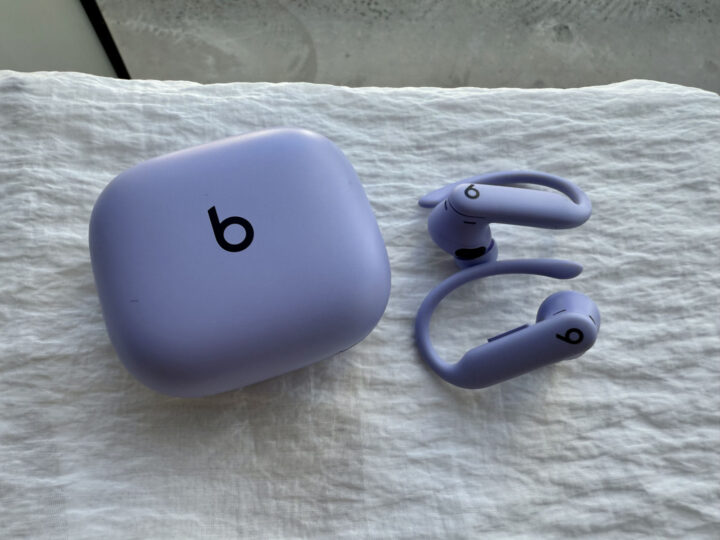
The second thing I noticed was how much I like the purple colour. A nice mauve, not a shrinking violet, but also not trying to punch you in the face with its purpleness. The exact correct amount of purple to go with blonde and brown hair alike.

Beats Powerbeats Pro 2 specifications and price

Dimensions Case: 7.5 x 6.6 x 3.4cm
Bud: 4.5 x 4.1 x 2.4 cm
Weight: (case) 69g (bud) 8.7g (total) 77.7g
Battery Up to 45 hours of battery life on a single charge, up to 10 hours of continuous bud playback
Fast Fuel: a 5-minute charge provides up to 1.5 hours of playback
Universal USB-C charging
Works with Qi-compatible wireless chargers
Features Active Noise Cancelling (ANC)
Transparency mode
Adaptive EQ
Personalised spatial audio with dynamic head tracking
Heart-rate monitoring for workouts
Sweat and water resistance IPX4-rated
Controls Single multifunction button per side
Volume rockers (up/down) on each side
Auto Play/Pause via optical sensors and motion accelerometers
Price (RRP) $399.95
Warranty One year
Official website Beats Australia

The big standout here is the heart-rate monitoring, as it’s great for people who want to keep track of their metrics without wearing a chest band or watch. Not many earbuds have heart-rate sensors; the Sennheiser Momentum Sport is a rare exception.

Other things to note are that it has physical buttons (yay!) and an IPX4 rating. You probably shouldn’t take it to the beach or wear it in a rainstorm, but it’ll be fine with a normal amount of sweat.

Performance

There are things you expect from the performance of a premium pair of Beats workout headphones – strong bass, lots of features, and a solid fit. Let’s break down how the Powerbeats Pro 2 performed in those categories.

Fit

When it comes to in-ear headphones, fit is everything. Without a good seal, you don’t get good noise cancelling or audio quality, plus you spend your whole workout pushing them back in.

One thing that I really like about the Powerbeats Pro 2 is that they have a built-in test to see if you’re using the right size earbuds. The problem is that I just couldn’t get a good seal on my left ear, no matter what I did. None of the ear tips gave me a good fit, which is really unusual. Sure, my left ear is a problem child for in-ears, but there’s usually at least one tip size that works well enough. I find that I have to adjust the left ear very often just sitting still, even more so while running.

My right ear did get a good fit, but I’m still having to adjust the fit more often than I’d like on that one, too. Not overly frequently, but enough that it’s frustrating.

Audio quality

When I can get a good seal, I’m actually really impressed with the Beats Powerbeats Pro 2. Normally, I think of Beats headphones as just auxiliary headphones for fashion purposes, or for bass-heavy music only. But the audio quality here is good enough that I could see them being someone’s primary headphones, not just workout headphones.

Yes, the bass is turned up more than standard, they’re Beats headphones – this is what you expect. But I can still hear enough details, and the high notes aren’t completely drowned out. There is a depth here, and having Spatial Audio on top of that just seals the deal.

Going through my usual test songs, “Simmer” by Hayley Williams lacks some of the usual delicacy that I enjoy on less bass-forward headphones, but it still just sounds really good. The bass guitar and bass drum are driving the show, grounding the whole song. The ghost notes on the snare are present, though distant, and the hi-hat patterns are a little more obscured than would be ideal. But her voice comes through clearly, and the emotion is largely conveyed.

Image: Alice Clarke.

“Full Heart Fancy” by Lucky Chops is another song that you don’t want too tethered by bass, but while it is very bass-heavy, it still manages to soar. Again, not in the ideal way on a pair of neutral headphones. However, this is the best I’ve heard it on a pair of Beats. The sousaphone just sings.

On a song these headphones were actually designed for, and one of my favourite workout tracks, “No Mercy” by Pvris, just sounds so good. Those driving snare rimshots with that bass drum just make you want to run. You get the pure emotion from Lynn Gunn’s voice.

With heavier, bassier dance tracks, it’s easy to hear that these headphones are in their element. The whole Apple Music Dance Workout playlist just sounds ideal.

I wouldn’t recommend them for a delicate concerto, but for the styles they’re designed for, they’re surprisingly good. Better than I would expect for $399.

Extra features

The biggest extra feature on the Beats Powerbeats Pro 2 that you wouldn’t find on most other headphones is the heart rate sensor. Whether it’s good depends on what you want it for. If you want a super-accurate, consistent heart rate reading to inform your serious marathon training, this is not the tool for that; that would be a chest strap.

However, if you don’t want to wear a chest strap or watch and want to be able to connect to a workout machine to get a reading in the gym, then these are ideal for that. The accuracy is going to depend on the fit – the better the fit, the more likely you are to get a reading. It’s a great “nice to have”.

Other features include the physical buttons. I love physical buttons; I am the president of the physical buttons on headphones fan club. I wish these physical buttons weren’t as easy to press accidentally while adjusting the headphones. That said, I did get used to their placement after a couple of weeks and now have way fewer accidental presses.

The noise cancelling is okay. It’s a long way from the best in-ear noise cancelling I’ve tried, but it’s also not really the worst. The transparency mode is good.

Being an Apple product, it also has Find My enabled, which sounds great at helping people find their headphones. But I did briefly lose these, and became convinced they had been stolen because they were showing up as being at a high school a few kilometres away from my apartment. I freaked out. Phone calls were made. My wife later found them in our apartment, still with high battery. So, while Find My is nice and can be useful, it’s not entirely reliable.

Who is the Beats Powerbeats Pro 2 for?

There are three groups of people who would enjoy the Beats Powerbeats Pro 2:

  1. People who want good workout headphones with an ear hook. These are the best in-ear workout headphones I’ve tried in a long, long time. They’re versatile, they sound good, and the ear hook will keep them on your ears even while moving your head a lot.
  2. People who want true wireless headphones with the security of an ear hook, even if they’re not working out. These are also the first workout headphones in a long time that I would recommend for everyday use. So, if you’re the kind of person who likes the idea of AirPods, but wants something a bit more secure, this is what you’ve been looking for.
  3. People who enjoy bass-forward headphones and prefer the in-ear, true wireless form factor. Like all Beats headphones, these are very bass-heavy. If you’re not a fan of the tiny Beats Studio Buds+ or the Beats Fit Pro, and want something more premium than the Beats Solo Buds, this is the style for you.

These are the best Beats headphones I’ve tried in a while. They are very good. If you want headphones with an ear hook, these are the ones you want.

Beats Powerbeats Pro 2
These are the best in-ear workout headphones I’ve tried in a long, long time.
Features
9
Value for money
6
Performance
9
Ease of use
8
Design
9
Positives
Comfortable
Sound good
Includes a heart rate sensor
Negatives
A little expensive for what they are
Noise cancelling is only okay
People with "difficult-to-fit" ears will have more difficulty than usual
8.2

The post Beats Powerbeats Pro 2 review: Solid workout headphones appeared first on GadgetGuy.


Your Wi-Fi could be the next big thing in home security

New AI-sensing technology looks to be on the way, potentially improving the way home security devices accurately detect risks. As handy as many security devices are, phantom notifications are an annoying occurrence. This forms the basis of a recent collaboration between Arlo and Origin AI that sees the two sharing detection technology.

While Arlo uses visuals to detect people and identify fires, Origin AI, a US-based wireless technology company, uses radio frequency signals to pick up on disturbances. One of its main technologies is called TruShield, which uses your Wi-Fi network as a form of motion detection.

TruShield works by monitoring the wireless signals sent between a router and connected devices. When you’re not home and the system notices a disturbance caused by someone moving around, i.e. an intruder, it sends an alert.

Origin AI’s tech is said to differentiate between human movement and that from pets, so your cat or dog shouldn’t cause any false alarms. It also doesn’t count your movement as an alert because the system disarms itself when it detects the presence of a specific device, like your phone.

Although a specific timeframe hasn’t been confirmed, Arlo plans to include Origin AI technology in its upcoming devices. Depending on how it’s rolled out, it could potentially alleviate the cost barrier of installing multiple security devices throughout a home.

For example, if you can only afford one camera, it could talk with your Wi-Fi-connected devices to monitor everything else. Alternatively, the technology could stack on top of Arlo’s existing motion-sensing devices.

The Arlo and Origin AI collaboration is one of multiple partnerships made by the home security brand lately, having also recently bolstered its SmartThings integration with Samsung. If the start of the year is anything to go by, 2025 seems to be a big year for home security.

Read more security news on GadgetGuy

The post Your Wi-Fi could be the next big thing in home security appeared first on GadgetGuy.


Wednesday, 26 March 2025

Oppo Watch X2 lasts up to 16 days on a single charge

Another wearable has entered the Australian market, with the Oppo Watch X2 joining the brand’s newly launched Reno 13 series of phones.

At $699, the Oppo Watch X2 throws the gauntlet down to its Apple Watch, Samsung Galaxy Watch, and Pixel Watch rivals, claiming up to 16 days of battery life when in its power-saving mode. A reported five days in what’s called “Smart Mode” seems pretty decent, too.

Designed to be a health and workout companion, the watch uses a stainless steel body and a titanium alloy bezel that’s rated at IP68, meaning it has no trouble getting wet. Its 1.5-inch AMOLED screen reaches 2,200 nits of brightness, which should help readability in direct sunlight.

Oppo’s latest wearable fits into the Android ecosystem, using Google’s Wear OS 5 software. In other words, if a Google Play app has a watch version, it’ll likely work on the Watch X2. As for its workout credentials, the watch supports tracking of more than 100 different workout types supported by dual-frequency GPS tracking.

Oppo also revealed a new health feature with the Watch X2: 60S Health Check-In. While wearing the watch, you can do a quick 60-second health assessment that tracks stats like your heart rate, wrist temperature, and blood oxygen levels.

Depending on your inclination, the Watch X2 comes in two variants: a Lava Black finish that comes with a sports band, and a leather band-adorned Summit Blue.

As an incentive to join the Oppo ecosystem, there’s a launch promotion live between now and 23 April 2025 from participating retailers, like directly from Oppo or JB Hi-Fi. It sees the watch come included with a $1,299 Reno 13 Pro, saving the full retail price of $699 in the process. If you purchase one of the cheaper phones, you get a $150 (with the Reno 13) or $75 (with the Reno 13 F) gift card instead.

Read more wearable tech news on GadgetGuy

The post Oppo Watch X2 lasts up to 16 days on a single charge appeared first on GadgetGuy.


Canon boosts entry-level video with EOS R50 V and PowerShot V1

Canon has launched two new cameras aimed at content creators in Australia, the PowerShot V1 and the EOS R50 V, as both combine lightweight designs with photo and video capabilities.

Made equally for shooting in portrait and landscape orientations, Canon’s latest cameras are definitely marketed as video-first shooters for younger people who want something a bit more capable than a phone camera.

Both cameras support 4K footage and the Canon Log 3 format, which provides more flexibility in the edit suite, particularly when colour grading. They also have a short-distance auto-focus feature, ideal for vloggers who hold objects close to the camera when presenting.

Canon PowerShot V1 food vlogging
The PowerShot V1 lets you get close to subjects with its finely tuned auto-focus system. Image: Canon.

Canon’s $1,499 PowerShot V1 is a fixed-lens camera, so no swapping out the glass. Instead, it uses a built-in 16-50mm f/2.8-4.5 lens that provides a reasonable level of versatility. The idea is that because it’s a vlogging camera, it’s mainly intended for capturing nearby subjects instead of punching all the way in.

Behind this lens is a new 1.4-inch CMOS sensor, which Canon claims produces better low-light performance. The PowerShot V1 also supports external microphones and audio monitoring during shoots. That’s in addition to speedy file transfers via both USB and Wi-Fi.

For more versatility, the Canon EOS R50 V is a bit more of a fully-fledged entry-level DSLR. Using an RF mount, it supports existing compatible lenses, or you can get the kit that comes with the new RF-S 14-30mm F4-6.3 lens for $1,499 (compared to $1,169 for the body alone).

Canon EOS R50 V camera vertical grip
A vertical tripod mount makes the R50 V social media-ready. Image: Canon.

With a lens attached, it’s a bit bulkier than the Canon PowerShot V1 (551g versus 429g), but it’s still a reasonably lightweight camera. Between the two, the interchangeable nature of the R50 V means it has wider usability, while the PowerShot V1 specialises in its vlogging purpose.

Both cameras will be coming to Australia by the end of April, with more details available online.

Read more camera news on GadgetGuy

The post Canon boosts entry-level video with EOS R50 V and PowerShot V1 appeared first on GadgetGuy.


Arlo’s new solar charger works its cheaper cameras too

Built to charge more of the brand’s cameras, the Arlo Universal Solar Panel has arrived in Australia.

Priced at $89 locally, the bespoke solar panel acts as a charger for a range of Arlo security devices, like the brand’s wireless floodlights and battery-powered cameras. Instead of needing to recharge devices every few months, your outdoor security tech can rely on the sun.

While it’s not the first solar panel from Arlo, the “Universal” label in its name is the main difference; the list of compatible devices is much longer than the brand’s previous solar charger. Not just limited to premium Arlo devices, like the Ultra, Pro, and Go series, the Universal Solar Panel also works with many of the cheaper Essential cameras.

As explained in Arlo’s press release, the broader compatibility aims to make it easier for buyers and retailers. There should be fewer instances of walking into a store, only to get confused trying to figure out which device a solar charger works with. Part of the wider compatibility comes from the solar panel coming with several different connectors to fit with Arlo’s different cameras and floodlights.

The solar panel comes with a 360-degree mount that lets you adjust its position to catch the most sun. It’s also weather-resistant, so it should stand up to Australia’s harsh climate.

Available to order online via Arlo’s website, the Universal Solar Panel has a 20% launch discount, bringing the cost down to $71 at the time of writing.

Read more security news on GadgetGuy

The post Arlo’s new solar charger works its cheaper cameras too appeared first on GadgetGuy.


Tuesday, 25 March 2025

Swann ActiveResponse Personal Safety Alarm review: Cheap SOS

8.6

The Australian security company Swann is best known for its cameras, but also branches out into other areas of security, like the ActiveResponse Personal Alarm. If you’ve ever walked a street and felt unsafe, or been concerned for the safety of a loved one during their commute, a personal alarm could be the answer.

Gadgets like the Swann ActiveResponse take the form of a small portable device designed to deter an attacker or alert others in an emergency. Once activated, they emit a loud, piercing sound, which can put an attacker off or at least alert others around you that you are in distress.

Swann ActiveResponse features

The Swann ActiveResponse Personal Alarm is a wireless distress button and siren in a lipstick form factor.

ActiveResponse size
Photo: Angus Jones

Opening the box, you will find the alarm, a readily available CR2 disposable lithium battery, a key carabiner and a lanyard.

ActiveResponse box contents
Photo: Angus Jones

Installation requires inserting the battery by unscrewing the alarm and using the standard Swann security app (also used for Swann cameras) to activate it.

The activation process simply requires following the instructions on your smartphone app, which establishes a Bluetooth connection with your smartphone and asks you for an emergency contact. Emergency contact details can be changed in the app at any time, and the battery level can also be checked here.

The top of the unit features a pull ring, which, when pulled, emits a 120-decibel siren equivalent to a thunderclap or a chainsaw. This same ring can be twisted to a lock or unlock position. If the button is pressed in the unlocked position or pulled in either the locked or unlocked position, a Bluetooth signal is sent to your smartphone, which will then send a text message to your emergency contact with your current position.

Swann ActiveResponse specifications and price

Battery Cr2 Lithium
Siren volume 120 Decibels
Dimensions 2 x 6 cm
Weight 32 grams
Price (RRP) $39.95
Website Swann
Warranty 2 years

Using the ActiveResponse

As I began testing the alarm, I started thinking of additional uses for this device. For example, it could be used by an elderly person to call for help, issued to a remote worker who works alone, or even used as a check-in device to simplify someone’s arrival.

A feature that initially confused me was Swann promoting free SMS alerts. The alarm does require a constant connection to your smartphone. The SMS comes from your phone, which isn’t a big deal, considering most Australian SIM plans include unlimited text messages. This means you are just using one of your included texts.

If the alarm and the smartphone go out of Bluetooth range, which I found to be approximately 10 metres, the alarm press will not work, and no SMS will be sent. You must have the Bluetooth-tethered phone and alarm with you. When the alarm is out of range from the phone, it will emit a tone for 20 seconds.

Emergency contact SMS. Screenshot: Angus Jones.

When you do press the button, your emergency contact receives an SMS with the first words “EMERGENCY ALERT” They also receive a GPS position and link, which opens in Google Maps to show the location. For the alert to work, the emergency contact must be awake and responsive to the SMS message.

Google Maps position
Google Maps position. Screenshot: Angus Jones.

The alarm is loud and works as expected, but it is not so loud that it deafens you. The activation of it requires a stiff tug as compared to a gentle press to activate the SMS, the latter of which is more user-friendly for the elderly.

If you are travelling overseas, you must have mobile roaming activated, including SMS. If you don’t, the SMS alert will not be sent.

When you do not require the alarm for a period, the battery can be removed, or you can turn the ActiveResponse off by pressing the help button for 20 seconds.

Who is the Swann ActiveResponse for?

For peace of mind, the Swann ActiveResponse is a no-brainer at just under $40 for children, commuting at night or for an elderly person needing some help.

As long as you have a connected phone nearby and the emergency contact is aware they could receive an alert, then you have the confidence that someone is looking out for you. The siren does, however, work independently and will attract others to your situation, which may also be enough to deter a potential attacker.

Swann ActiveResponse Personal Safety Alarm
Cheap and effective, the Swann ActiveResponse offers extra reassurance for children, night commuters, and the elderly.
Features
8
Value for money
10
Performance
7
Ease of use
9
Design
9
Positives
Low cost peace of mind
Great design and small size
Negatives
Requires to be tethered to smartphone to send SMS
8.6

The post Swann ActiveResponse Personal Safety Alarm review: Cheap SOS appeared first on GadgetGuy.